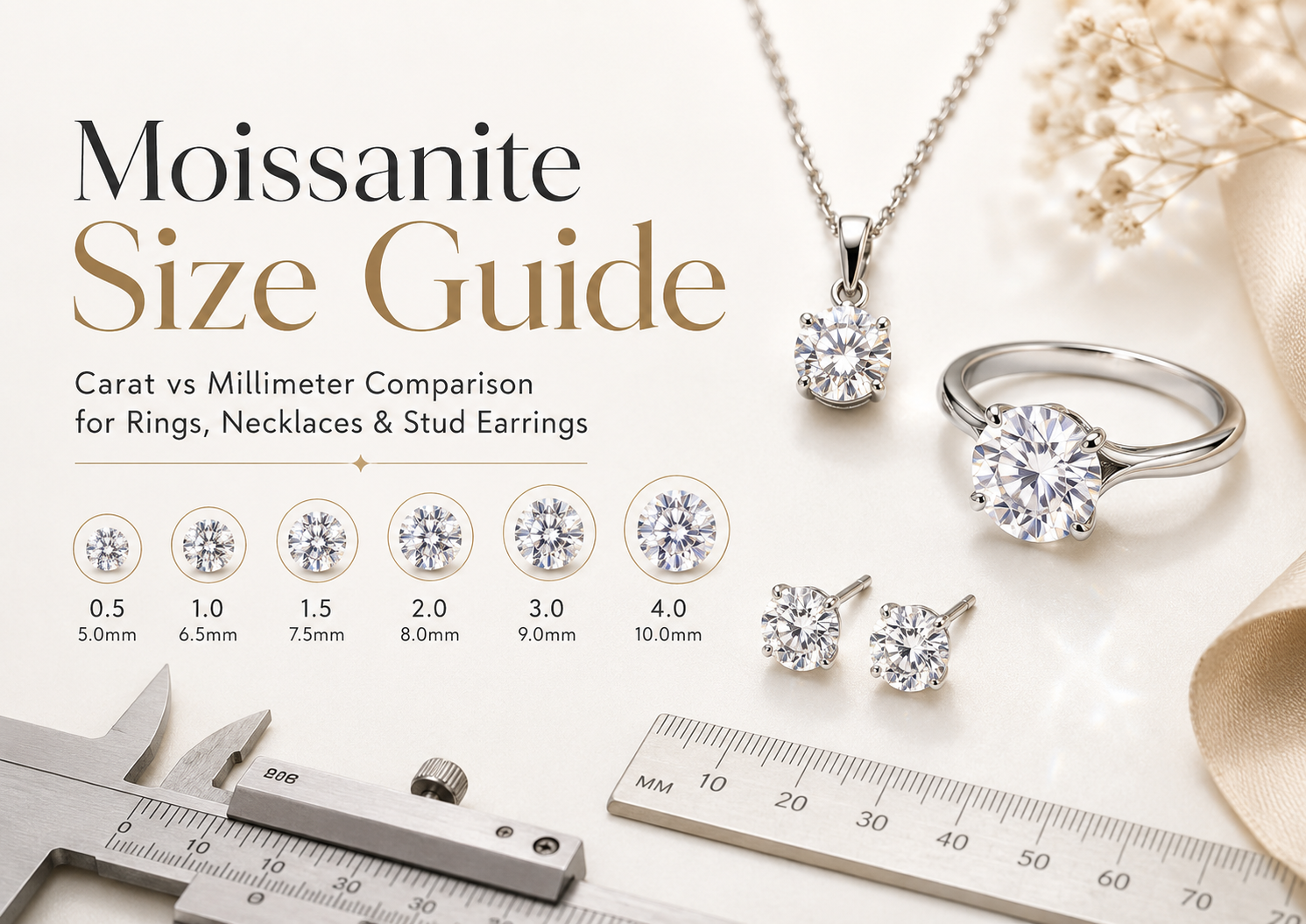
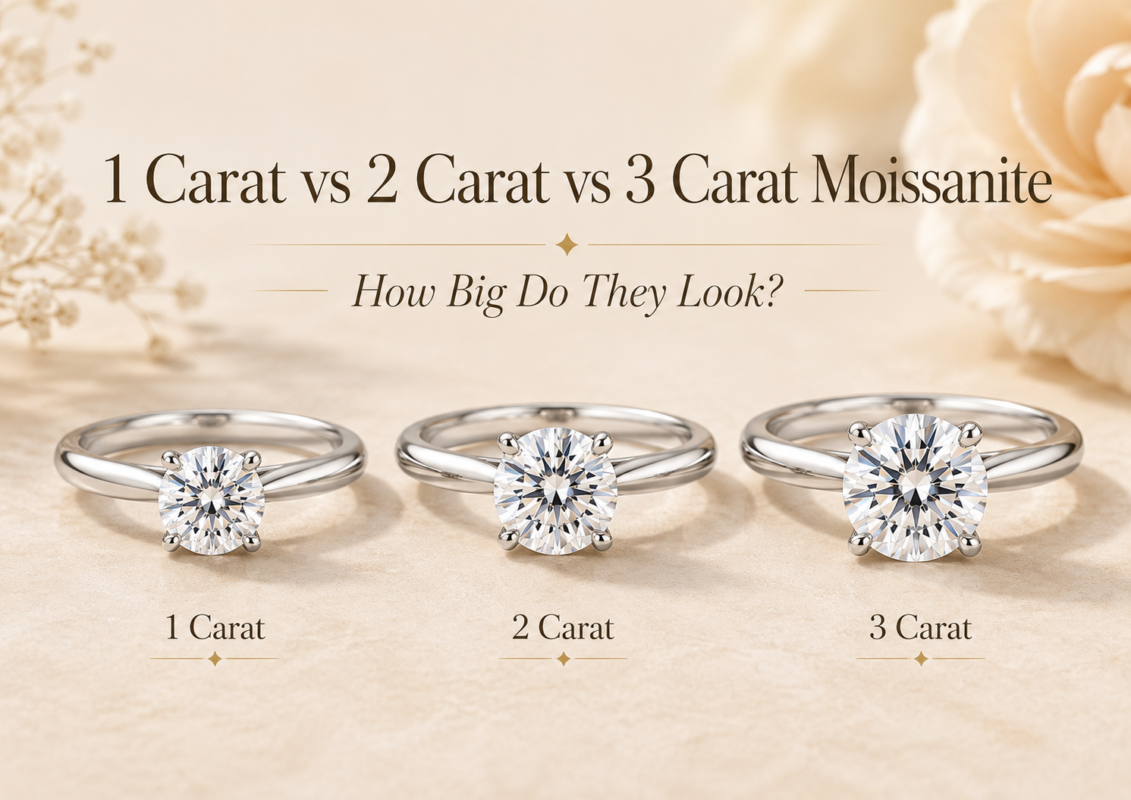
A visual moissanite size guide for rings, pendant necklaces and stud earrings.
Moissanite Buying Guide
A moissanite size guide should help you understand not only the carat number,
but also how large the gemstone will actually look when it is worn.
When shopping for moissanite jewelry, you may see a stone described by
carat, carat equivalent, millimeters, or a combination of all three.
These measurements are related, but they do not mean exactly the same thing.
Carat measures weight, while millimeters describe the visible width, diameter,
length or height of a gemstone.
This guide compares common round moissanite sizes and shows how they may appear
in rings,
pendant necklaces
and stud earrings.
It also explains why two gemstones with the same stated carat-equivalent size
may look different when their shapes, cutting proportions or settings change.
Quick answer
For visual appearance, check the millimeter measurement first.
For general size comparison, carat-equivalent weight is useful.
For the most accurate purchase decision, compare both measurements and look
at how the stone appears in the finished jewelry setting.
01 · Understanding the Measurements
Carat vs Millimeter: What Is the Difference?
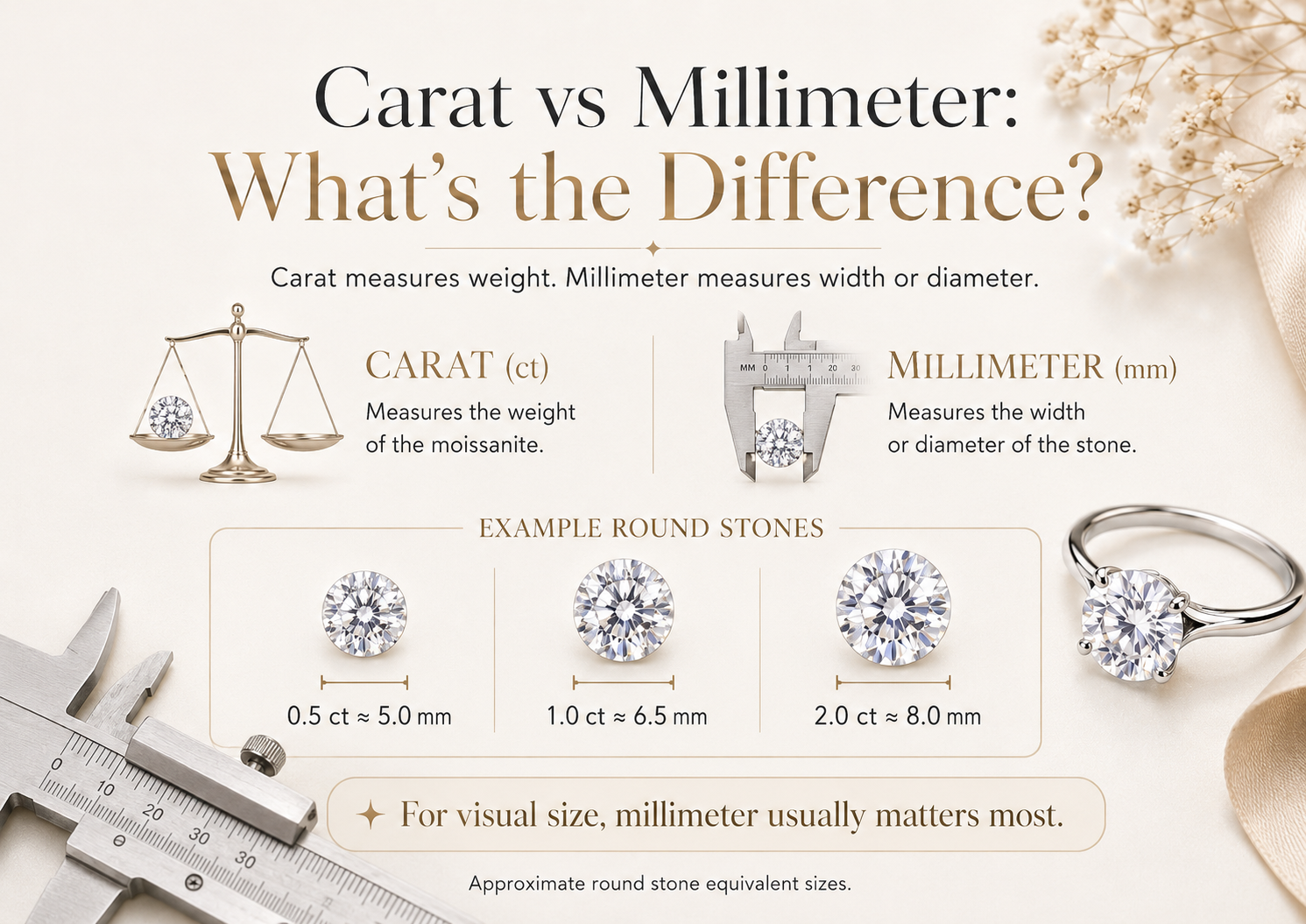
Carat and millimeter measurements answer two different questions.
Carat tells you how much a gemstone weighs. Millimeters tell you how wide,
long or tall it is.
Carat measures gemstone weight, while millimeters measure its visible dimensions.
CT
Carat Measures Weight
One metric carat equals 200 milligrams. However, moissanite and diamond
have different densities. A moissanite stone and a diamond can have the
same visible diameter while having different actual weights.
MM
Millimeters Measure Visible Size
A round stone is normally measured across its diameter. Oval, pear,
emerald and other elongated shapes are usually listed by length and width,
such as 5 × 7 mm or 5 × 8 mm.
What does carat equivalent mean for moissanite?
Because moissanite is lighter than diamond, many jewelry listings use
diamond equivalent weight, sometimes written as DEW,
carat equivalent or ct eq. This describes the approximate diamond weight
that would create a similar face-up size.
For example, a round gemstone measuring approximately 6.5 mm is commonly
described as having a 1-carat diamond-equivalent appearance. The actual
moissanite weight may be lower, even though the two stones have a similar
visible diameter.
Important:
Product terminology can vary between sellers. Before ordering, check whether
the listed carat number refers to actual gemstone weight, diamond-equivalent
weight, or total carat weight for the entire piece.
02 · Quick Reference Chart
Round Moissanite Carat vs Millimeter Size Chart
The following chart shows common approximate round-stone size equivalents.
These numbers are useful for visual comparison, but finished measurements
can vary slightly according to cutting depth, girdle thickness and individual
manufacturing specifications.
Approximate carat equivalent
Round diameter
General appearance
Common jewelry use
0.25 ct equivalent
About 4.0 mm
Minimal and subtle
Small pendants and delicate studs
0.50 ct equivalent
About 5.0 mm
Delicate and refined
Everyday earrings, pendants and petite rings
1.00 ct equivalent
About 6.5 mm
Classic and balanced
Solitaire rings and noticeable everyday jewelry
1.50 ct equivalent
About 7.5 mm
Elegant and eye-catching
Statement solitaires and special gifts
2.00 ct equivalent
About 8.0 mm
Strong visual presence
Engagement rings and bold pendants
3.00 ct equivalent
About 9.0 mm
Bold and luxurious
Statement rings and large pendants
4.00 ct equivalent
About 10.0 mm
Dramatic statement size
High-impact jewelry designs
If your main concern is how large the stone will look, compare the millimeter
size. If you are comparing broad product categories or budgets, carat-equivalent
size can provide a convenient starting point.
03 · Rings
Moissanite Ring Size Guide
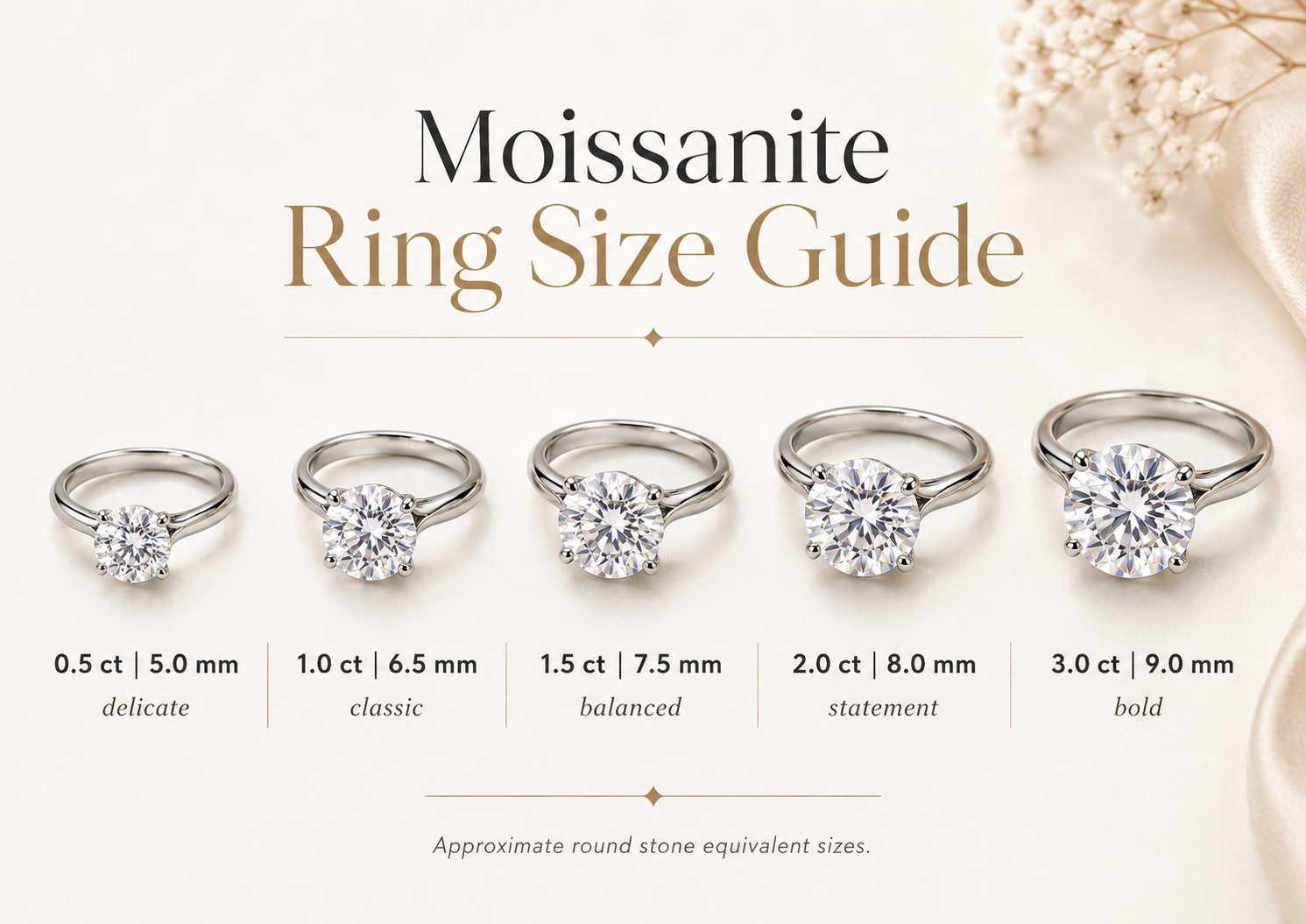
A center stone can appear larger or smaller depending on finger size,
band width, setting height and surrounding accent stones. A simple solitaire
shows the center stone clearly, while halo and pavé settings can create a
larger overall visual footprint.
Approximate round moissanite size comparison in classic solitaire ring settings.
5.0–6.5 mm
A refined range for buyers who prefer delicate or classic everyday
sparkle. It works especially well with slim bands and minimalist settings.
7.5–8.0 mm
A balanced statement range with stronger visual impact while still
remaining versatile for many engagement and occasion-ring styles.
9.0 mm and Above
A bold choice designed to attract attention. Larger stones often benefit
from secure prongs, balanced settings and comfortable band proportions.
Factors that change how large a ring looks
A narrow band can make the center stone appear more prominent.
A halo adds visual width around the center gemstone.
An elevated setting may make the stone look more noticeable from the side.
Elongated shapes can create greater finger coverage than round stones.
Smaller fingers may make the same gemstone appear visually larger.
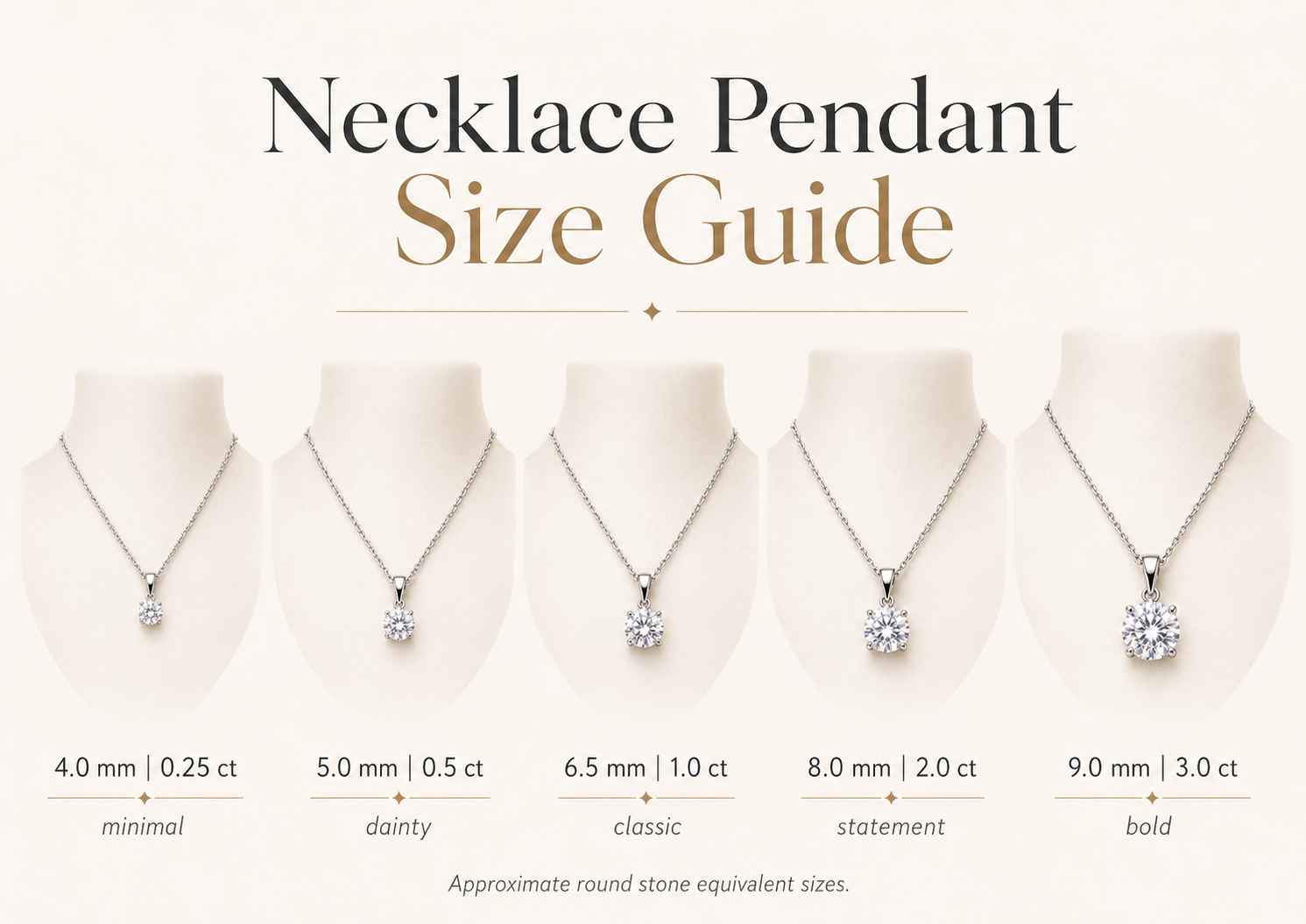
For pendant necklaces, stone diameter affects how visible the pendant looks
from a normal viewing distance. The chain length, pendant setting and bail
also influence the final appearance.
Visual comparison of common round moissanite pendant sizes.
Minimal and Everyday Pendants
Stones around 4.0–5.0 mm create a delicate appearance. They work well
with fine chains, layered necklace looks and understated everyday outfits.
Classic and Statement Pendants
Stones around 6.5–9.0 mm create stronger visibility. They are suitable
for romantic gifts, occasion jewelry and single-pendant styling.
Check the complete pendant measurement:
A 6.5 mm gemstone does not mean the complete pendant is only 6.5 mm tall.
The surrounding prongs, frame and bail can make the finished pendant noticeably
larger than the loose stone.
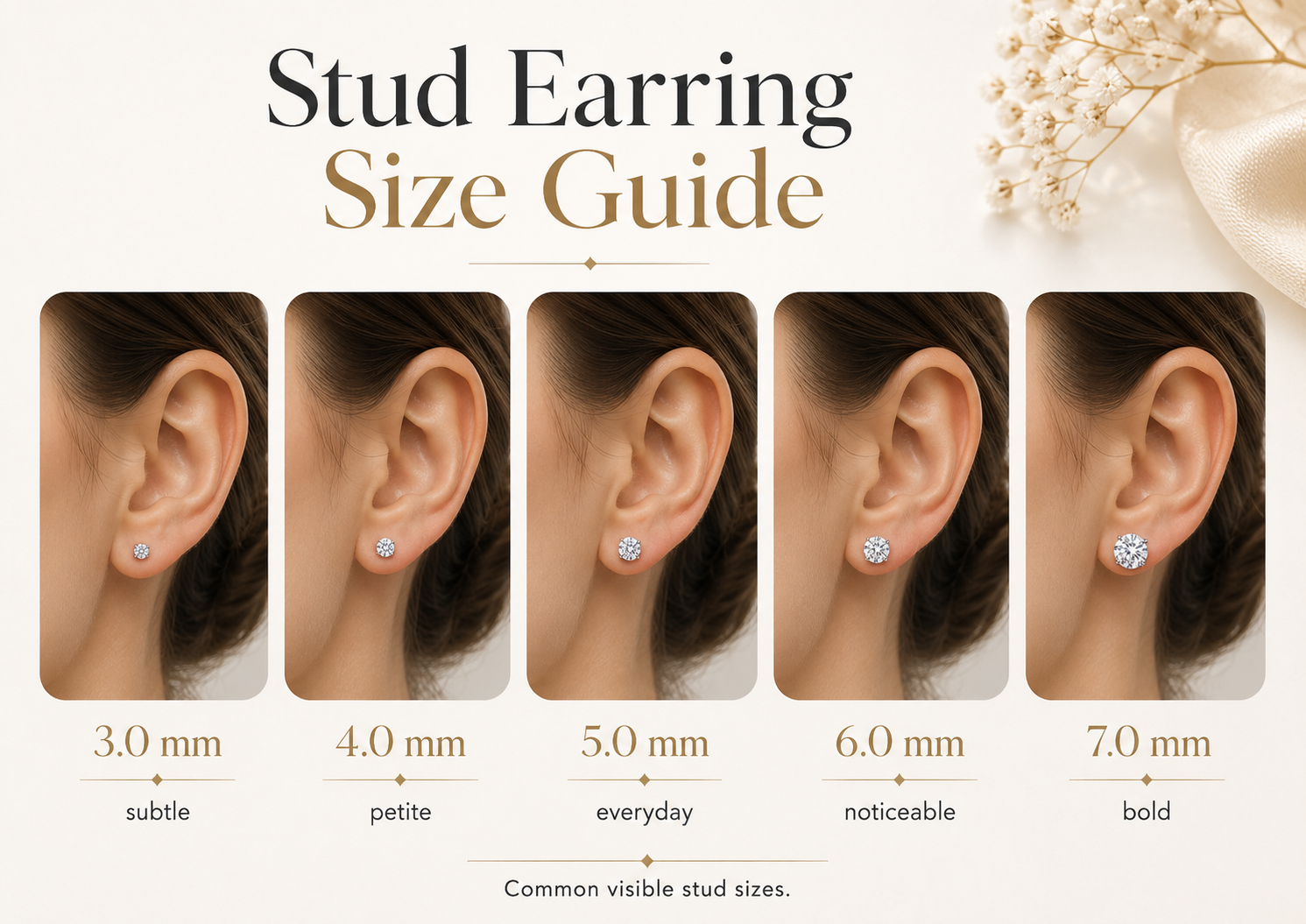
Stud earrings are viewed directly against the earlobe, so even a one-millimeter
increase can create a noticeable visual difference. Smaller studs feel subtle
and easy to wear, while larger stones create a brighter and more prominent look.
Common visible stud earring sizes shown from subtle to bold.
Stone diameter
Appearance
Suggested styling
3.0 mm
Very subtle
Second piercings, minimal looks and delicate stacking
4.0 mm
Petite
Understated daily wear
5.0 mm
Noticeable but balanced
Classic everyday stud size
6.0 mm
Bright and prominent
Dressy daily wear and meaningful gifts
7.0 mm
Bold
Statement styling and special occasions
Per-stone size vs total carat weight
Earrings are often sold as a pair using total carat weight, written as CTW.
For example, a pair listed as 1.00 CTW may contain two stones of approximately
0.50 carat equivalent each. Always check whether the product description refers
to one individual stone or the combined pair.
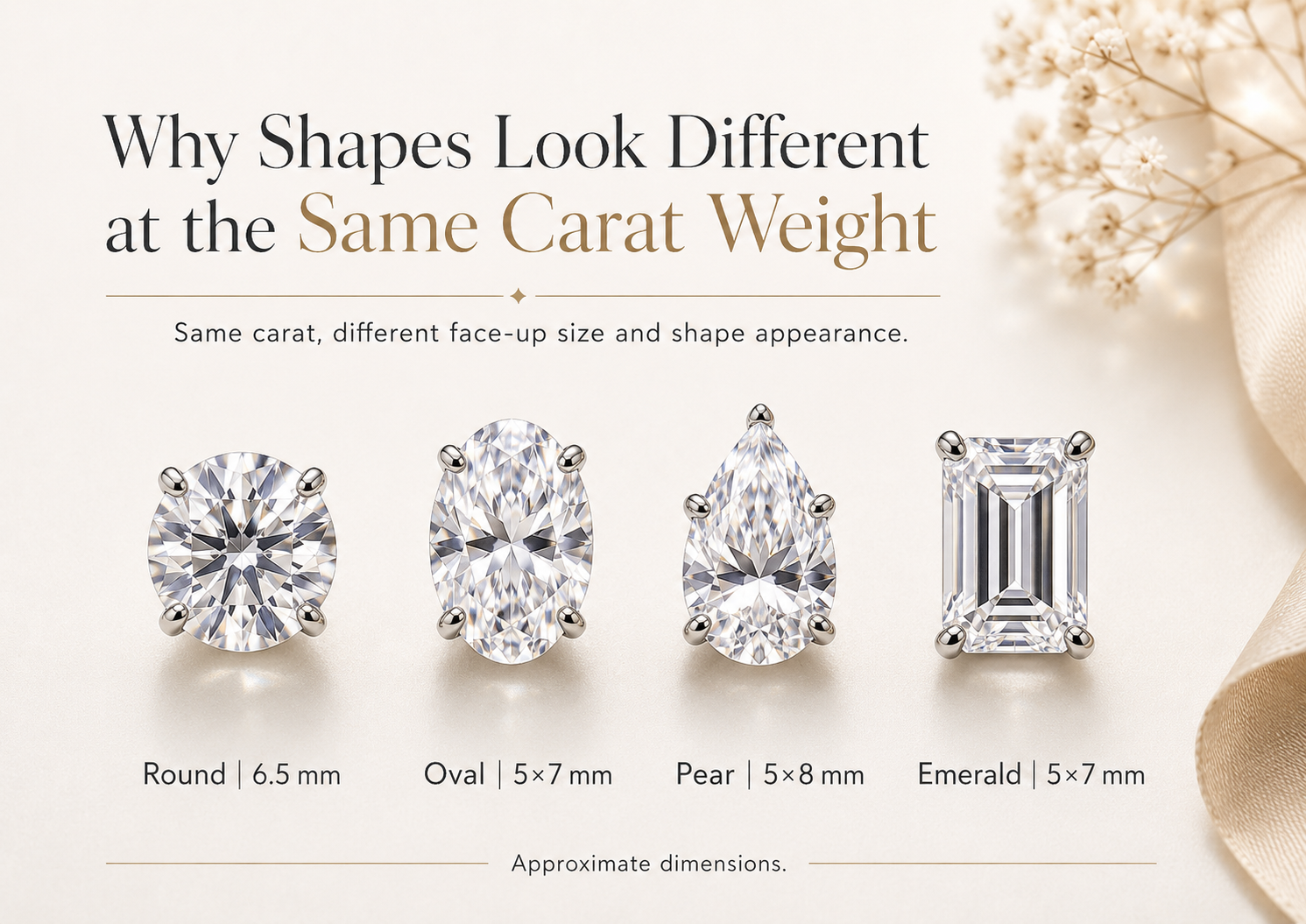
Why Different Shapes Look Different at the Same Carat Weight
Carat-equivalent size alone does not determine visual appearance. The stone's
length-to-width ratio, cutting depth and outline all affect how much surface area
is visible from above.
Stones with similar carat-equivalent descriptions can have different visible outlines and dimensions.
Round Shapes
Round stones are measured by diameter. They create a balanced,
symmetrical appearance and are easy to compare using a single
millimeter measurement.
Elongated Shapes
Oval, pear and emerald cuts are measured by length and width.
Their elongated outlines can create more finger coverage and may
appear larger in one direction.
Two oval gemstones can also look different even when both are listed as
5 × 7 mm. One may have a slimmer outline, while another may look wider.
Product photographs, videos and complete measurements are therefore important
when choosing a fancy-shaped stone.
07 · Buying Advice
How to Choose the Right Moissanite Size
The best size is not automatically the largest size. It should suit the jewelry
type, the wearer's style, the setting and the intended occasion.
1
Choose the Jewelry Type
A 6.5 mm stone may look classic in a ring, prominent in an earring,
and refined in a pendant. Consider how the piece will be viewed.
2
Check Millimeter Dimensions
Use diameter for round stones and length × width for elongated shapes.
This gives the clearest idea of visible size.
3
Review the Setting
Halo, bezel, prong and decorative settings all change the overall size,
outline and personality of the finished piece.
Choose 4–5 mm for a delicate, subtle appearance.
Choose around 6.5 mm for a classic, balanced round-stone look.
Choose around 7.5–8 mm for a stronger statement.
Choose 9 mm or larger when bold visual impact is the priority.
For fancy shapes, compare both length and width rather than carat alone.
For earrings, confirm whether the carat number is per stone or per pair.
A round stone measuring approximately 6.5 mm is commonly described
as having a 1-carat diamond-equivalent appearance. Its actual
moissanite weight may be lower because moissanite is less dense
than diamond.
Should I choose moissanite by carat or millimeters?
Use millimeters when visible size is your main concern.
Use carat-equivalent size as a convenient comparison category.
Reviewing both gives you a clearer understanding of the finished jewelry.
What moissanite ring size looks best for everyday wear?
Many buyers find round sizes around 6.5–8.0 mm balanced for everyday
rings, but the best choice depends on finger size, personal style,
setting design and comfort preferences.
What is a good size for everyday moissanite stud earrings?
A 4–5 mm stone creates a petite to classic everyday appearance.
Sizes around 6–7 mm are more noticeable and create a stronger
statement on the earlobe.
Does a 1-carat oval look larger than a 1-carat round stone?
An oval can appear larger in length and provide more finger coverage,
while a round stone has a balanced circular outline. Compare actual
length and width measurements because proportions vary between stones.
Why do two stones with the same millimeter size look different?
Cutting proportions, depth, outline, setting style and viewing angle
can change visual appearance. Millimeter measurements are important,
but product photos and setting details should also be reviewed.
Measurement note:
All size comparisons are approximate. Actual gemstone dimensions and weights
may vary according to shape, cut, proportions and manufacturer specifications.
Confirm the measurements shown on the individual product page before ordering.