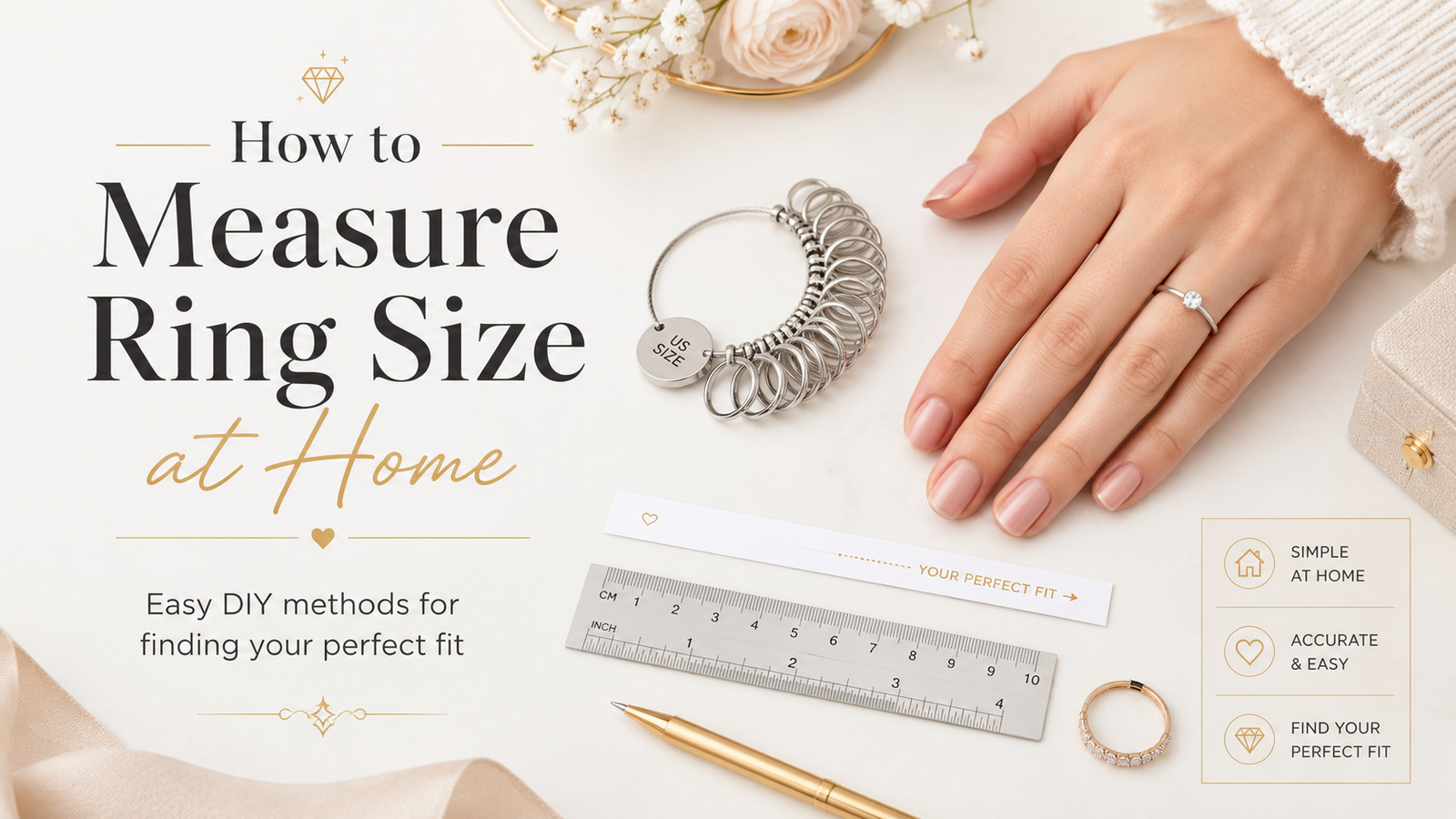
Learning how to measure ring size at home can help you order
a ring more confidently, especially when shopping online or preparing a surprise
gift. With a strip of paper, a ruler or a ring that already fits, you can estimate
your US ring size in just a few minutes.
The key is to measure in millimeters, repeat the process more than once and account
for temperature, knuckle size and band width. This guide explains three practical
methods, provides a US ring size conversion chart and shows you how a properly
fitted ring should feel.
Quick Answer
How do you measure ring size at home?
Wrap a non-stretch strip of paper around the base of your finger, mark where it
overlaps and measure the length in millimeters. The result is your approximate
finger circumference. Compare it with a US ring size chart.
For greater accuracy, measure the inside diameter of a ring that already fits the
correct finger. Take two or three measurements at the end of the day and use the
largest consistent result when you fall between sizes.
Home methods provide an estimate. For expensive rings, unusually wide bands or
difficult-to-fit fingers, professional sizing by a jeweler is the safest option.
Before You Measure
Why Accurate Ring Sizing Matters
A ring that is too tight can feel uncomfortable, leave a deep mark and become
difficult to remove when your fingers swell. A ring that is too loose may rotate,
catch on clothing or slide off without you noticing.
Accurate sizing is especially important when ordering online because ring sizes
are based on very small differences. A change of only a fraction of a millimeter
in inside diameter can move the result to another half size.
Measure the exact finger and hand.
The same finger on your left and right hands may not have the same circumference.
Your dominant hand is often slightly larger.
01
Finger Circumference
The distance around the base of your finger, measured in millimeters.
This is the result produced by the paper-strip or string method.
02
Inside Diameter
The straight distance across the inner opening of a ring, measured through
the center from one inside edge to the other.
03
US Ring Size
A standardized size number that corresponds approximately to a specific
inside diameter and finger circumference.
Choose Your Method
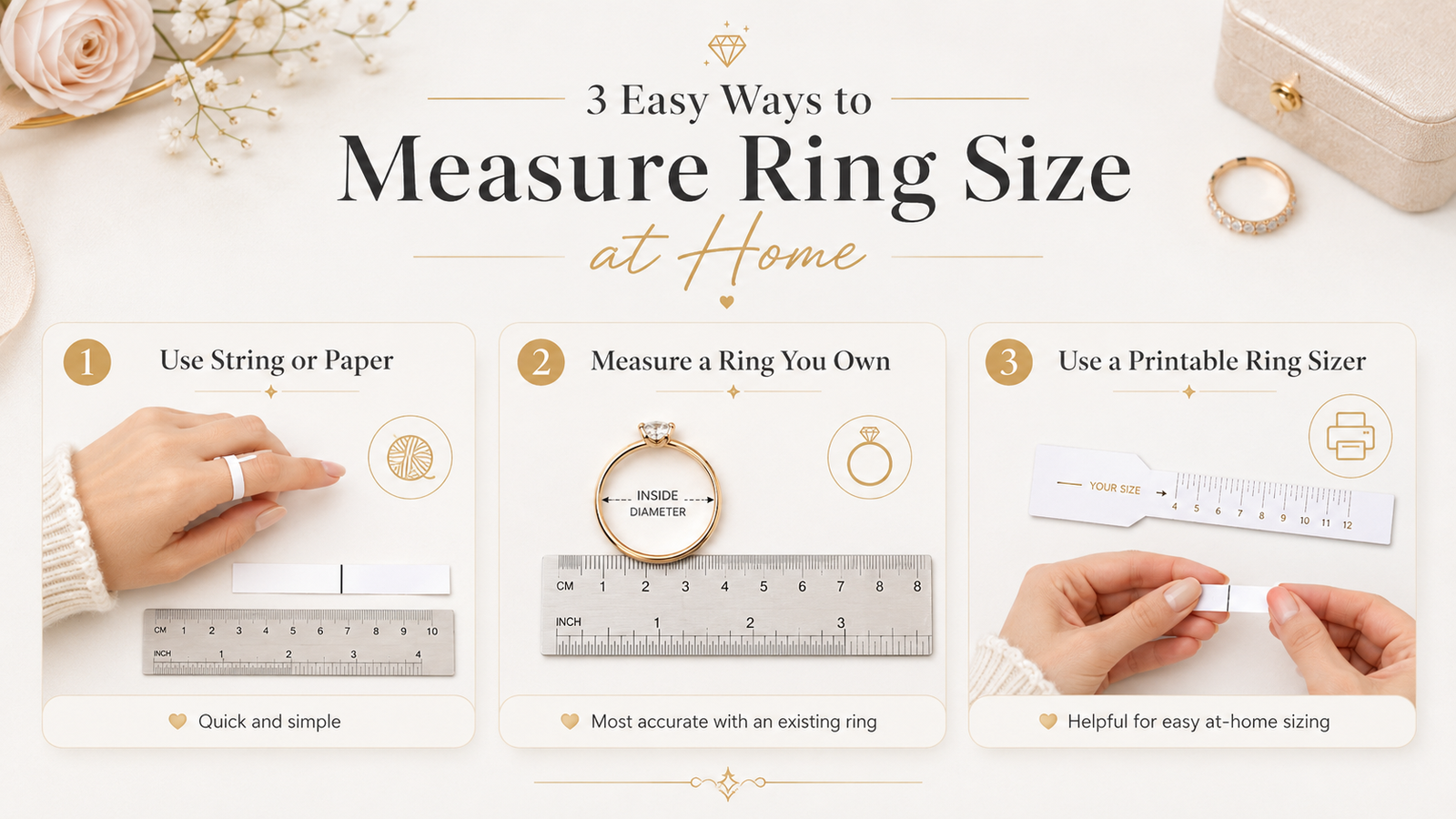
3 Easy Ways to Measure Ring Size at Home
You can estimate your ring size by measuring your finger, measuring a ring that
already fits or using a correctly printed ring sizer. When possible, compare the
results from two different methods.
Measure your finger with paper, measure the inside diameter of an existing ring
or use a printable ring sizer at its correct scale.
1
Use Paper or Non-Stretch String
Best when you do not already own a properly fitting ring. Paper is usually
easier to control than soft or elastic string.
2
Measure a Ring You Already Own
Usually the most reliable home method when the existing ring fits the same
finger comfortably.
3
Use a Printable Ring Sizer
Convenient when the document is printed at 100% scale and checked against
a ruler before use.
Method One
How to Measure Ring Size with String or Paper
A thin strip of paper is preferable to elastic string because it is less likely
to stretch. Use a strip approximately 6–10 millimeters wide so it sits flat against
the finger without twisting.
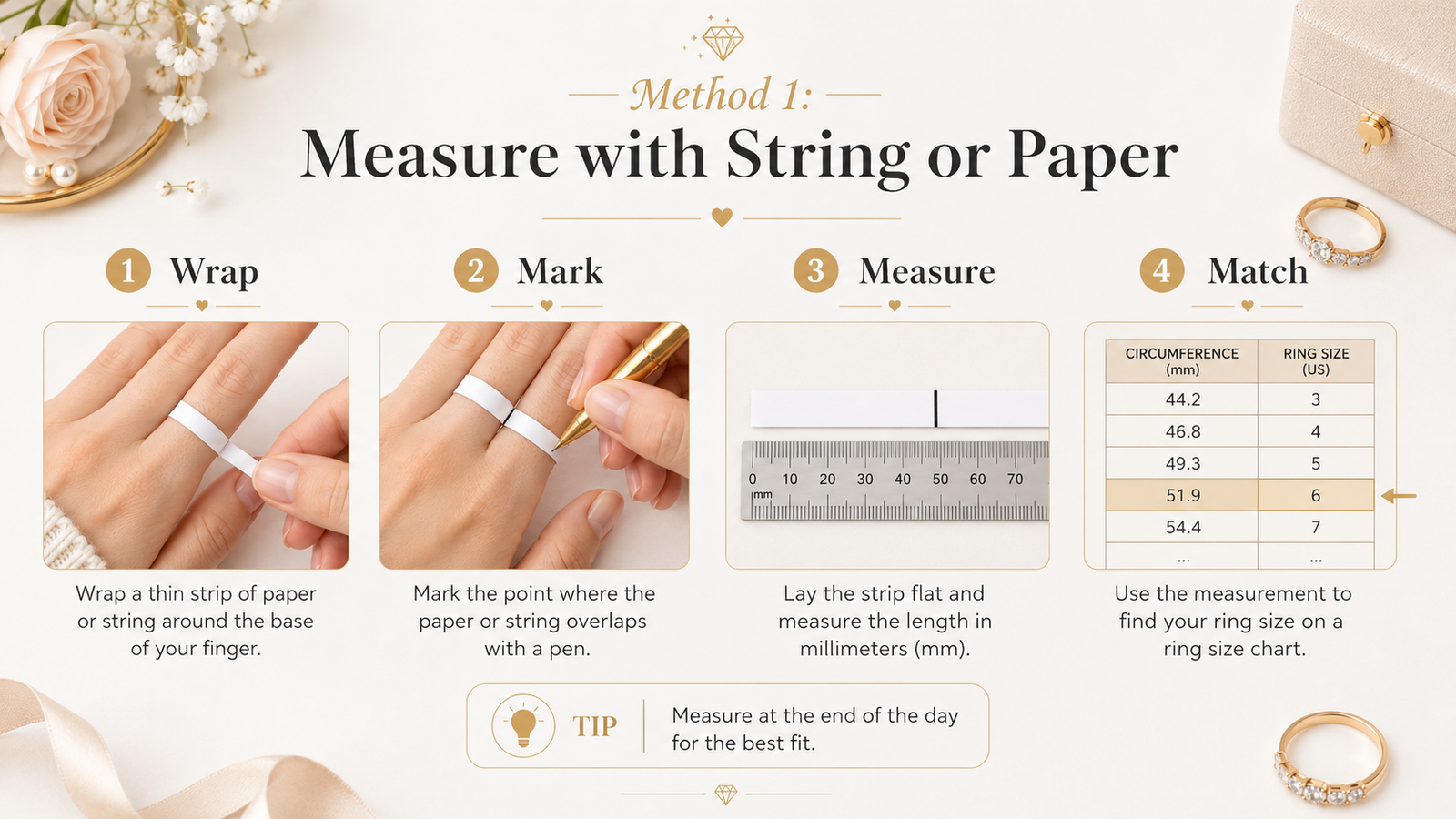
Wrap, mark, measure and compare the circumference with a US ring size chart.
1
Prepare a Thin Strip
Cut a narrow strip of non-stretch paper. You may also use firm, non-elastic
string, but avoid yarn, elastic thread or material that changes length when pulled.
2
Wrap It Around the Correct Finger
Place the strip around the base of the finger where the ring will sit.
Keep it comfortably snug without pressing into the skin.
3
Check That It Can Pass the Knuckle
When your knuckle is noticeably wider than the base of the finger, test the
paper loop over the knuckle before marking it. The ring must pass over the
knuckle without becoming excessively loose at the base.
4
Mark the Overlap Point
Use a fine pen to mark exactly where the end overlaps the paper. A thick
line can change the result, so keep the mark narrow and precise.
5
Measure in Millimeters
Lay the strip flat without stretching it. Measure from the beginning of
the strip to the marked line using the millimeter side of a ruler.
6
Repeat and Compare
Repeat the process at least two more times. Compare the most consistent
circumference with the US ring size chart below.
Example: if the paper measures approximately 51.9 millimeters
around the finger, the estimated US ring size is 6.
Method Two
How to Measure a Ring You Already Own
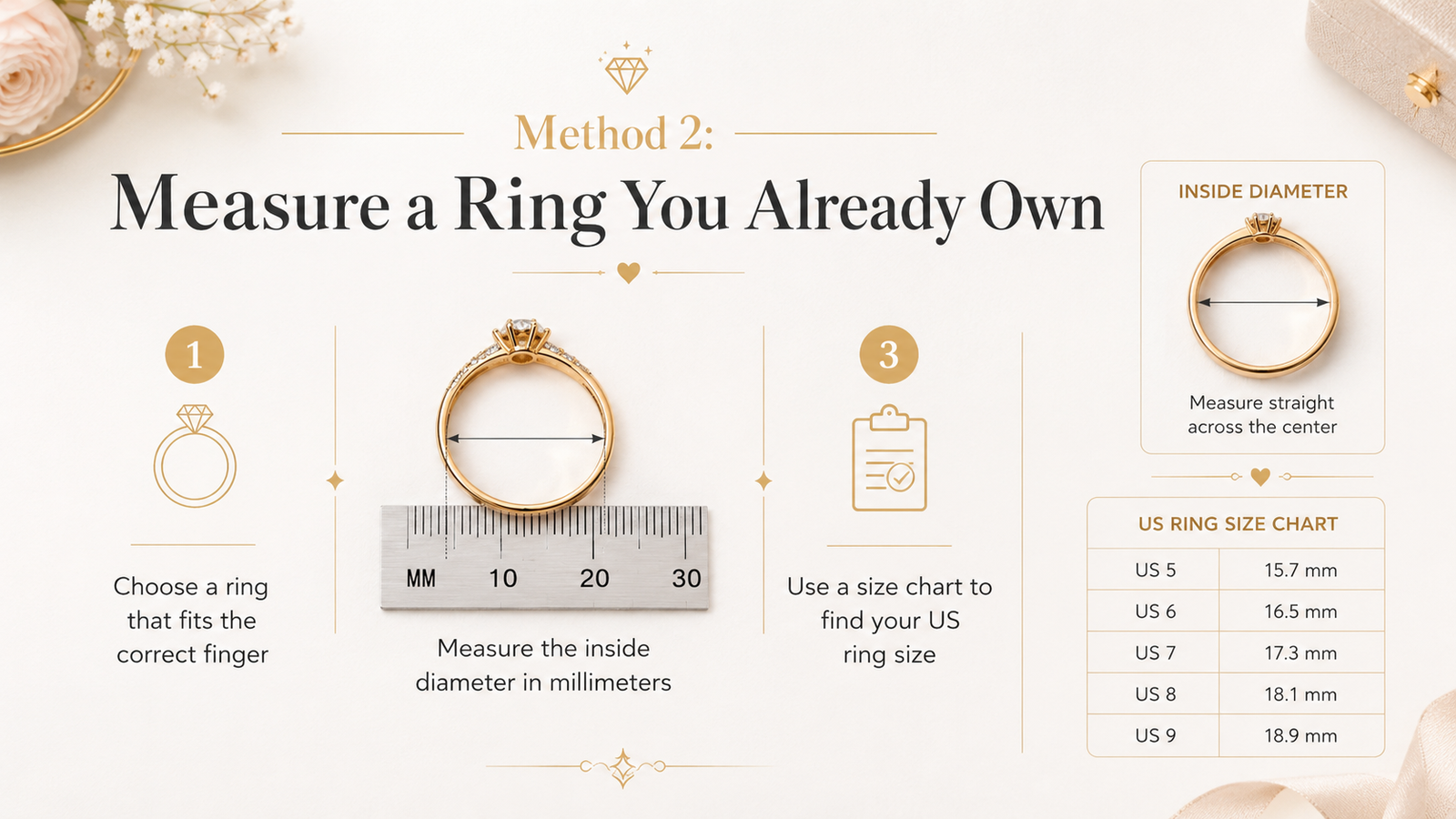
Measuring an existing ring is often more accurate than wrapping paper around the
finger—as long as the ring fits the correct finger and has not become bent or
distorted.
Measure straight across the widest part of the inner opening without including
the metal edges.
1
Choose the Correct Ring
Select a round ring that currently fits the same finger on the same hand.
Avoid using a ring that is already too tight, loose or visibly misshapen.
2
Place It on a Flat Surface
Set the ring over a millimeter ruler or use digital calipers. Keep the ring
level so you are viewing the true inner opening.
3
Measure the Inside Diameter
Measure straight across the center from one inner edge to the opposite inner
edge. Do not include the thickness of the band.
4
Compare with the Size Chart
Match the inside diameter in millimeters with the nearest US ring size.
When the result falls between two sizes, consider the band width and desired fit.
Common measuring error: measuring from the outer edges of the
ring produces an oversized result. Only measure the empty inner space.
Method Three
How to Use a Printable Ring Sizer Correctly
A printable ring sizer can provide a convenient estimate, but only when the page
is printed at its intended scale. Browser, phone and printer settings may resize
documents automatically.
1
Print at 100% Scale
Select “Actual Size” or “100%” in the print settings. Do not select “Fit to
Page,” “Shrink” or automatic scaling.
2
Check the Calibration Line
Measure the document’s reference line with a physical ruler. Do not use the
sizer when the calibration measurement is incorrect.
3
Cut the Strip Carefully
Cut along the outside line and open the indicated slot without widening it.
Inaccurate cutting may change the fit.
4
Pull It Snugly, Not Tightly
Place the sizer around the finger and pull until it sits like a comfortable
ring. It should move over the knuckle with mild resistance.
Do not measure a printable guide directly from a phone or computer screen.
Screen dimensions and zoom settings are not reliable physical measurements.
Size Conversion
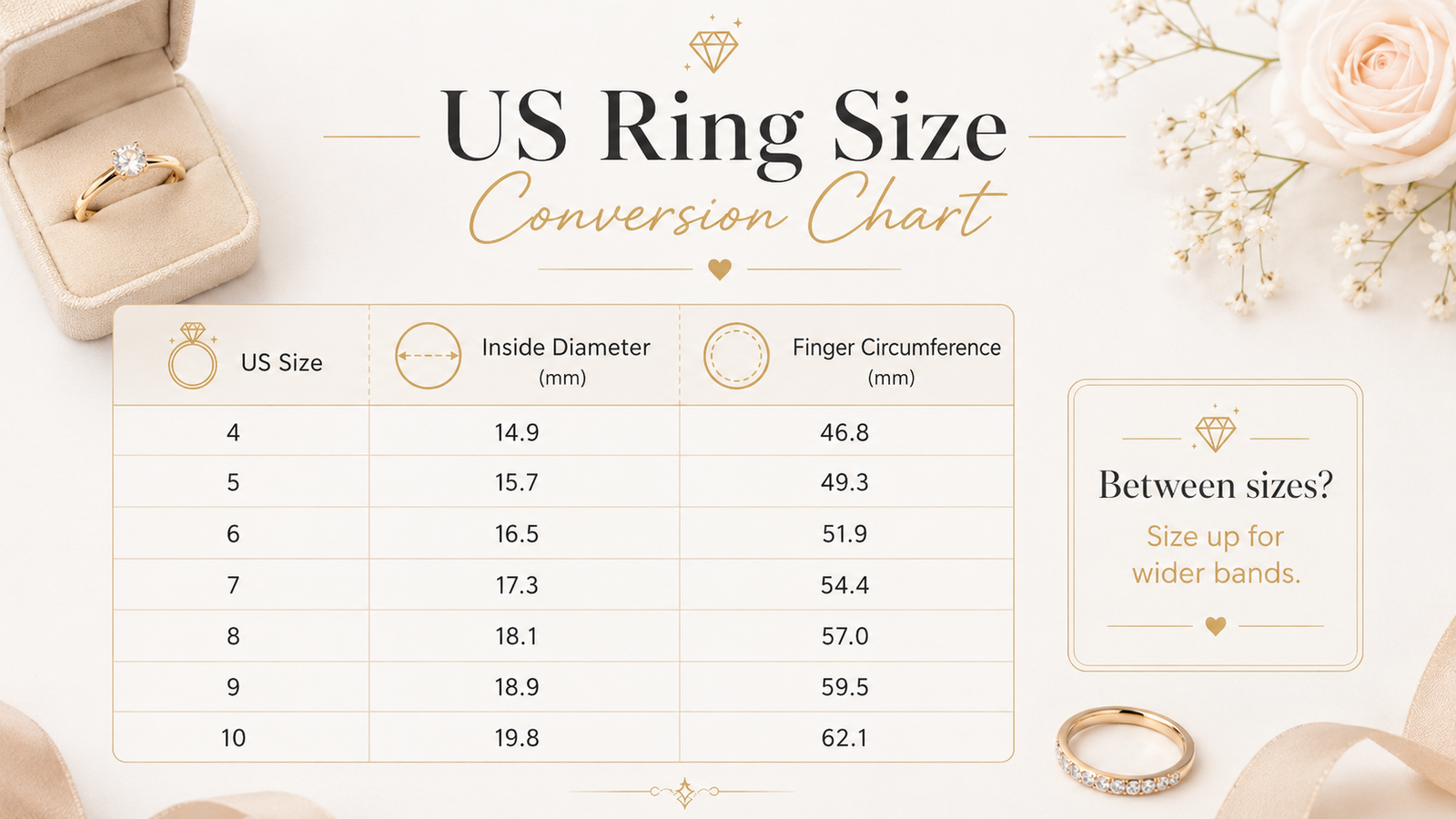
US Ring Size Chart: Diameter and Circumference
Use the circumference column for the paper-strip method and the inside-diameter
column when measuring a ring you already own. Measurements are approximate, and
individual manufacturer charts may vary slightly.
Match the finger circumference or inside ring diameter with the nearest US size.
US Ring Size
Inside Diameter
Finger Circumference
3
14.0 mm
44.0 mm
3.5
14.4 mm
45.2 mm
4
14.9 mm
46.8 mm
4.5
15.3 mm
48.0 mm
5
15.7 mm
49.3 mm
5.5
16.1 mm
50.6 mm
6
16.5 mm
51.9 mm
6.5
16.9 mm
53.1 mm
7
17.3 mm
54.4 mm
7.5
17.7 mm
55.7 mm
8
18.1 mm
57.0 mm
8.5
18.5 mm
58.3 mm
9
18.9 mm
59.5 mm
9.5
19.4 mm
60.8 mm
10
19.8 mm
62.1 mm
10.5
20.2 mm
63.4 mm
11
20.6 mm
64.6 mm
11.5
21.0 mm
65.9 mm
12
21.4 mm
67.2 mm
12.5
21.8 mm
68.5 mm
13
22.2 mm
69.7 mm
Between two sizes?
A slightly larger size is generally more comfortable for a wide band, swollen
fingers or a prominent knuckle. A narrow, top-heavy ring may require a closer fit
to reduce spinning.
Fit Check
How Should a Properly Sized Ring Fit?
A correctly fitted ring should feel secure without causing discomfort. It should
move over the knuckle with gentle resistance and sit comfortably at the base of
the finger.
✓
A Good Fit
Slides over the knuckle with mild resistance
Sits securely without pinching
Can rotate slightly when intentionally moved
Does not fall off when the hand points downward
Leaves no deep or painful indentation
×
Possible Wrong Size
Feels painful or difficult to remove
Creates strong pressure or numbness
Slides over the knuckle without resistance
Spins constantly or tilts to one side
Falls off during normal hand movement
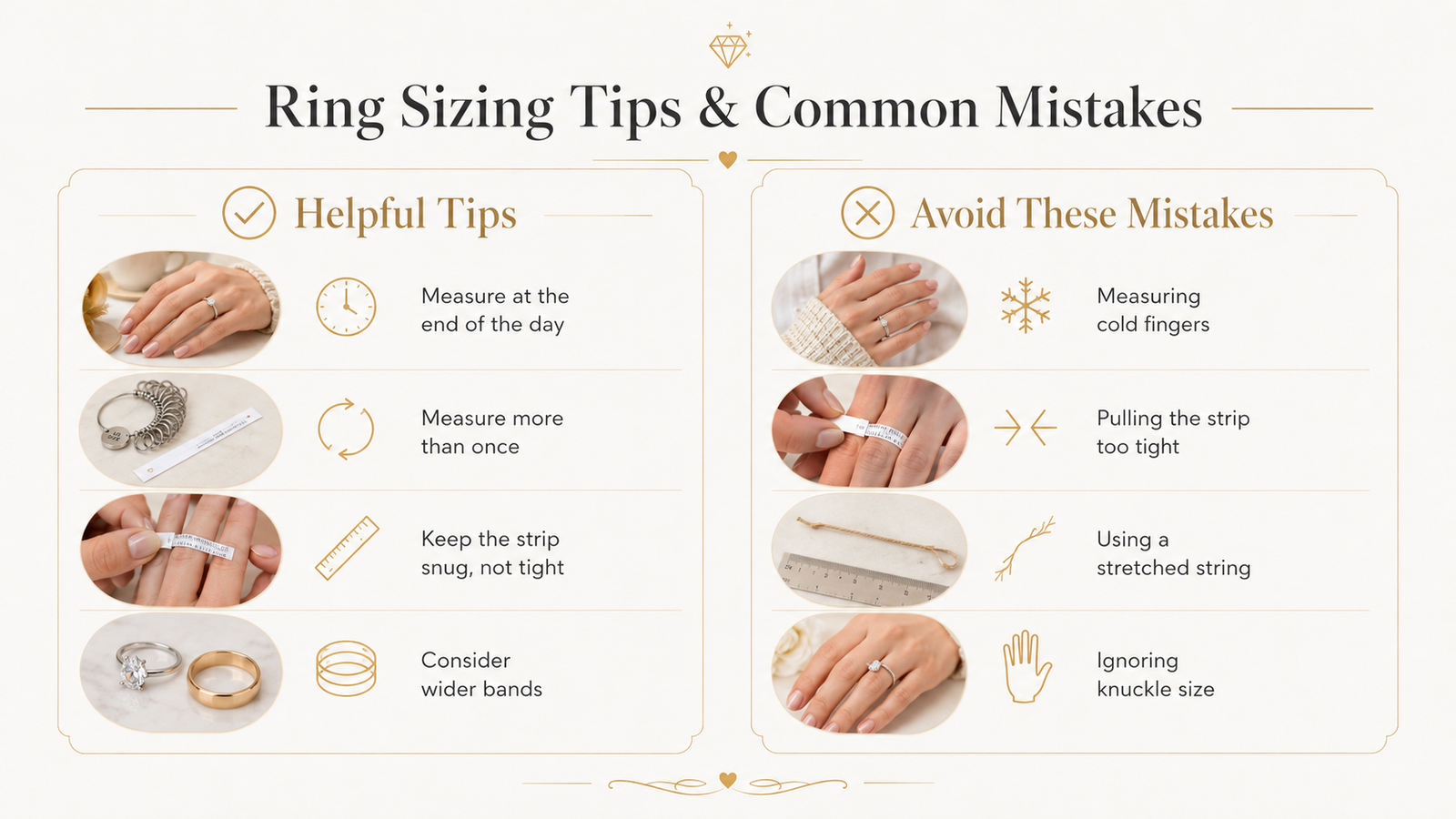
Improve Accuracy
Ring Sizing Tips and Common Mistakes
Measure several times under normal conditions and avoid stretching or overtightening
the measuring strip.
✓ Helpful Sizing Tips
Measure at the End of the Day
Fingers are often slightly larger later in the day, making this a better
time to estimate a comfortable everyday fit.
Use Normal Room Temperature
Measure when your hands are comfortably warm—not immediately after exposure
to cold weather, hot water or intense exercise.
Measure Two or Three Times
Repeat the process on different occasions. Large variations suggest that
the strip tension or measurement technique needs adjustment.
Consider the Band Width
Wide bands generally feel tighter than thin bands at the same nominal size.
You may need to size up slightly.
× Mistakes to Avoid
Pulling the Paper Too Tight
Compressing the finger produces a size that may feel uncomfortably tight
when converted into a rigid metal ring.
Using Stretchy Material
Elastic string, yarn and soft thread can lengthen while being pulled and
produce an inaccurate circumference.
Ignoring the Knuckle
A measurement taken only at the finger base may be too small to pass over
a prominent knuckle.
Measuring Only Once
Finger size changes with temperature and activity. One result should not
be treated as final when it differs from your usual fit.
Special Considerations
How to Choose a Size in Special Situations
When You Are Between Sizes
Consider the band width, knuckle size and normal finger swelling. For a wide
band or finger that regularly swells, choosing the larger size is usually
more comfortable.
For Wide Ring Bands
Bands wider than approximately 6 millimeters cover more skin and often feel
tighter. Ask whether the design requires a quarter-size or half-size adjustment.
For Large Knuckles
Measure both the knuckle and the base of the finger. A size between the two
measurements may help the ring pass the knuckle without becoming excessively loose.
For Top-Heavy Rings
Rings with large center stones can rotate when the fit is loose. A closer fit,
sizing beads or another jeweler-approved solution may improve stability.
During Pregnancy or Temporary Swelling
Finger size may change temporarily. Avoid forcing a tight ring and consider
delaying a permanent sizing decision until measurements become stable.
For a Surprise Gift
Borrow a ring worn on the correct finger and measure its inside diameter.
You may also ask a trusted friend or family member without revealing the surprise.
Ring construction also affects fit and comfort. Explore our
moissanite ring settings guide
to compare solitaire, halo, three-stone, bezel and pavé designs.
Frequently Asked Questions
Frequently Asked Questions About Measuring Ring Size
What is the most accurate way to measure ring size at home?
Measuring the inside diameter of a properly fitting ring with digital calipers
is usually the most accurate home method. The ring must fit the same finger on
the same hand.
Is the string method accurate?
It can provide an estimate, but soft or stretchy string may distort the result.
A non-stretch paper strip is generally easier to measure consistently.
What time of day should I measure my finger?
Measure near the end of the day when your hands are at a normal, comfortable
temperature. Avoid measuring immediately after cold exposure, hot water or exercise.
What should I do when I am between ring sizes?
Consider choosing the larger size for a wide band, prominent knuckle or finger
that frequently swells. For a thin, top-heavy design, professional advice may
help prevent excessive spinning.
Are ring sizes the same on both hands?
Not necessarily. The corresponding fingers on your left and right hands may
have different circumferences, especially when one is your dominant hand.
How tight should the paper strip be?
It should touch the skin without compressing it. The loop should represent the
way a comfortable metal ring would sit and pass over the knuckle.
Do wide rings require a larger size?
Wide bands often feel tighter because they contact more of the finger. Depending
on the design and wearer, a quarter-size or half-size increase may be appropriate.
Can I measure ring size from a phone screen?
No. Screen size, resolution and zoom settings vary. Printable ring sizers must
be printed at 100% scale and verified with a physical ruler.
What if my measurements are inconsistent?
Repeat the measurement under normal conditions and use a second method. When
the results continue to differ, visit a jeweler for professional sizing.
Final Takeaway
Measure More Than Once Before Ordering Your Ring
The simplest way to measure ring size at home is to wrap a non-stretch paper strip
around the finger and compare the circumference with a US ring size chart. For a
more reliable estimate, measure the inside diameter of a ring that already fits.
Always measure the correct finger and hand, use millimeters and repeat the process
under normal temperature conditions. Account for the knuckle and band width before
choosing between two sizes.
Find a Ring for Your Perfect Fit
Explore elegant moissanite rings and contact Sunshine Jewelry for available
sizes and product details.
Choose a women's sunshine diamond ring gift by checking her style, exact ring size, verified listing details, daily routine, and current store policies.