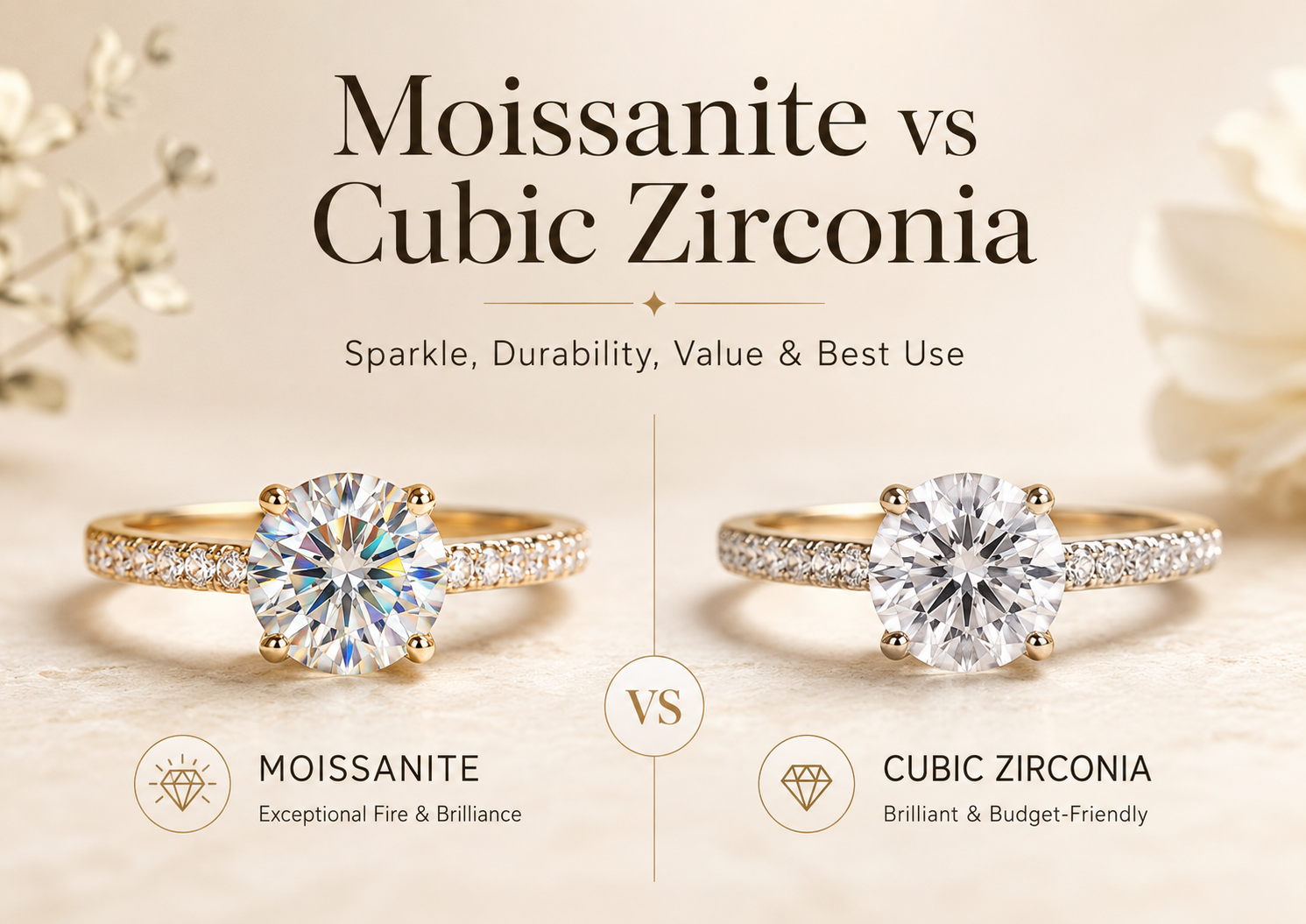
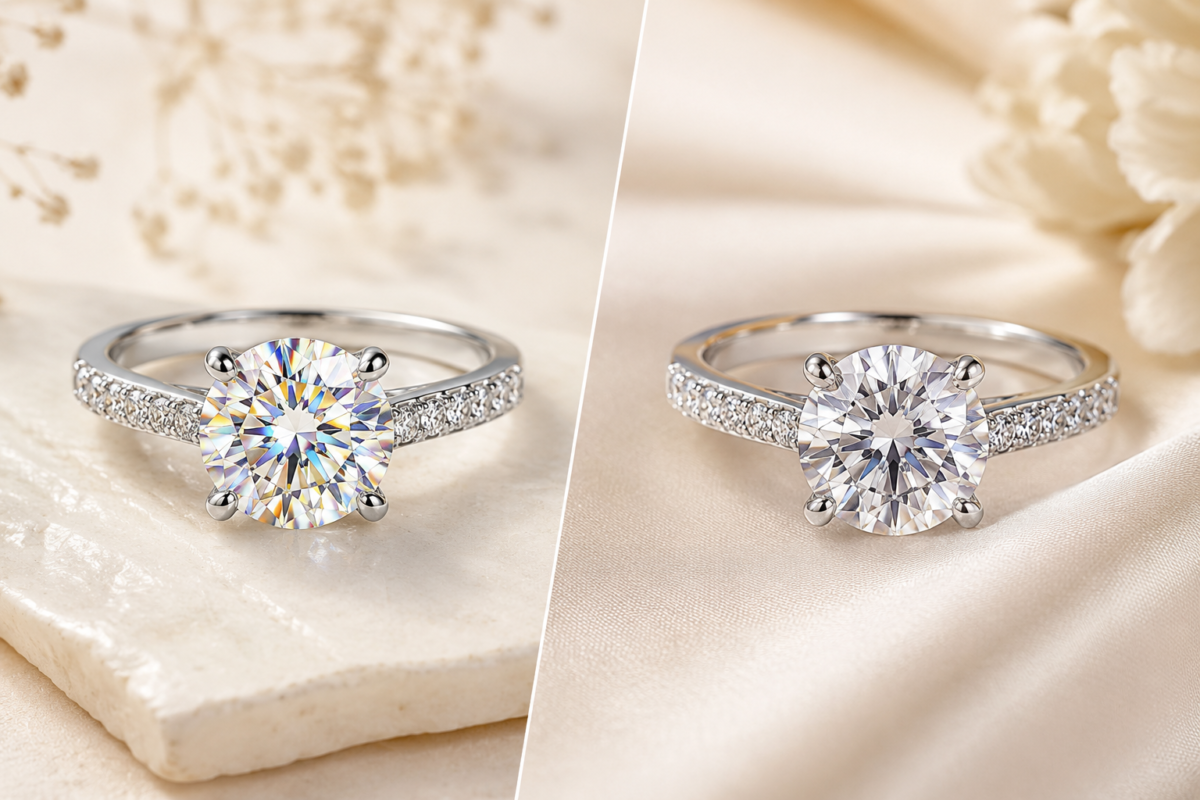
Moissanite vs cubic zirconia can be confusing at first glance. Both are brilliant, laboratory-produced gemstones that can create a bright, diamond-like appearance—but they are very different materials with different levels of fire, hardness, durability and price.
Moissanite is a form of silicon carbide known for exceptional fire and strong durability. Cubic zirconia, usually called CZ, is a synthetic form of zirconium oxide that offers an attractive bright-white appearance at a much lower initial price.
So which one is better?
The answer depends on how you plan to wear the jewelry, how much sparkle you prefer, your budget and how important long-term wear is to you.
Quick Answer
Choose moissanite if you want stronger fire, greater scratch resistance and a stone better suited to frequent or long-term wear.
Choose cubic zirconia if keeping the upfront price as low as possible matters most and the jewelry is intended mainly for fashion, occasional wear or short-term use.
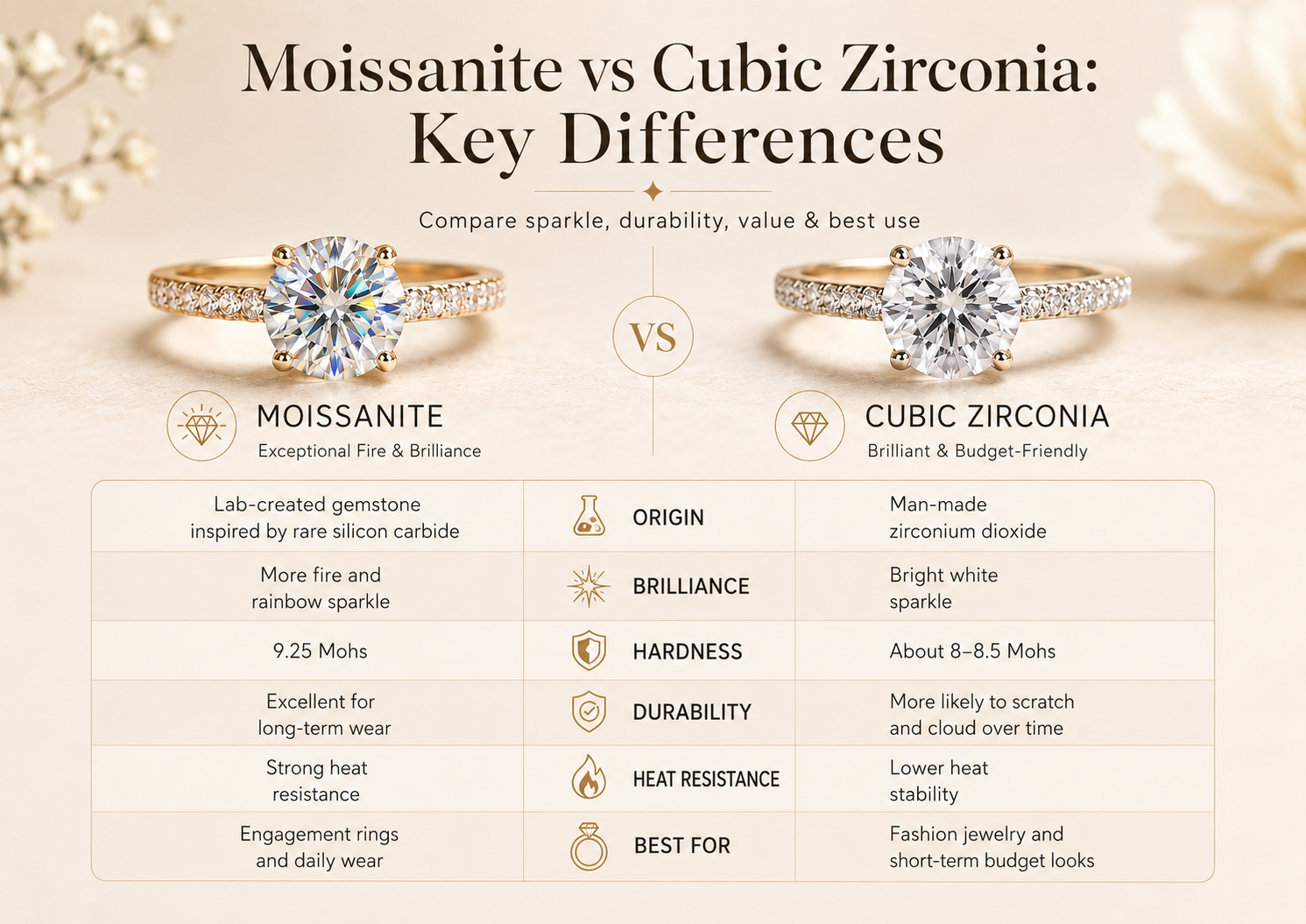
Moissanite vs Cubic Zirconia: Key Differences at a Glance
Feature
Moissanite
Cubic Zirconia
Material
Silicon carbide
Stabilized zirconium oxide
Mohs Hardness
About 9.25
About 8–8.5
Sparkle
Strong brilliance with pronounced rainbow fire
Bright white sparkle with less dispersion
Scratch Resistance
Excellent
Good, but more susceptible to surface wear
Initial Price
Higher
Much lower
Everyday Wear
Very suitable
Better suited to lighter or occasional wear
Engagement Rings
Strong long-term option
Budget-focused option
The largest practical differences are therefore not simply appearance. They are hardness, optical performance, wear resistance and long-term use.
What Are Moissanite and Cubic Zirconia?
What Is Moissanite?
Moissanite used in modern jewelry is a laboratory-created gemstone made from silicon carbide.
It is valued for its high refractive index, strong dispersion and excellent hardness. These properties help create the intense flashes of white and rainbow-colored light associated with moissanite jewelry.
Cubic zirconia is a laboratory-produced crystalline form of zirconium oxide. It became widely used in jewelry because it can be manufactured with excellent clarity, strong brightness and very low production cost.
CZ is particularly common in affordable fashion jewelry, costume jewelry, travel jewelry and designs where a large bright stone is desired without a high price.
Important: Cubic Zirconia Is Not Zircon
Cubic zirconia and zircon are not the same gemstone. Cubic zirconia is a synthetic zirconium oxide material, while zircon is a naturally occurring mineral with a completely different chemical composition and gemological history.
Moissanite vs Cubic Zirconia: Which Sparkles More?
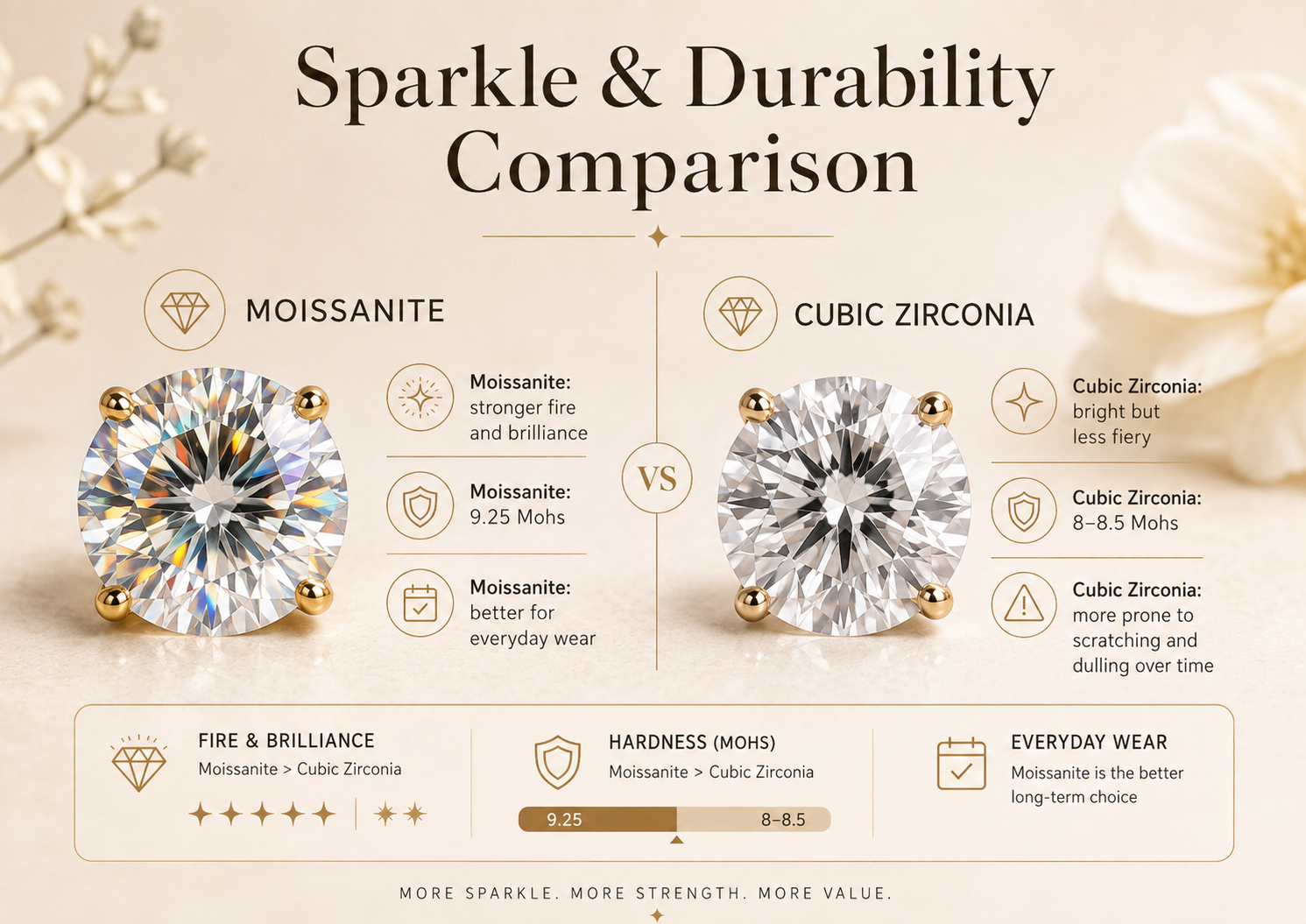
Both stones can look brilliant, but they interact with light differently.
Moissanite Has Stronger Fire
One of moissanite's most recognizable characteristics is its strong dispersion, commonly called fire.
When light enters the stone and separates into spectral colors, moissanite can produce noticeable flashes of blue, green, yellow, orange and red—especially under spot lighting or direct sunlight.
Some buyers love this colorful sparkle because it creates a lively, highly visible appearance.
Cubic Zirconia Produces a Bright White Look
High-quality CZ can look extremely bright and clear when new. Its sparkle tends to appear somewhat whiter and less fiery than moissanite.
For consumers who prefer a relatively calm, bright appearance—or simply want an affordable sparkling stone—this can still be very attractive.
Sparkle Winner:
If your priority is intense brilliance and colorful fire, moissanite generally has the advantage.
Hardness is especially important when choosing jewelry intended for daily wear.
The Mohs scale measures resistance to scratching. It does not measure every aspect of durability, but it provides a useful indication of how easily a gemstone's surface may be scratched.
Gemstone
Mohs Hardness
Practical Meaning
Moissanite
About 9.25
Excellent resistance to everyday scratching
Cubic Zirconia
About 8–8.5
Good hardness, but more susceptible to wear and scratches
Is Moissanite More Durable Than Cubic Zirconia?
For frequent wear, yes. Moissanite's higher hardness gives it stronger resistance to surface scratching.
That is especially valuable for rings because hands regularly come into contact with desks, doors, bags, tools and other objects.
Does That Mean CZ Is Fragile?
No.
CZ is still substantially harder than many everyday materials and can perform well in jewelry when treated carefully. The difference becomes more important over months and years of frequent wear.
Does Cubic Zirconia Get Cloudy Over Time?
This question requires an important distinction.
CZ does not simply become internally cloudy because a certain number of months have passed. However, its surface can accumulate oils, soap residue, cosmetics and dirt, while scratches and abrasion can gradually reduce the crispness of its reflections.
As a result, heavily worn cubic zirconia may appear less brilliant than when it was new.
Cleaning can restore sparkle caused by surface contamination, but scratches and permanent surface wear cannot simply be cleaned away.
Does Moissanite Lose Its Sparkle?
Moissanite itself is highly stable and resistant to scratching, although oils and residue can still build up on the surface of any gemstone.
Regular cleaning therefore matters for both stones.
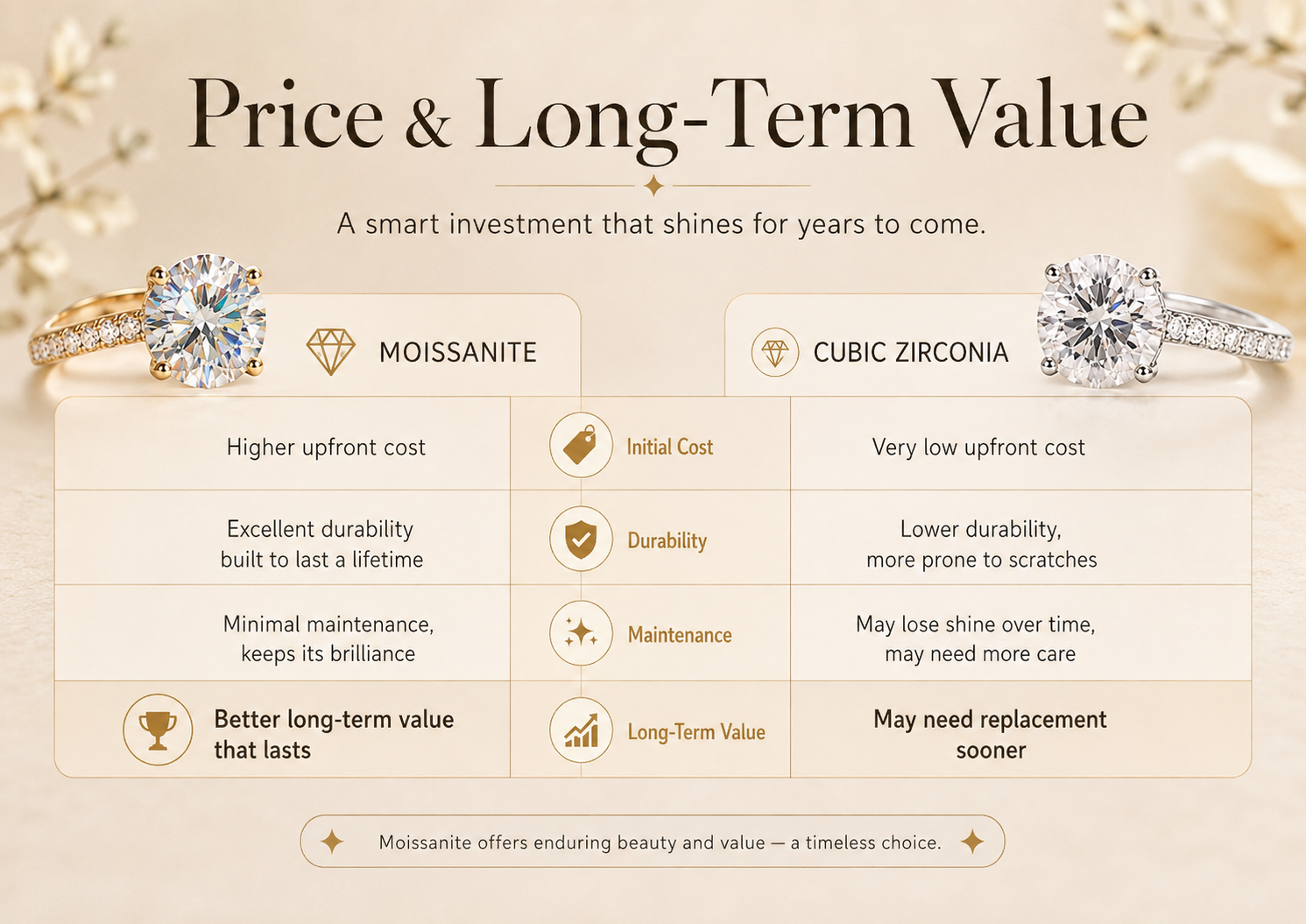
Cubic zirconia is normally much less expensive than moissanite.
This makes CZ especially appealing when the primary goal is obtaining a large, clear, sparkling stone for the lowest possible upfront price.
Moissanite generally costs more because its production, crystal material, cutting and market positioning are different.
However, the cheapest stone is not automatically the best value for every type of jewelry.
Think About Cost Per Wear
Imagine one ring is worn only a few times each year while another is worn almost every day.
For occasional jewelry, a very inexpensive CZ piece may make complete sense.
For a ring intended to be worn regularly over many years, paying more for stronger scratch resistance and long-term optical performance may provide greater practical value.
Important:
“Long-term value” here refers to durability and useful wear—not guaranteed resale or investment value. Neither stone should be purchased solely as a financial investment.
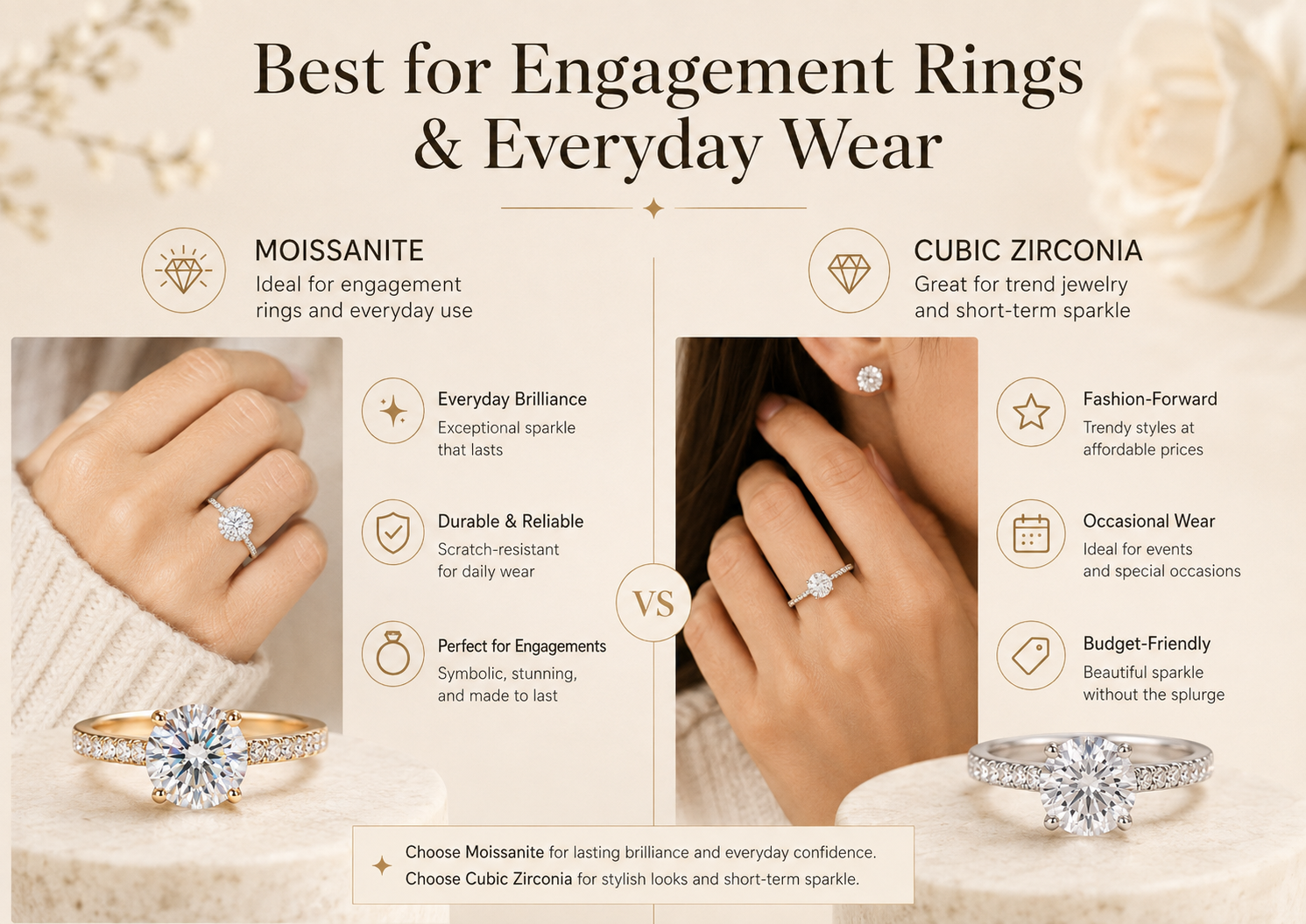
For an engagement ring intended to be worn every day, moissanite is generally the stronger practical choice.
The reason is not that CZ cannot be used in an engagement ring. It certainly can.
The difference is that an engagement ring typically experiences years of repeated wear. That makes scratch resistance, durability and long-term appearance more important than they might be for occasional fashion jewelry.
Choose Moissanite for an Engagement Ring If:
You expect to wear the ring every day.
You want stronger scratch resistance.
You enjoy noticeable rainbow fire.
You want a large center-stone appearance without natural-diamond pricing.
You want the stone to remain part of the same ring for long-term use.
Choose Cubic Zirconia If:
Your budget is extremely limited.
The ring is temporary.
You plan to upgrade the center stone later.
You need a travel or replacement engagement ring.
You are comfortable replacing the stone if significant wear develops.
Color and Clarity: Does One Look More Like Diamond?
Both gemstones can be produced with excellent apparent clarity and a nearly colorless appearance.
CZ often displays a clean, white appearance when new. Moissanite can also be produced in highly colorless grades, although its stronger rainbow fire may make it visually different from diamond under certain lighting.
This is why choosing a gemstone based only on the question “Which looks most like a diamond?” can be misleading.
Large center stones make optical differences easier to notice.
A larger moissanite may show stronger rainbow flashes, while a large CZ can create impressive visual size at a very low price.
However, larger stones in rings also expose more surface area to daily contact. This makes scratch resistance increasingly relevant if the ring will be worn frequently.
Moissanite or Cubic Zirconia: Which Should You Choose?
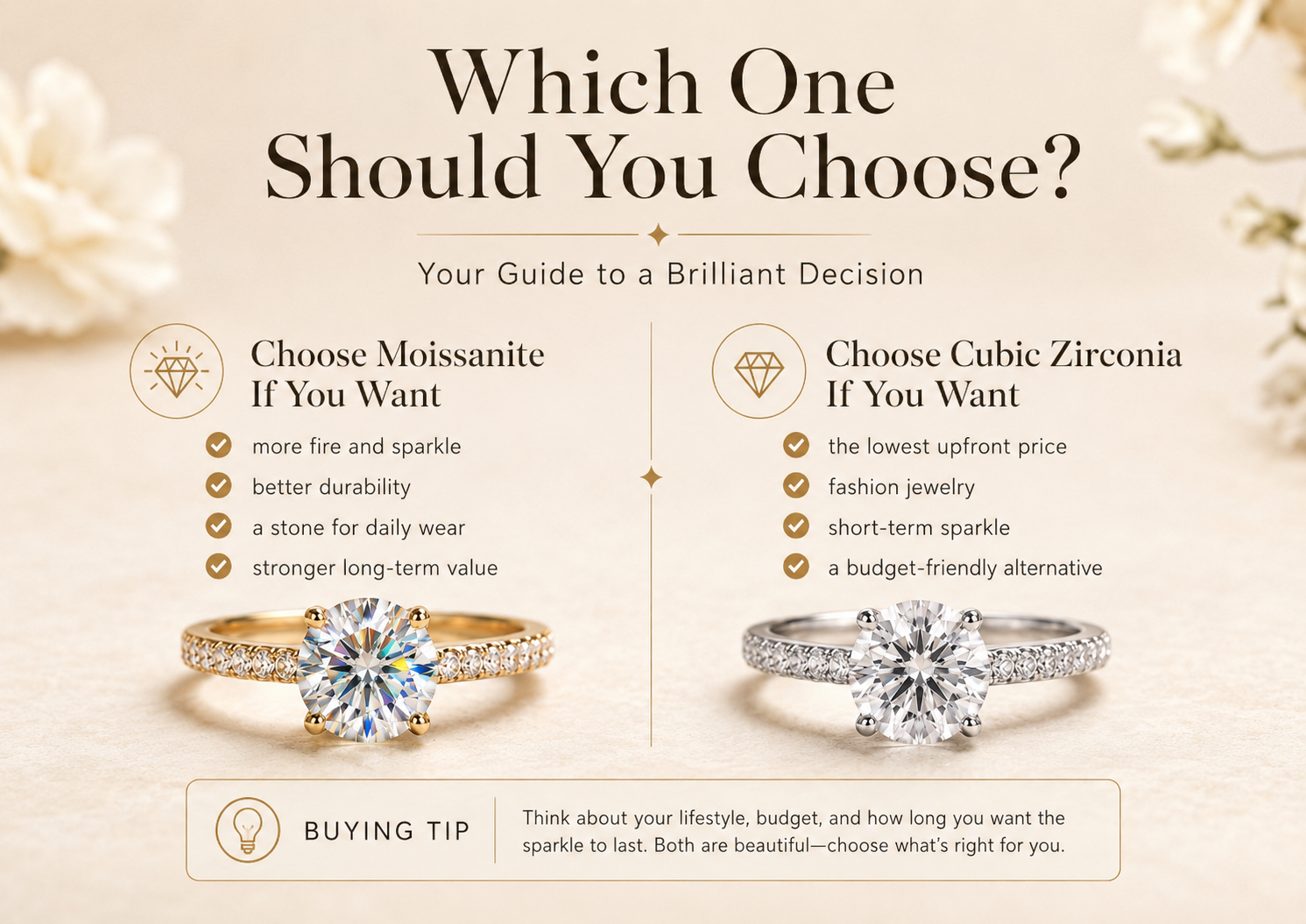
Choose Moissanite If You Want:
More rainbow fire and optical intensity.
Greater resistance to everyday scratching.
A gemstone suitable for frequent long-term wear.
An engagement-ring center stone designed for daily use.
More durability than a typical fashion-jewelry stone.
Choose Cubic Zirconia If You Want:
The lowest possible upfront price.
A large visual size on a very limited budget.
Fashion or trend jewelry.
A temporary, travel or backup ring.
Jewelry that will only be worn occasionally.
The Practical Verdict
For a piece that will be worn frequently for years, moissanite usually provides the stronger balance of brilliance and durability.
For fashion jewelry, temporary pieces or the lowest possible budget, cubic zirconia remains a practical and attractive option.
Frequently Asked Questions About Moissanite vs Cubic Zirconia
Is moissanite the same as cubic zirconia?
No. Moissanite is silicon carbide, while cubic zirconia is stabilized zirconium oxide. They have different optical, physical and durability characteristics.
Is moissanite better than cubic zirconia?
For frequent and long-term jewelry wear, moissanite generally has an advantage because it is harder and more resistant to scratching. CZ can be the better choice when very low initial cost is the highest priority.
Which sparkles more, moissanite or cubic zirconia?
Moissanite generally displays stronger dispersion and more noticeable rainbow-colored fire. Cubic zirconia produces attractive brilliance but typically appears less fiery.
Which is harder, moissanite or cubic zirconia?
Moissanite is harder. It measures about 9.25 on the Mohs scale, while cubic zirconia generally measures about 8–8.5.
Can you wear cubic zirconia every day?
Yes, but frequent wear can gradually create more surface scratches and abrasion than would typically occur with moissanite. Proper care and periodic cleaning can help maintain its appearance.
Does cubic zirconia turn cloudy?
CZ can appear dull or cloudy when dirt, oil and residue accumulate on its surface. Surface scratches and abrasion can also reduce its crisp brilliance over time. Cleaning helps with residue but cannot remove permanent scratches.
Does moissanite get cloudy?
Moissanite does not normally become internally cloudy from ordinary aging. However, surface oils and residue can temporarily reduce sparkle and should be removed with regular cleaning.
Is cubic zirconia suitable for an engagement ring?
It can be used for an engagement ring, especially when budget is the main consideration. For a ring intended for many years of daily wear, moissanite's additional hardness generally makes it a stronger practical option.
Is cubic zirconia the same as zircon?
No. Cubic zirconia is a laboratory-produced zirconium oxide material. Zircon is a naturally occurring mineral and a completely different gemstone.
Which is more expensive, moissanite or cubic zirconia?
Moissanite is normally more expensive. CZ is among the most affordable clear gemstone alternatives used in jewelry.
Final Verdict: Moissanite vs Cubic Zirconia
Moissanite and cubic zirconia can both create beautiful, brilliant jewelry, but they are designed for different priorities.
Moissanite is the stronger option when you prioritize fire, hardness, everyday durability and long-term wear.
Cubic zirconia excels when you prioritize affordability, large visual size and fashion flexibility.
Instead of asking which gemstone is universally “better,” consider how the piece will actually be used.
The best stone is the one that matches your lifestyle, budget and expectations.
A detailed zircon vs moissanite comparison covering gemstone identity, sparkle, color, durability, settings, care, identification limits, and buying priorities.
A detailed guide to sunshine rings for women, including solar symbolism, design types, gemstone-label checks, settings, sizing, styling, care, and gifting.