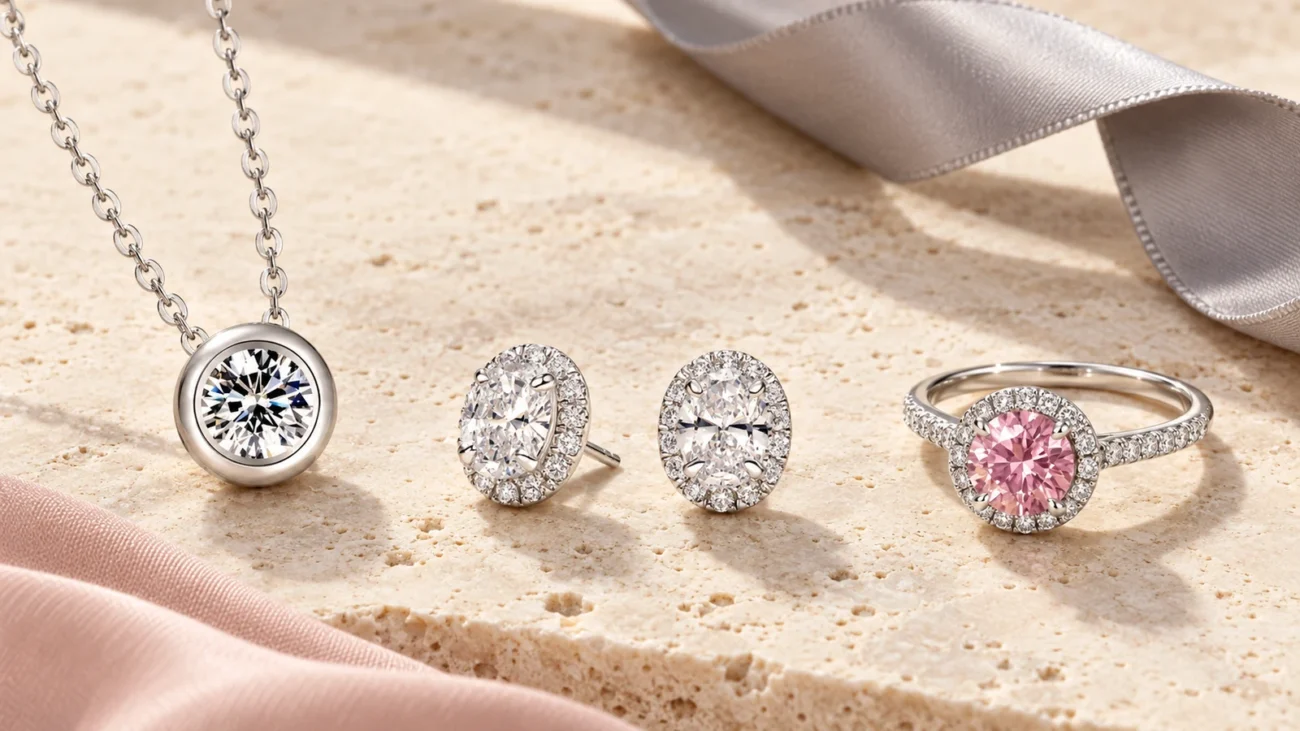
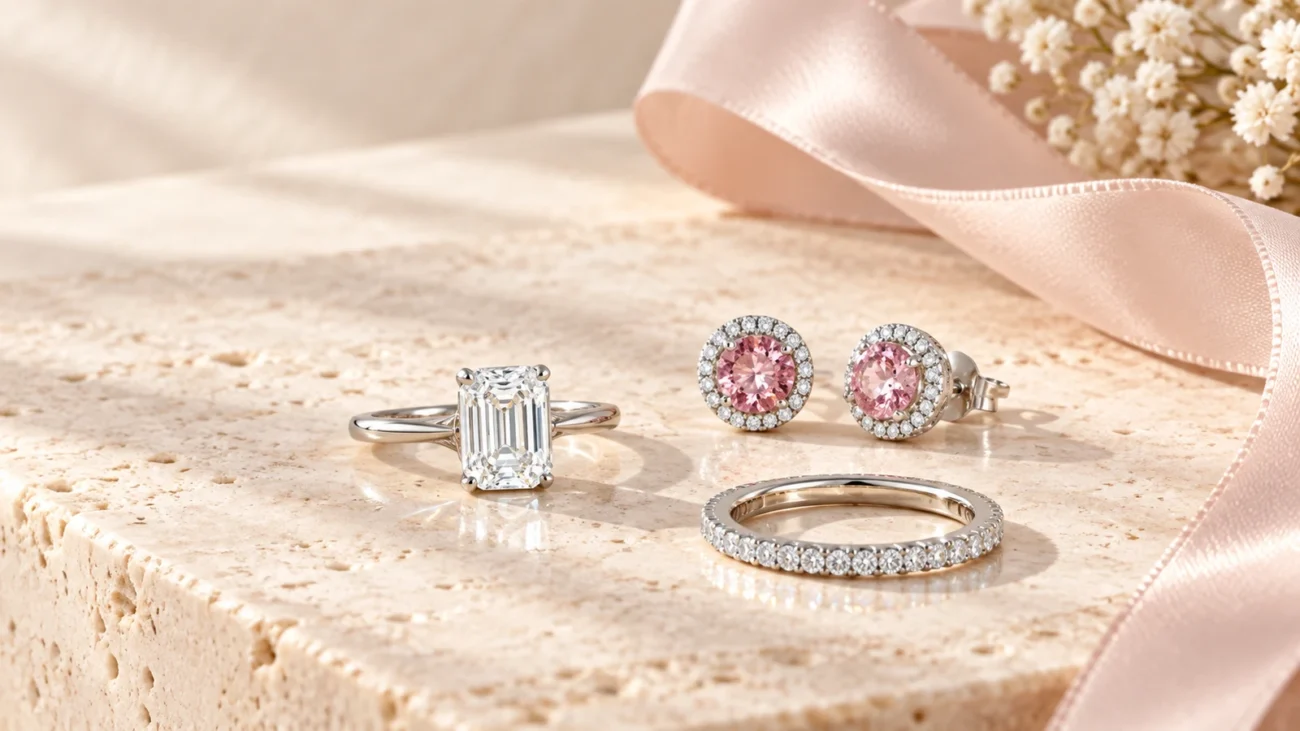
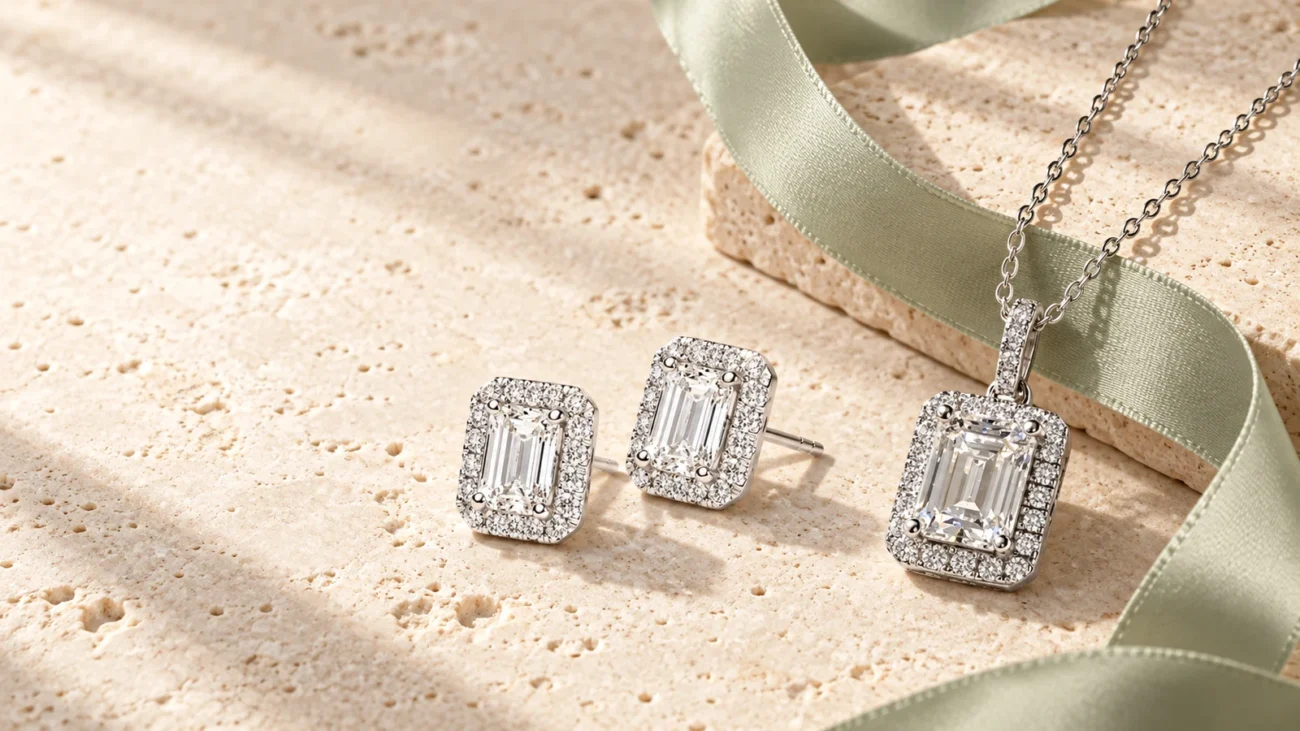
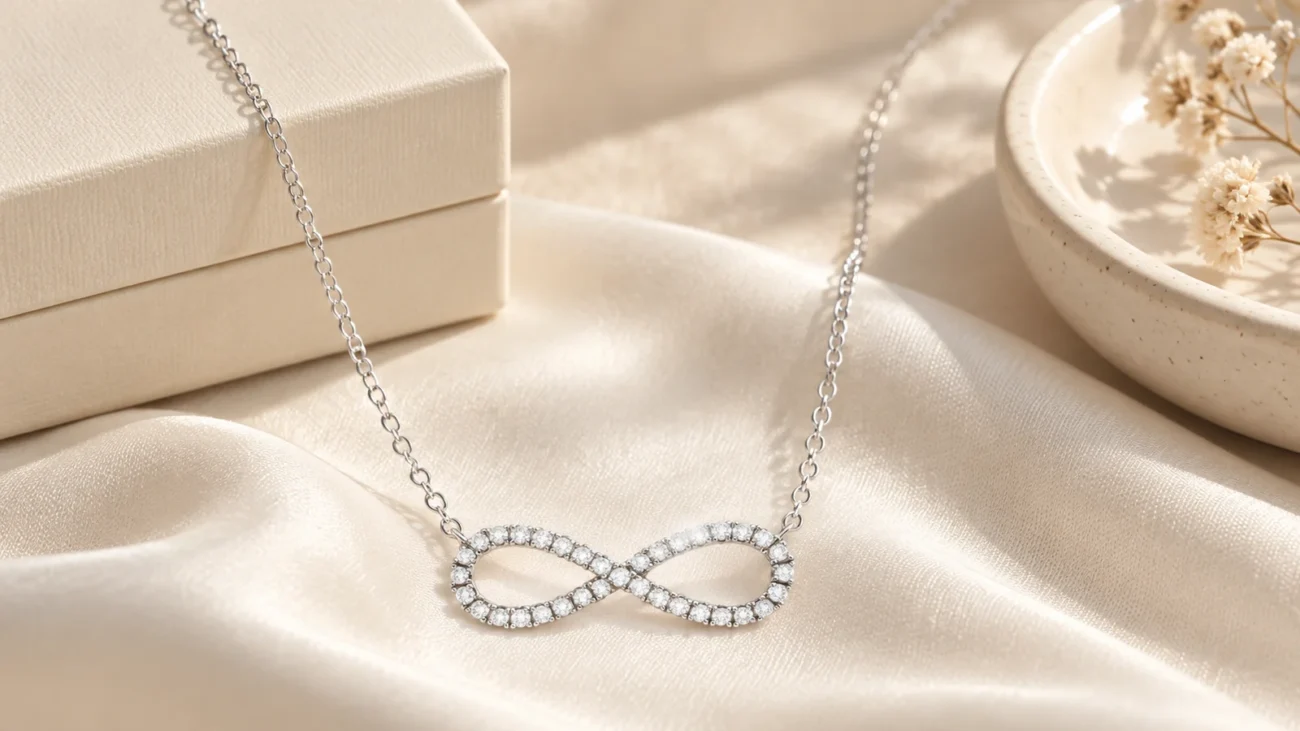
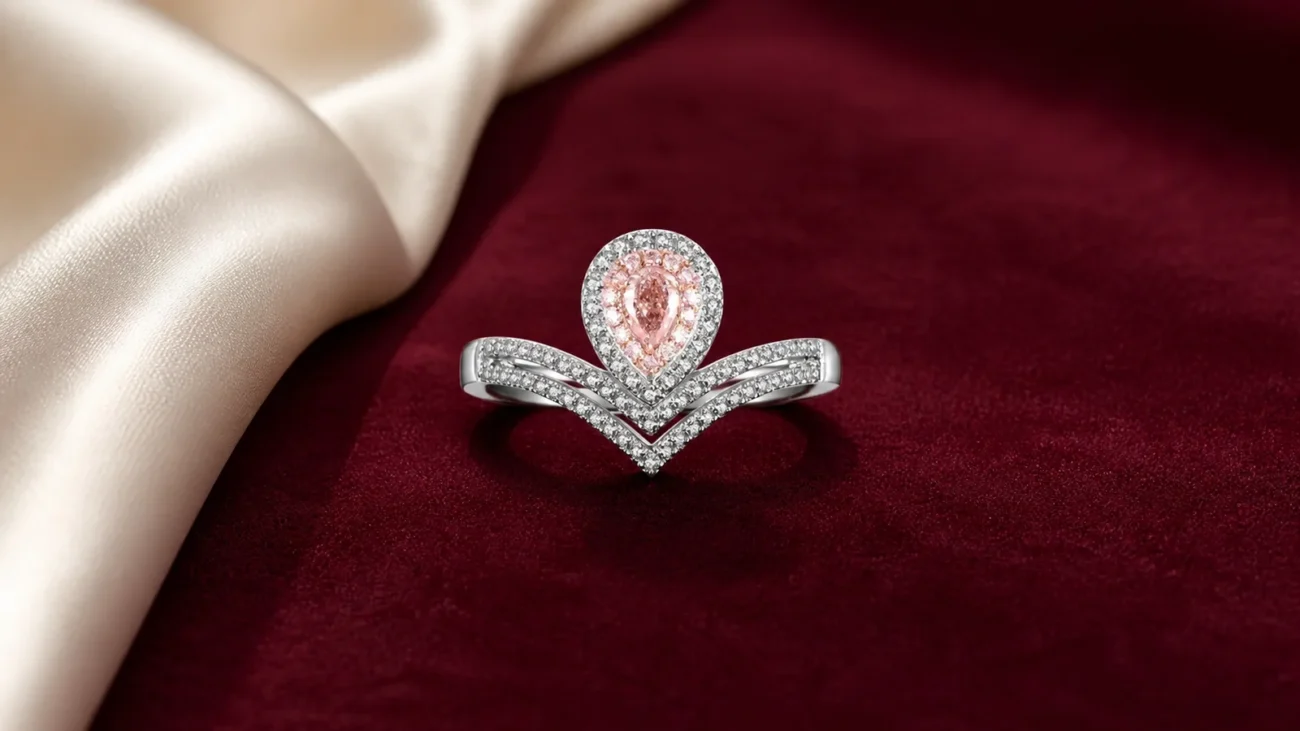
Learning how to tell if moissanite is real is not as simple
as looking for rainbow sparkle or touching the stone with a basic diamond tester.
Genuine moissanite has recognizable optical properties, but no single home test
can confirm every gemstone with complete certainty.
The safest approach is to combine seller transparency, supporting documents,
magnified inspection, appropriate testing equipment and professional verification.
This guide explains what you can check yourself, which warning signs to watch for
and when to ask a jeweler or gemologist for help.
Quick Answer
How can you tell if moissanite is real?
Start by confirming that the seller clearly identifies the stone as moissanite.
Review the product specifications and supporting report, inspect the stone under
magnification, observe its brilliance and fire, and use a tester specifically
designed to distinguish moissanite from diamond.
These checks can identify useful clues, but the most dependable confirmation
comes from a qualified jeweler, gemologist or independent gemological laboratory.
A certificate, rainbow sparkle or a positive result on a basic thermal diamond
tester should not be treated as conclusive evidence by itself.
Understanding the Question
What Does “Real Moissanite” Actually Mean?
In jewelry, “real moissanite” normally means that the gemstone is genuinely
composed of silicon carbide and has been sold accurately as moissanite. It does
not mean that the stone is a mined diamond, laboratory-grown diamond or natural
moissanite recovered from the earth.
Nearly all gem-quality moissanite sold in modern jewelry is created under
controlled laboratory conditions. Naturally occurring moissanite is exceptionally
rare and is not the normal source of commercial moissanite engagement rings,
earrings, necklaces or bracelets.
01
Genuine Moissanite
A silicon carbide gemstone correctly identified and sold as moissanite.
It is normally laboratory-created for jewelry use.
02
Laboratory-Grown Diamond
A diamond created in a laboratory with essentially the same carbon crystal
structure as a mined diamond. It is not moissanite.
03
Cubic Zirconia
A different manufactured gemstone material sometimes used as a diamond
imitation. It is not moissanite.
04
Glass or Other Simulants
Materials that may resemble a colorless gemstone but have different optical,
physical and durability characteristics.
Important: a seller should describe the gemstone clearly.
Moissanite should not be presented as a mined diamond or a laboratory-grown diamond.
Use several checks together instead of relying on one visual clue, certificate
or testing device.Six Practical Checks
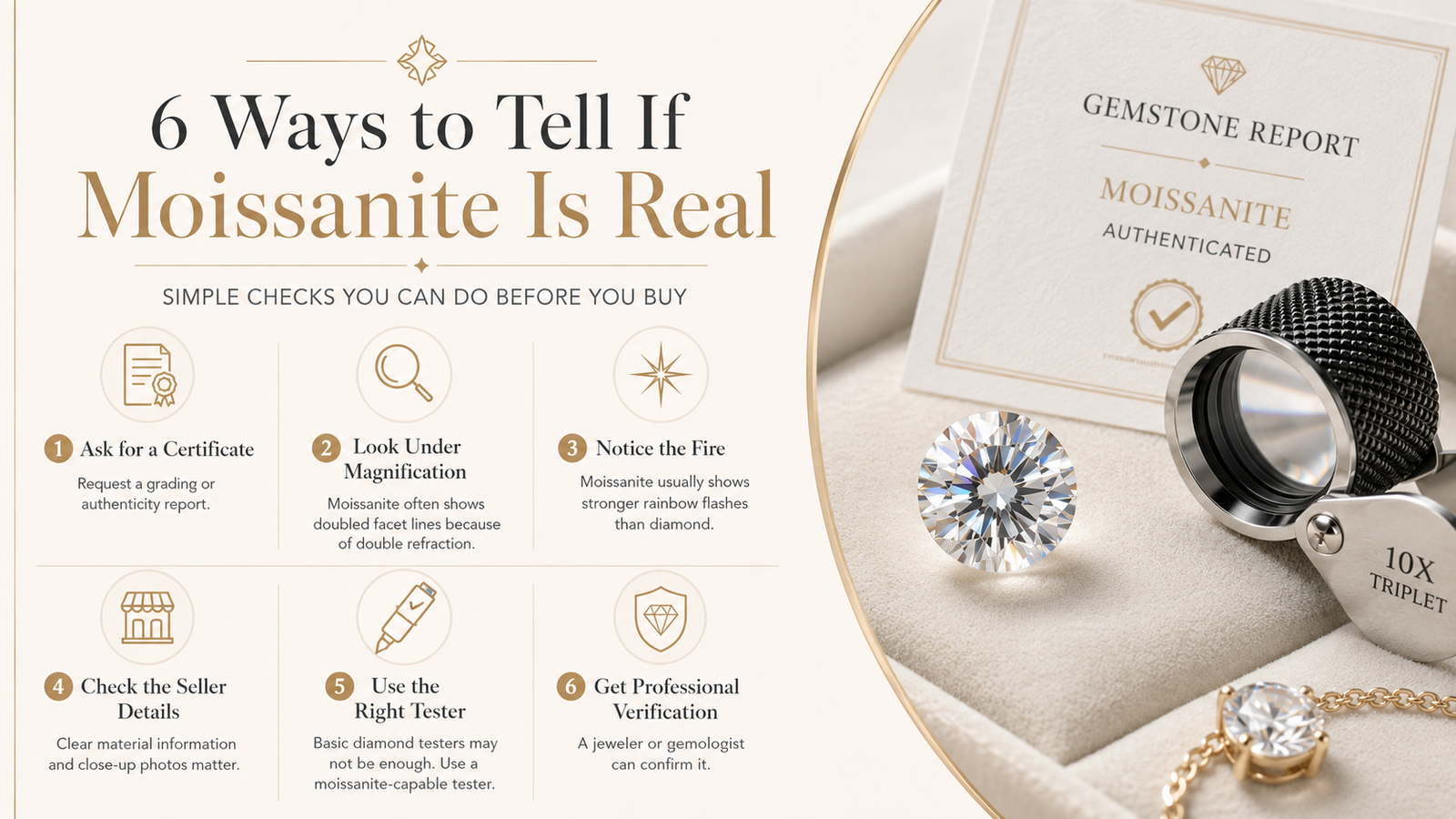
6 Ways to Tell If Moissanite Is Real
The following checks move from basic purchase research to professional
verification. The first five may help you identify inconsistencies, while the
final method provides the strongest level of confidence.
1
Check How the Seller Describes the Stone
Start with the product page, invoice and packaging. The gemstone should
be identified clearly as moissanite rather than described only with vague
expressions such as “diamond stone,” “diamond quality,” “diamond-like
crystal” or “luxury simulated stone.”
Look for specific information including:
The word moissanite in the product title or description
Stone shape and millimeter measurements
Equivalent carat appearance, if used
Stone color and clarity information
Metal type and hallmark
Close-up photographs and video
Return, refund and warranty terms
Clear disclosure does not prove the stone’s identity, but unclear or
inconsistent product information is an immediate warning sign.
2
Review the Certificate or Authenticity Report
Some moissanite jewelry is supplied with a manufacturer’s authenticity
card, grading document or stone report. Check whether the document identifies
the stone as moissanite and whether it includes a report number, measurements,
shape and identifiable issuer.
When an online verification system is available, enter the report number
on the issuer’s official website rather than using a link supplied through
an unknown message.
A certificate is supporting evidence—not automatic proof.
Printed cards, report numbers and gemstone inscriptions can be copied or
misrepresented. Compare the report with the actual stone and use another
verification method.
3
Inspect the Stone Under Magnification
A 10× jeweler’s loupe can reveal useful clues, particularly when the stone
is clean and viewed through the crown at a slight angle.
Moissanite is doubly refractive. Depending on the cut and viewing direction,
some facet junctions may appear doubled under magnification. Diamond is
singly refractive and normally shows single facet lines.
However, facet doubling is not always easy for an inexperienced observer
to recognize. Modern cutting styles, stone orientation, dirt and the setting
can make the effect difficult to see.
Magnification should therefore be treated as an identification clue rather
than a guaranteed home test.
4
Observe the Brilliance and Rainbow Fire
Moissanite has high dispersion and commonly produces vivid flashes of
rainbow color under focused lighting. Diamond usually presents a different
balance of white brilliance and colored fire.
For a basic visual comparison:
Clean the stone so oils and residue do not distort its appearance.
Observe it in indirect daylight.
Move it slowly beneath a small, bright light source.
Compare white reflections with colored flashes.
Strong rainbow fire may be consistent with moissanite, but it cannot prove
authenticity. Cut quality, lighting, stone size, camera processing and other
simulants can all affect the appearance.
5
Use a Moissanite-Capable Tester
A basic thermal conductivity tester is not enough because moissanite and
diamond both conduct heat efficiently. Some conventional diamond testers
may therefore give a positive diamond response when used on moissanite.
Use a multi-tester or professional device specifically designed to separate
diamond from moissanite. Follow the manufacturer’s calibration and testing
instructions and make sure:
The gemstone is clean and dry
The probe touches the stone rather than the metal setting
The tester is properly charged and calibrated
The stone is large enough for the device
Several readings are taken where appropriate
A tester result is more useful when combined with magnification, documents
and professional inspection.
6
Request Professional Verification
A qualified jeweler or gemologist can examine the gemstone with professional
optical and electronic instruments. This is the best option when the item
is expensive, the seller’s information is unclear or the results of home
checks do not agree.
Professional inspection can also examine the complete jewelry piece,
including:
The identity of the center and accent stones
The condition of prongs and settings
Metal hallmarks and construction
Possible coatings or treatments
Damage, chips, abrasions or loose stones
Visual Identification
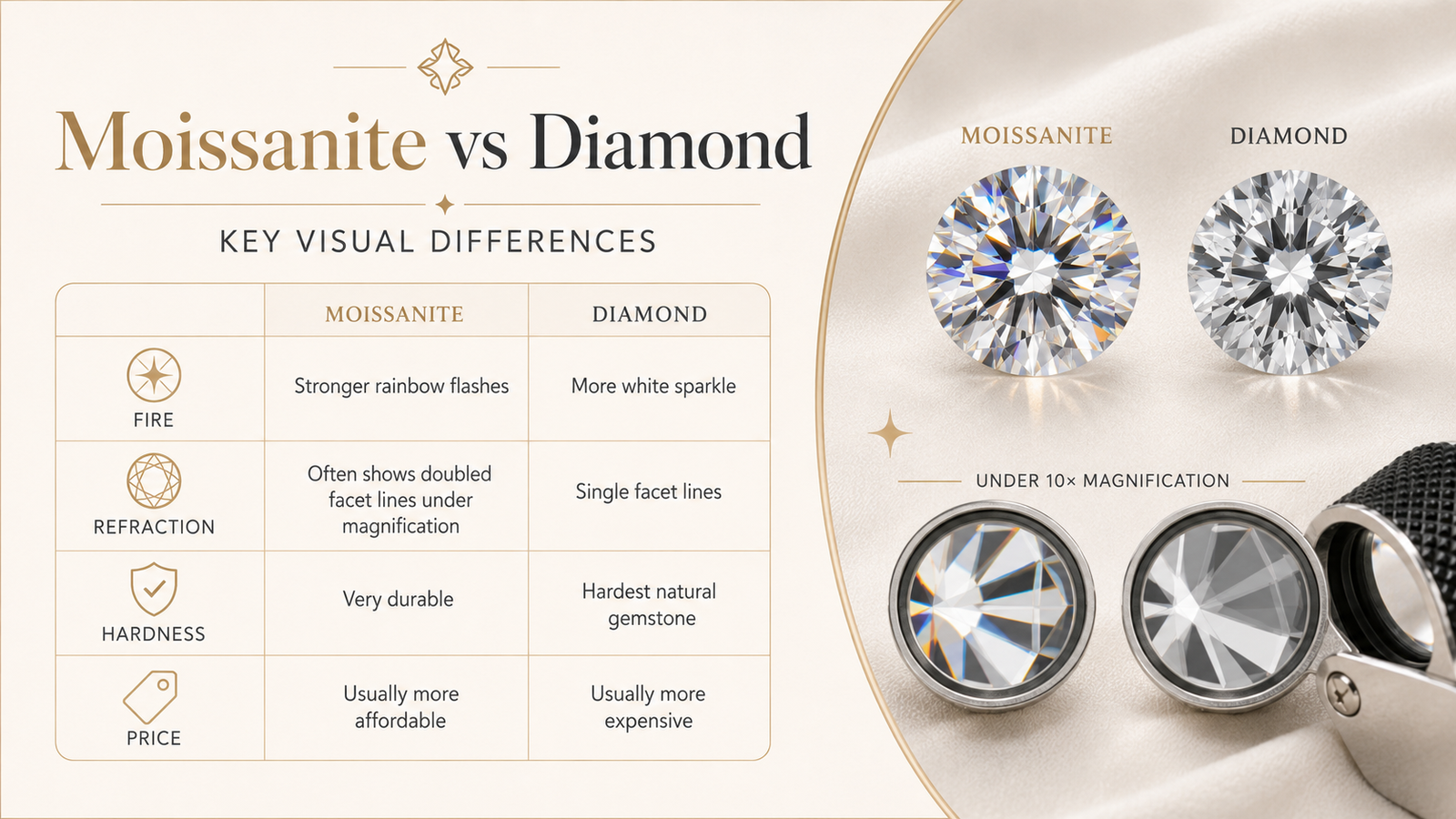
Moissanite vs Diamond: What Differences Can You See?
Moissanite and diamond can look similar at first glance, particularly in a
well-cut colorless round stone. Their optical properties are not identical,
however, and experienced observers may notice differences in fire and refraction.
Moissanite often displays stronger rainbow fire and may show doubled facet
junctions under magnification, while diamond is singly refractive.
Characteristic
Moissanite
Diamond
Material
Silicon carbide
Crystalline carbon
Typical jewelry origin
Laboratory-created
Mined or laboratory-grown
Refraction
Doubly refractive
Singly refractive
Visible fire
Often produces stronger rainbow flashes
Usually presents a different balance of white brilliance and fire
Thermal tester result
May register as diamond on a basic thermal tester
Normally registers as diamond
Relative price
Usually more accessible
Usually more expensive at comparable visual size
None of these visual comparisons should be used as the sole basis for identifying
an unknown gemstone. Read our complete
moissanite vs diamond guide
for a more detailed comparison of appearance, durability, price and everyday use.
Safe At-Home Review
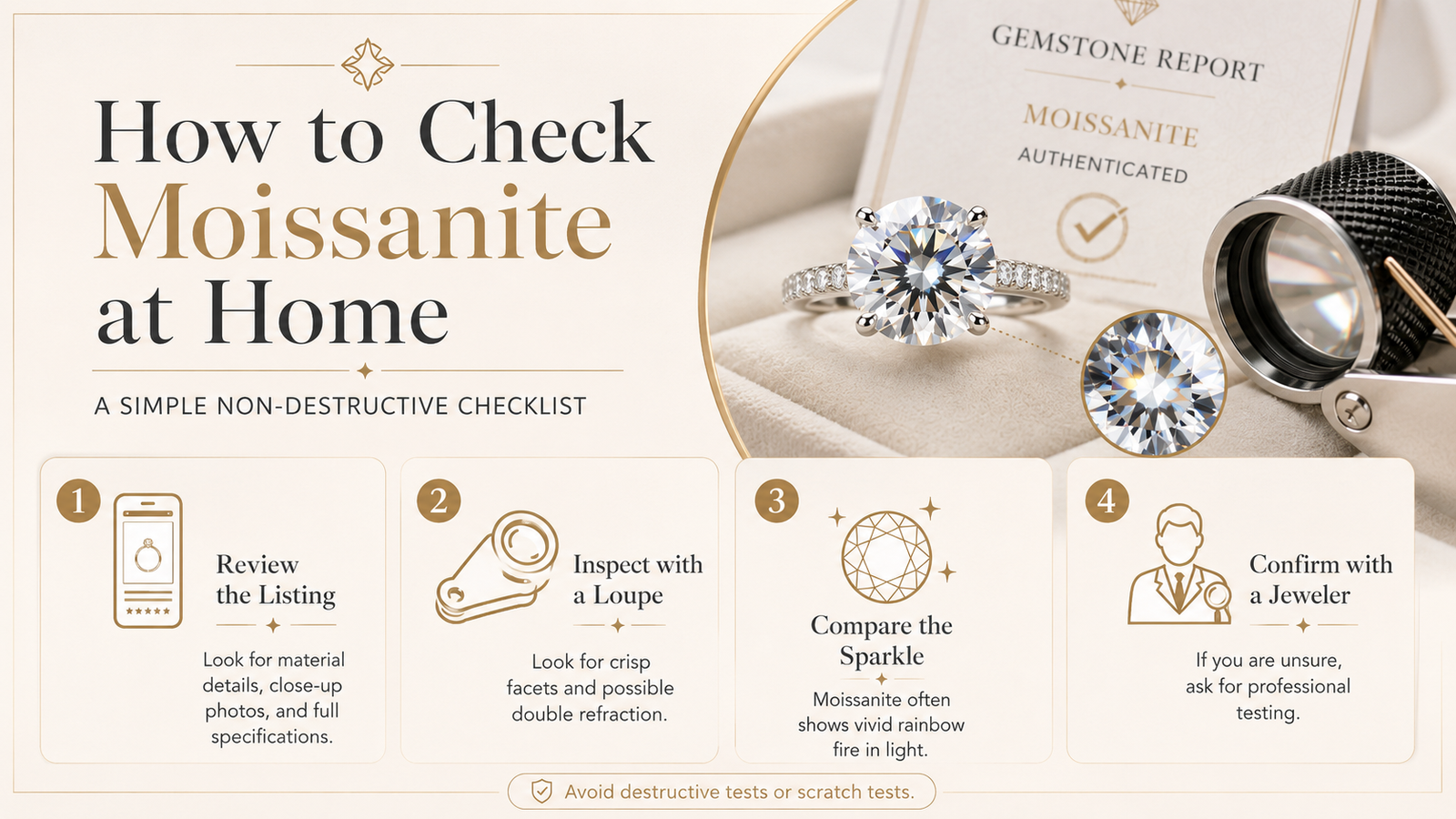
How to Check Moissanite at Home Without Damaging It
At-home inspection is most useful for identifying inconsistencies and deciding
whether professional testing is necessary. It should remain non-destructive.
Review the seller’s information, inspect the clean stone under magnification
and seek professional help when the result remains uncertain.
1
Clean the Gemstone First
Oil, soap and lotion can hide facet details and reduce visible brilliance.
Use warm water, mild soap and a soft brush when the setting is secure.
2
Review the Product Listing and Invoice
Confirm that the stone material, measurements, metal, return terms and
seller identity are consistent across the listing and purchase documents.
3
Use a Clean 10× Loupe
View the stone from several angles and look for crisp facet junctions,
possible facet doubling, damage, coatings or unusual surface wear.
4
Compare Different Lighting Conditions
Observe the stone in daylight and beneath a small direct light. Note its
white brilliance and colored flashes without assuming that fire alone
proves its identity.
5
Check the Supporting Report
Compare the listed shape, dimensions and report number with the gemstone
you received. Verify the issuing organization independently when possible.
6
Escalate Uncertain Results
When the seller information, optical clues and tester results conflict,
stop experimenting and arrange professional identification.
Not reliably when the device measures only thermal conductivity. Moissanite has
thermal properties that are similar enough to diamond that some conventional
testers may signal “diamond.”
A device designed to separate diamond and moissanite may evaluate additional
properties, such as electrical conductivity, or combine more than one testing
method. Even then, limitations can arise from:
Very small stones
Mounted stones surrounded by metal
Incorrect calibration
A dirty or wet gemstone surface
Insufficient probe contact
Coated or unusual materials
Low-quality or poorly maintained testing devices
Best practice: do not advertise a gemstone as confirmed
moissanite solely because a low-cost handheld tester produced one positive result.
Before You Purchase
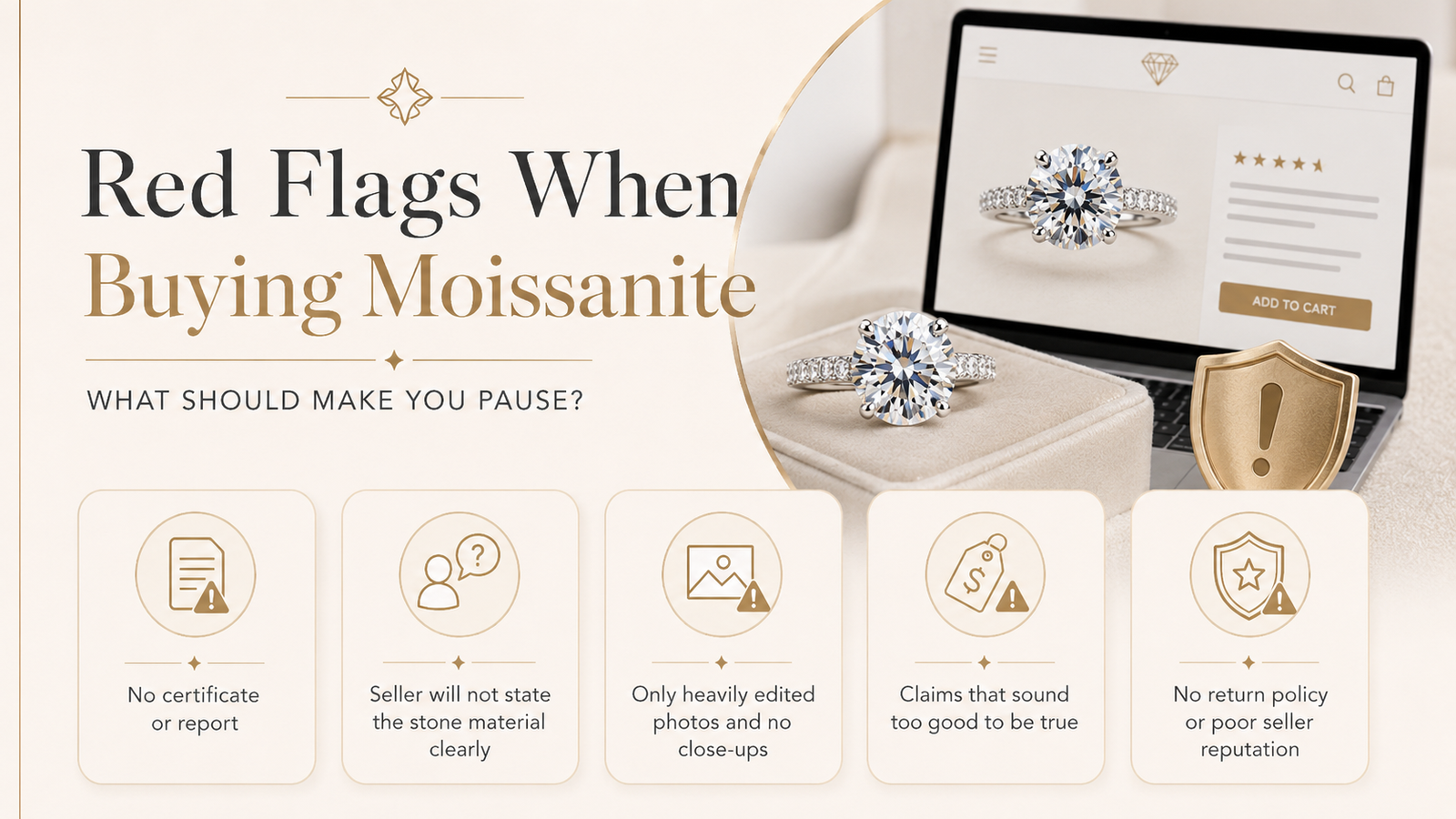
Red Flags When Buying Moissanite Online
A trustworthy seller should make it easy to understand what you are buying.
Pause before purchasing when important product or business information is missing.
Missing product details, unrealistic claims and weak customer protections
should make you investigate further before paying.
!
The Stone Material Is Not Clearly Named
The listing repeatedly says “diamond” or “diamond stone” but avoids stating
whether the item is moissanite, cubic zirconia, lab-grown diamond or another material.
!
The Seller Guarantees It Is a Diamond
Moissanite is a separate gemstone material. Marketing it as a mined or
laboratory-grown diamond is inaccurate.
!
Only Heavily Edited Images Are Available
No close-up video, side view, scale reference or ordinary-light photograph
is available to evaluate the actual product.
!
The Report Cannot Be Explained
The seller cannot identify the issuer, explain the report number or confirm
whether the document matches the stone being sold.
!
The Claims Are Unrealistic
Statements such as “completely scratch-proof,” “identical to diamond in every
way” or “guaranteed investment value” should be treated cautiously.
!
No Return or Dispute Process Exists
The seller provides no clear return address, refund conditions, customer
service channel or protected payment method.
In the United States, jewelry sellers are expected to describe gemstone products
truthfully and avoid creating the impression that a simulated stone is a mined
or laboratory-grown diamond.
Most Reliable Approach
The Best Ways to Verify Moissanite Professionally
The strongest verification combines supporting documents, suitable testing
equipment and examination by a qualified professional.
01
Document Review
A professional can compare the report, measurements, inscription and stone
with the jewelry being examined. Documents are more useful when the issuer
and report number can be independently verified.
02
Gemological Instruments
A jeweler or gemologist may use magnification, polarized light, thermal and
electrical testing or other instruments appropriate to the stone and setting.
03
Independent Laboratory Report
For higher-value jewelry or disputed transactions, an independent laboratory
identification report provides stronger documentation than a seller-created card.
Professional verification is especially worthwhile when:
The item has a significant purchase price.
The stone was bought secondhand or from an unknown seller.
The report or inscription appears inconsistent.
A tester gives conflicting results.
The seller described the item as diamond and moissanite at different times.
You need written identification for insurance, resale or a dispute.
Protect Your Jewelry
Tests You Should Not Use to Identify Moissanite
Online videos often recommend improvised tests that are unreliable, destructive
or dangerous. Avoid testing methods that may damage the gemstone, setting or metal.
×
Scratch Tests
Do not scratch glass, metal, another gemstone or the jewelry itself.
Hardness testing requires controlled conditions and trained interpretation.
×
Open-Flame or Heat Tests
Heat can damage metal, solder, plating, treatments and nearby accent stones.
It also creates a safety hazard.
×
Fog Tests
Condensation behavior depends on temperature, surface cleanliness and
humidity. It cannot reliably identify moissanite.
×
Water or Newspaper Tests
Informal transparency and refraction demonstrations are influenced by the
cut, mounting and viewing angle and should not be treated as identification.
×
UV Light Alone
Fluorescence varies among gemstones and individual stones. A UV response
or lack of response is not conclusive.
×
Visual Fire Alone
Strong rainbow flashes are associated with moissanite, but lighting,
cutting and other gemstone materials can produce misleading results.
Buyer Checklist
What to Check Before Ordering Moissanite Jewelry
✓
The listing clearly identifies the stone as moissanite.
✓
The product includes realistic close-up photos or video.
✓
The stone shape, measurements and setting are stated.
✓
The metal type and hallmark are described accurately.
✓
The certificate issuer and report number can be explained.
✓
The seller has clear contact, shipping and return policies.
✓
The payment method provides appropriate buyer protection.
✓
Professional verification is available for higher-value purchases.
Frequently Asked Questions
Frequently Asked Questions About Real Moissanite
How can I tell if moissanite is real at home?
Review the seller’s description and report, clean the stone, inspect it under
10× magnification and observe its light performance. A moissanite-capable tester
can add another clue, but professional verification is more dependable.
Will real moissanite pass a diamond tester?
It may pass a basic thermal conductivity diamond tester because moissanite also
conducts heat efficiently. Use equipment designed to distinguish diamond from
moissanite rather than relying on a thermal tester alone.
Does rainbow sparkle prove a stone is moissanite?
No. Moissanite often displays strong rainbow fire, but lighting, cutting,
photography and other gemstone materials can produce similar visual effects.
Does a certificate guarantee that moissanite is real?
A certificate or authenticity card supports the seller’s description, but it
should be checked against the actual stone. Verify the issuer and report number
and use another identification method when possible.
Is laboratory-created moissanite real moissanite?
Yes. Commercial jewelry moissanite is normally laboratory-created silicon
carbide. “Laboratory-created” describes its origin; it does not mean the
material is cubic zirconia or glass.
Can a jeweler tell moissanite from diamond?
A qualified jeweler or gemologist with suitable training and instruments can
normally distinguish moissanite from diamond and other common simulants.
Can fake moissanite certificates exist?
Printed documents, report numbers and inscriptions can be copied or misused.
Treat a certificate as one part of the evidence rather than the only proof.
Is cubic zirconia the same as moissanite?
No. Cubic zirconia and moissanite are different materials with different optical,
physical and durability properties.
Should I perform a scratch test on moissanite?
No. Scratch tests can damage the gemstone, metal or another surface and do not
provide dependable identification under uncontrolled home conditions.
Final Takeaway
Use Several Checks Before Deciding a Moissanite Stone Is Real
The most reliable answer to how to tell if moissanite is real comes from combining
evidence. Begin with accurate seller disclosure and supporting documents, then
examine the clean stone under magnification and use suitable testing equipment.
Rainbow fire, a certificate or a positive thermal diamond-tester result may provide
useful clues, but none should be treated as complete proof on its own. For an
expensive, secondhand or disputed item, request professional gemological verification.
Explore Sunshine Jewelry
Discover moissanite rings, necklaces, earrings and bracelets with clear
product information and elegant everyday designs.
Choose a women's sunshine diamond ring gift by checking her style, exact ring size, verified listing details, daily routine, and current store policies.