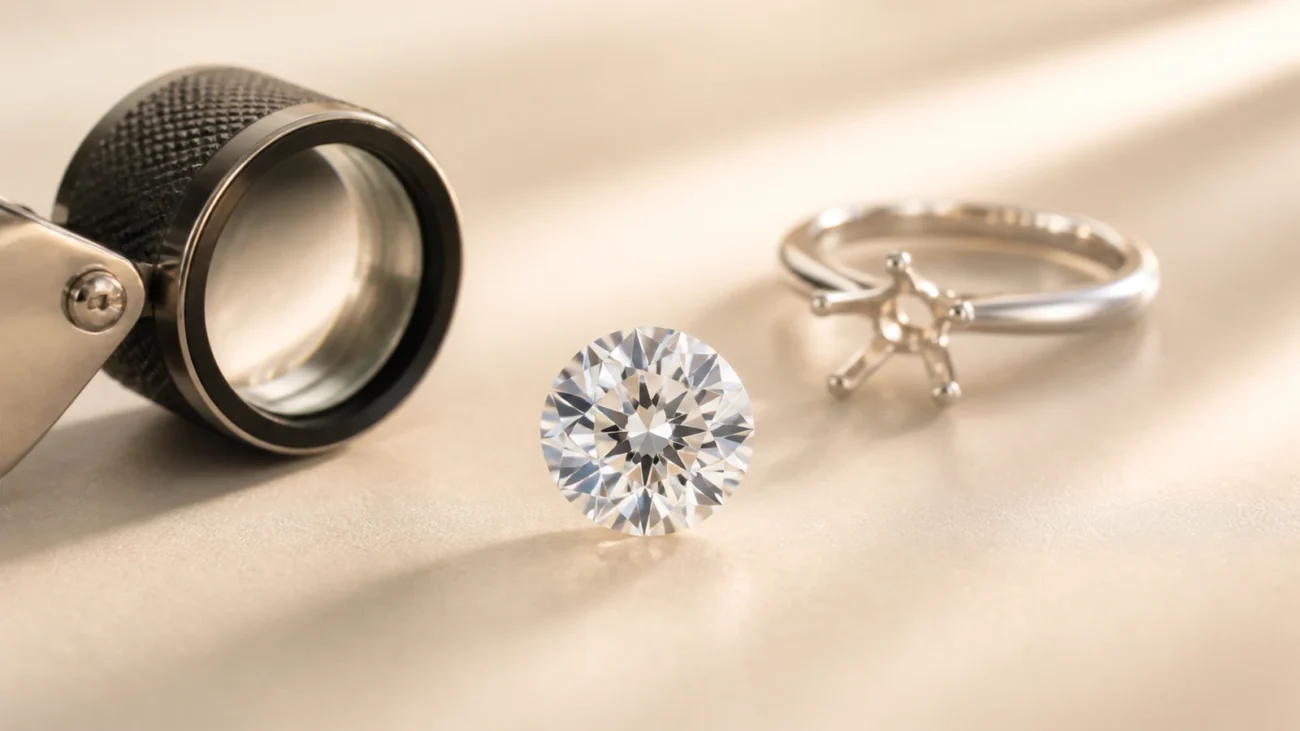
A practical guide to moissanite color, clarity and stone selection.
Moissanite color and clarity can influence how bright, white, clean and visually balanced a gemstone appears—but choosing the highest-looking grade is not always necessary to get a beautiful stone.
For most buyers, the best moissanite is the stone that looks bright and eye-clean in real life, works well with the chosen metal and setting, and offers the right balance between appearance and budget.
In this guide, we explain common moissanite color descriptions such as D–F colorless and G–H near-colorless, clarify how terms such as VVS and VS are used in the jewelry market, and show how lighting, stone size, cut shape and metal can change what you actually see.
Quick Answer
For a bright icy-white appearance, many buyers prefer colorless moissanite in the D–F range. Near-colorless stones can offer excellent visual value and may show only subtle warmth in normal wear. For clarity, prioritize an eye-clean stone rather than paying only for a higher label. Always compare the actual stone, its dimensions, cut, lighting and finished setting.
Important Grading Note:
D–Z color grades and FL–I3 clarity grades originate from diamond grading systems. Some moissanite brands and sellers use similar terminology for consumer comparison, but moissanite grading practices are not completely standardized across every manufacturer or laboratory. Always check how the individual seller defines its grades.
What Does Moissanite Color Mean?
When jewelers talk about moissanite color, they are usually describing how colorless—or how warm—the stone appears.
A highly colorless stone has a bright, white visual appearance. A warmer stone may show subtle yellow, cream, gray or other undertones depending on the material, lighting, cut and viewing angle.
The distinction can be extremely subtle in normal jewelry. A gemstone viewed loose against a white grading background may appear different once it is mounted in a ring and worn on the hand.
This is why color should never be evaluated in isolation.
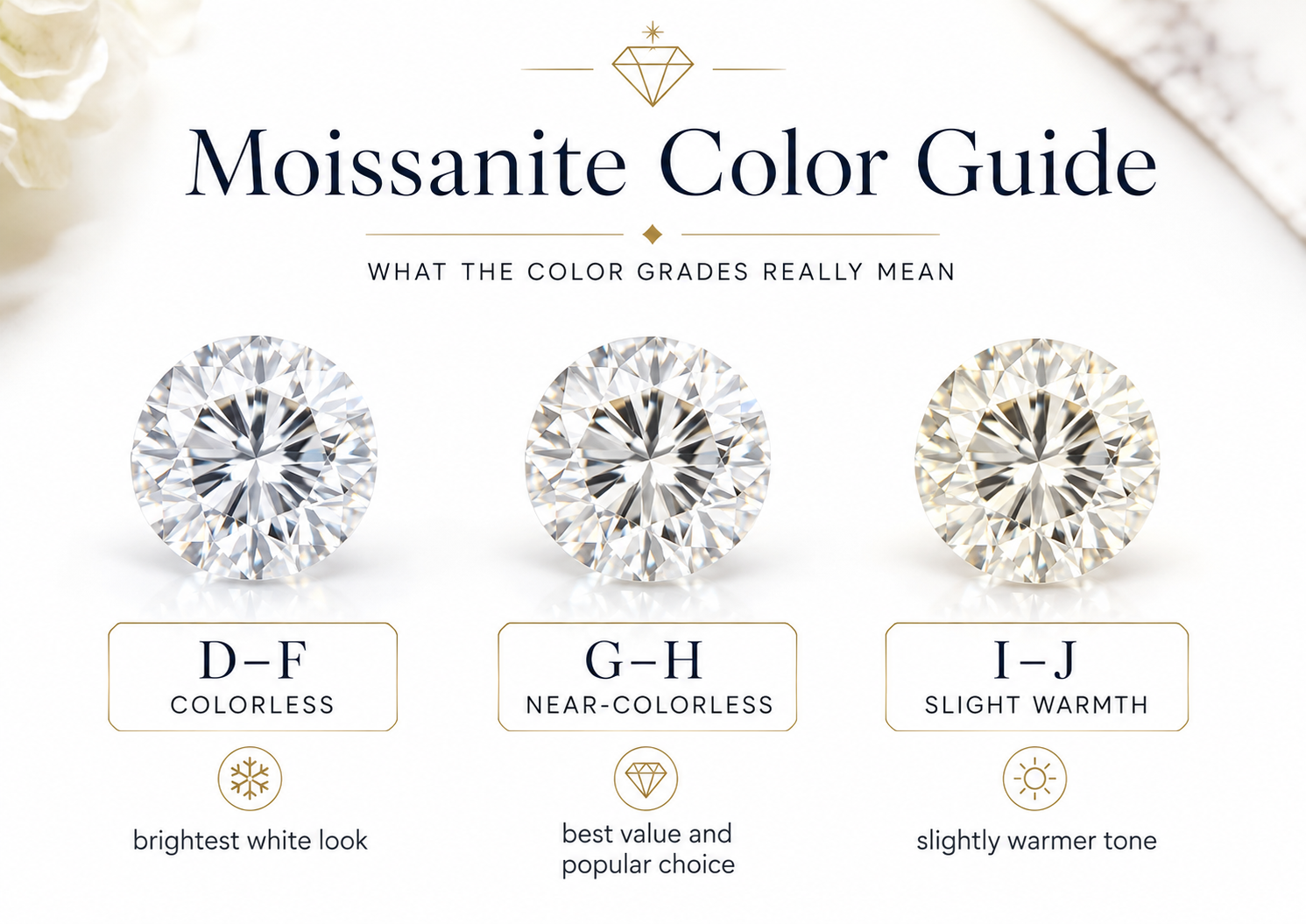
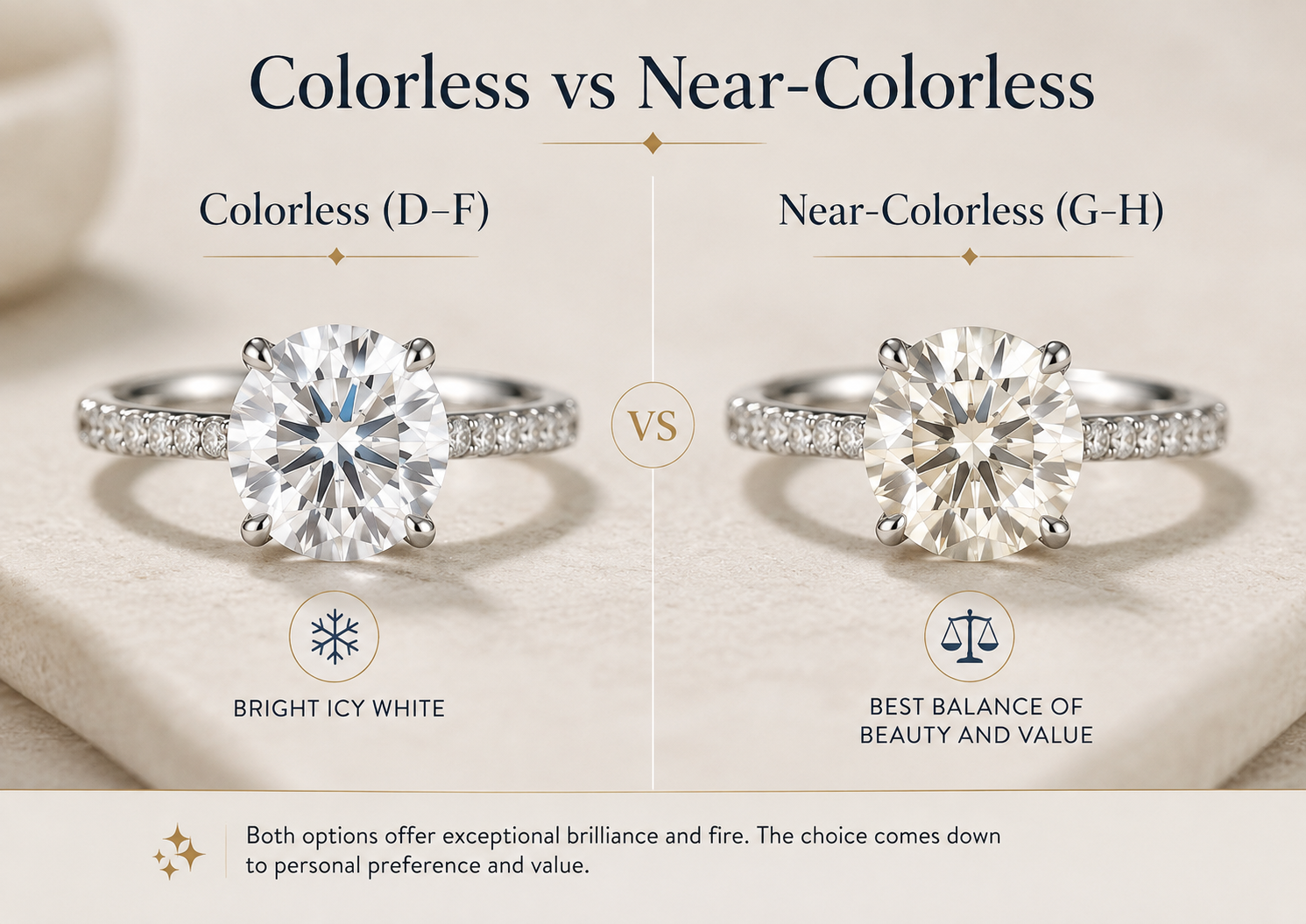
Simplified visual comparison of common moissanite color descriptions. Seller grading categories may vary.
Many sellers describe white moissanite using terminology similar to the familiar diamond D–Z color scale.
Common Description
General Appearance
Who May Prefer It
D–F / Colorless
Bright, cool and icy-white appearance
Buyers who prioritize the whitest visual look
G–H / Near Colorless
Mostly white face-up with possible subtle warmth
Buyers seeking a balance between appearance and value
I–J and warmer ranges
Warmth may become more noticeable in certain lighting or settings
Buyers who enjoy softer tones or warmer metal settings
These groupings are useful for shopping, but they should not be interpreted as one universal moissanite laboratory standard.
For example, Charles & Colvard describes its own moissanite offerings using categories including D–E–F colorless, G–H–I near-colorless and J–K faint color. You can read its grading explanation in
Making the Grade.
D–F is commonly marketed as the colorless or premium white range. These stones are designed to produce a clean, icy appearance and often pair especially well with white metals such as sterling silver, white gold and platinum.
Choose this direction when:
You strongly prefer a crisp, white gemstone.
You are using white metal and want minimal visible warmth.
The ring has a larger center stone where body tone may be easier to notice.
You are comfortable paying more when a seller charges a premium for higher color.
G–H Near-Colorless Moissanite
Near-colorless stones may still look extremely white once set in jewelry. Small differences are often difficult to notice without a direct side-by-side comparison under controlled lighting.
This range can be particularly attractive for buyers who care more about the complete ring than obtaining the highest possible color label.
Practical Buying Rule:
Do not assume that a one-letter grade difference will produce an obvious real-world difference. Compare actual photographs and videos of the stone whenever possible.
Colorless vs Near-Colorless Moissanite: Which Should You Choose?
Colorless and near-colorless stones can both appear bright and beautiful once mounted.
Neither option is automatically better.
Colorless moissanite is the logical choice for someone who specifically wants the coolest and whitest visual appearance. Near-colorless moissanite can be the more practical choice when the difference is difficult to detect in normal wear and the buyer would rather allocate more budget to the center-stone size, ring setting or metal.
Clarity describes the visibility of internal characteristics and surface features that may affect how clean a gemstone appears.
Inclusions are characteristics located within the stone, while blemishes are surface-related characteristics. Many are microscopic and impossible to notice during normal wear.
For consumers, the most practical question is usually not:
“What is the highest clarity grade?”
The more useful question is:
“Does the stone look clean to the naked eye?”
This is often called being eye-clean.
Understanding Moissanite Clarity Grades
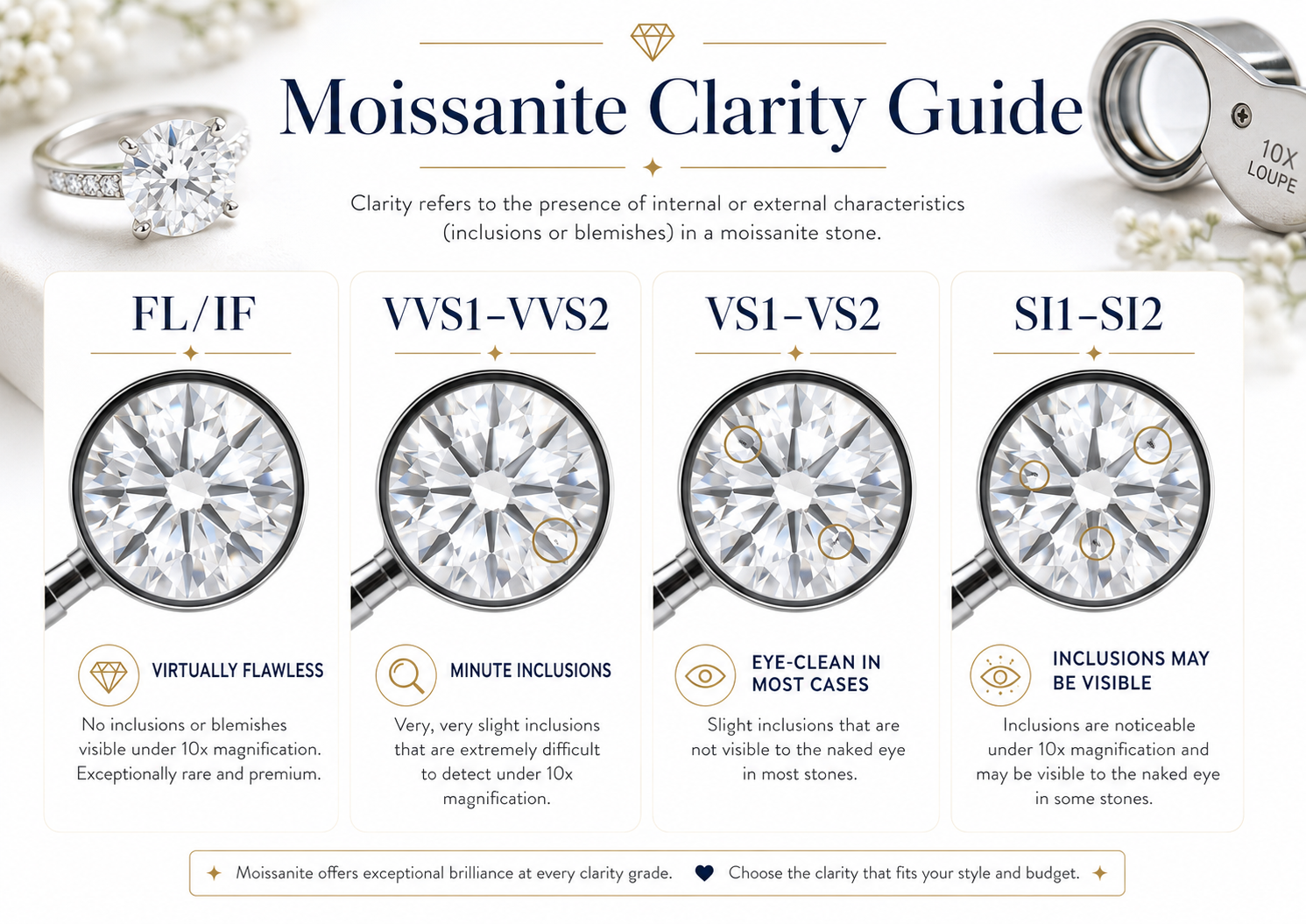
Diamond-style clarity terminology is sometimes used descriptively for moissanite; grading practices vary by seller.
You may encounter labels such as FL, IF, VVS1, VVS2, VS1, VS2, SI1 and SI2 when shopping for moissanite.
These terms come from the established diamond clarity vocabulary. GIA's formal clarity scale is specifically a diamond grading system, so buyers should not assume that every moissanite labeled “VVS” has been independently graded using identical laboratory procedures.
Premium terminology; not necessary for most buyers
VVS
Very small characteristics that are difficult to detect under magnification
Often far cleaner than required for normal viewing
VS
Minor characteristics visible primarily under magnification
Can provide excellent eye-clean value
SI
Characteristics may be easier to locate under magnification
Inspect photographs and confirm whether the stone remains eye-clean
Is VVS Moissanite Better Than VS?
On paper, a VVS-labelled stone describes fewer or less-visible characteristics than a VS-labelled stone. In practical jewelry use, however, both may look equally clean without magnification.
If you cannot see an inclusion with the naked eye, paying substantially more solely for a higher clarity label may provide little visible benefit.
Should You Buy Flawless Moissanite?
There is usually no need to chase a “flawless” label simply because it sounds best.
Do Stone Size and Shape Affect How Color and Clarity Look?
Yes. The same color or clarity description can look different depending on the stone's size, cut style and proportions.
Larger Stones Can Reveal More
As the face-up size increases, there is simply more gemstone to observe. Slight warmth, facet patterns and internal characteristics may therefore become easier to notice in some larger stones.
This does not mean that a large moissanite automatically requires the highest color and clarity grade. It means that buyers should rely more heavily on actual visual inspection as stone size increases.
Brilliant Cuts Can Hide Minor Characteristics
Round, oval, cushion, pear and other brilliant-style cuts contain many facets that create lively reflections. This optical activity can make tiny internal characteristics difficult to identify with the naked eye.
Step Cuts Can Make Clarity More Noticeable
Emerald and Asscher-style cuts use broader, more open step facets. Their cleaner visual pattern may make internal characteristics or subtle body color easier to observe.
For this reason, shoppers choosing a large emerald-cut moissanite may want to inspect clarity and color more carefully than someone choosing a small brilliant round stone.
Lighting and Ring Metal Can Change How Moissanite Looks
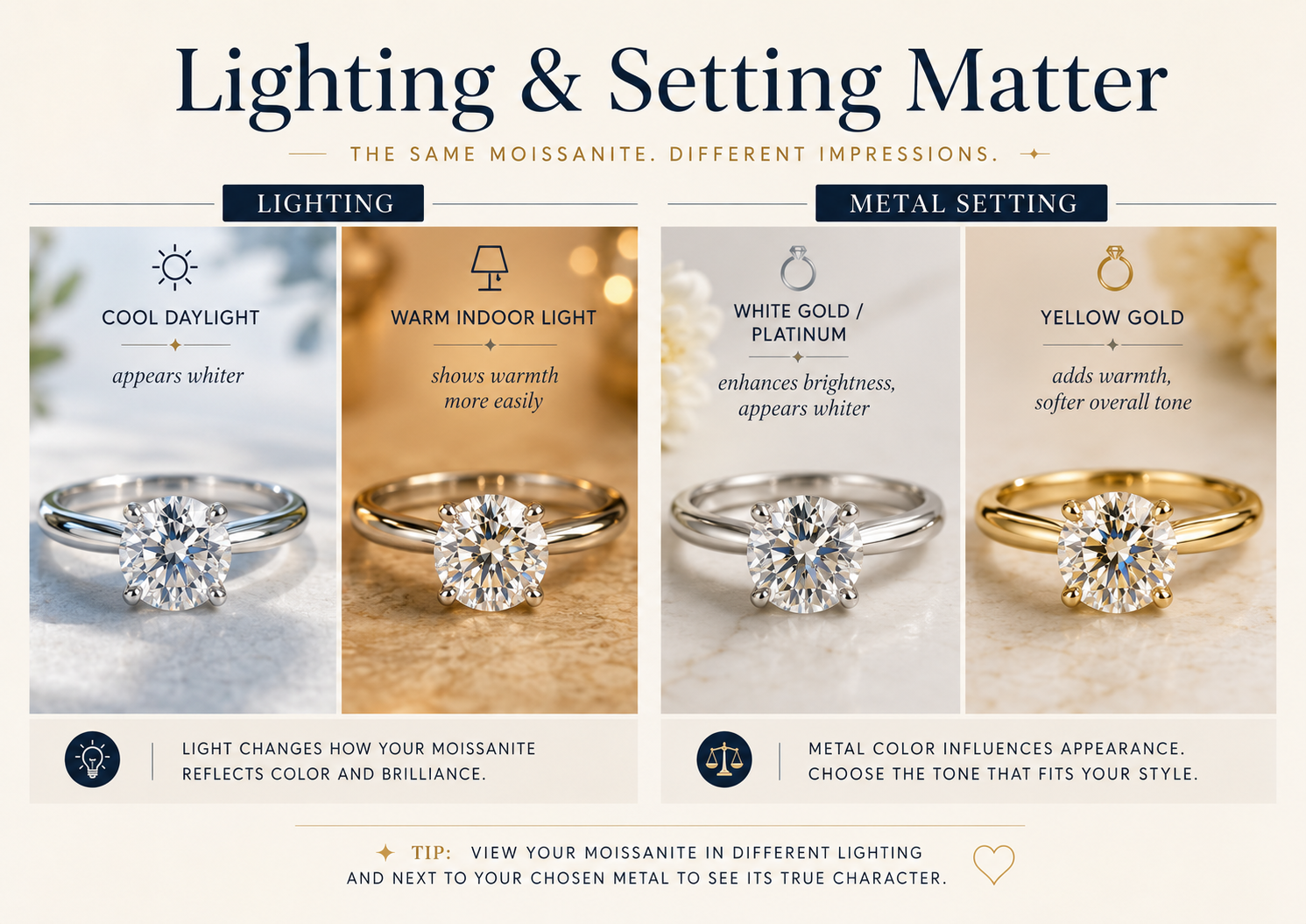
Lighting and surrounding metal influence perceived color without changing the gemstone's actual material.
A gemstone does not exist visually in isolation. The environment around it strongly influences what the eye perceives.
Cool Daylight
Neutral or cooler daylight often makes white gemstones look crisp and bright. This is one of the most useful lighting conditions for comparing subtle color differences.
Warm Indoor Lighting
Warm LEDs, lamps and restaurant lighting can add yellow or amber reflections to both the gemstone and metal. A completely colorless stone can therefore appear warmer in one room than another.
White Gold, Platinum and Silver
White metals create a cool visual frame around the stone. This can emphasize whiteness, but it can also make subtle warmth in the gemstone easier to notice through contrast.
Yellow and Rose Gold
Warm metals can make a slightly warm gemstone feel harmonious rather than obviously tinted. Prongs, baskets and reflections from the metal can contribute to the finished appearance.
Color and clarity contribute to overall appearance, but cut quality and facet execution have a major influence on how a gemstone interacts with light.
A high-color stone with poor proportions may look less lively than a well-cut stone with a slightly lower color description.
Likewise, microscopic clarity characteristics that are invisible to the naked eye may have almost no noticeable effect on everyday sparkle.
The Best Buying Principle
Prioritize the complete visual performance of the stone instead of chasing the highest possible number or letter on a specification sheet.
What Is the Best Moissanite Color and Clarity Combination?
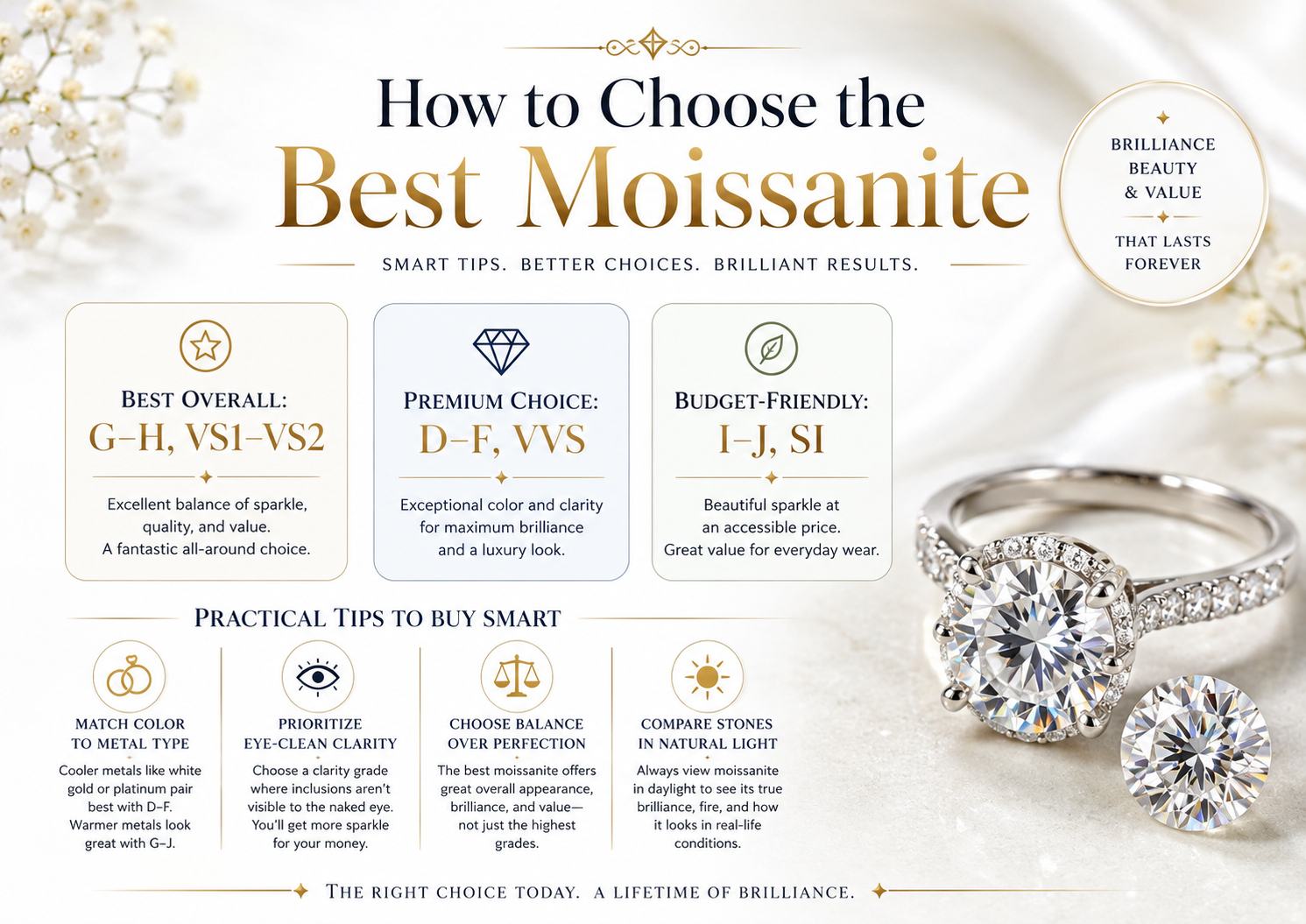
The best choice balances visible beauty, setting, lifestyle and budget rather than relying on grade labels alone.
There is no single combination that is best for every buyer, but the following framework is useful.
Best for an Icy-White Premium Look
Consider:
D–F color + a very clean, eye-clean stone
This combination works especially well when:
the center stone is large;
the setting is white gold, platinum or silver;
maximum whiteness is personally important;
budget is secondary to specification preference.
Best Balance of Beauty and Value
Consider:
Near-colorless + eye-clean clarity
For many buyers, this can provide the strongest practical balance. The stone may appear extremely white once mounted while allowing more budget for size, setting or metal.
Best for Warm Gold Settings
A slightly warmer stone can work beautifully in yellow or rose gold because the entire piece already has a warmer color palette.
Do not automatically pay more for a completely icy-white center if the finished design intentionally uses warm metal.
How Color and Clarity Affect Moissanite Price
Higher advertised grades can increase price, but color and clarity are only part of the cost.
For independent gemstone background, the
American Gem Society
also explains the composition and laboratory-created origin of modern jewelry-grade moissanite.
Frequently Asked Questions About Moissanite Color and Clarity
What is the best color grade for moissanite?
There is no universal best grade. D–F is commonly preferred for an icy-white appearance, while near-colorless stones can provide excellent visual value. The ideal choice depends on the actual stone, setting, metal and personal preference.
Is D color moissanite worth it?
It can be worth considering if maximum colorlessness is important to you, especially for a larger stone in a white-metal setting. If the visual difference between grades is difficult to detect, a lower-priced near-colorless option may provide better value.
Is G-H moissanite yellow?
A near-colorless stone should not automatically look yellow. Subtle warmth may be visible under certain lighting, in larger stones or during side-by-side comparisons, but many near-colorless stones appear very white in finished jewelry.
What is VVS moissanite?
VVS terminology generally describes extremely small clarity characteristics that are difficult to see under magnification. Because moissanite grading systems vary between sellers, check how the specific manufacturer defines the term.
Is VVS better than VS moissanite?
VVS indicates a higher descriptive clarity level, but a good VS stone may look equally clean to the naked eye. Eye-clean appearance and overall cut quality are often more meaningful to buyers than microscopic differences.
Does moissanite clarity affect sparkle?
Severe or highly visible characteristics can influence appearance, but microscopic inclusions may have little practical effect. Cut quality, facet execution, cleanliness and lighting can have a greater visible impact on sparkle.
Does moissanite look warmer in yellow gold?
Yellow gold can reflect warm tones into and around the gemstone, changing its perceived appearance. This does not change the stone's actual material or grade.
Does a larger moissanite need a higher color grade?
Not necessarily, although slight warmth may be easier to observe in some larger stones. Compare the actual stone rather than choosing solely by a grade label.
Are moissanite color and clarity grades standardized?
Not to the same extent as GIA diamond grading. Different moissanite manufacturers and sellers may use different terminology or thresholds, so buyers should review the seller's grading definitions and actual stone images.
Should I choose color or clarity first?
Start by making sure the stone is eye-clean. Then choose the color appearance that works with your preferred metal, size and budget. After both are acceptable, focus on cut, proportions and setting quality.
Final Verdict: What Moissanite Color and Clarity Should You Buy?
The best moissanite is not automatically the stone with the highest color and clarity labels.
For most buyers, the smartest approach is to choose a stone that:
looks clean to the naked eye;
has the color appearance you genuinely prefer;
is well cut and symmetrical;
matches the chosen metal and setting;
has appropriate dimensions for the jewelry;
comes from a seller that clearly discloses its specifications.
If you want the coolest and whitest appearance, look toward a colorless stone. If you want excellent visual quality while controlling your budget, near-colorless and eye-clean options can be especially compelling.
Buy what looks beautiful in real life—not simply what looks best on a grading label.
Grading note: The GIA color and clarity scales referenced above are formal diamond grading systems. They are included because similar terminology is frequently used in moissanite marketing and comparison. Individual moissanite manufacturers may use different grading systems, definitions or quality standards.
A practical guide to choosing and styling sapphire blue accessories, including jewelry types, metal and outfit pairings, product-label checks, care, and FAQs.