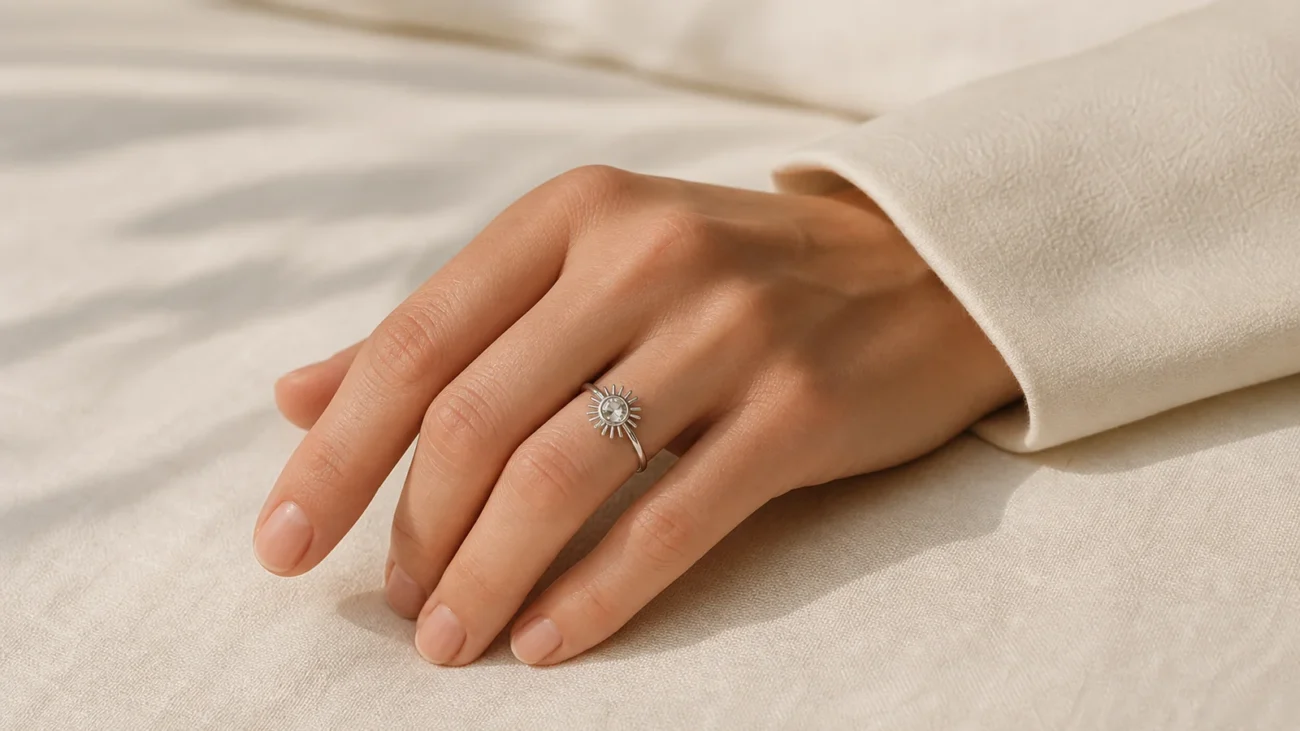
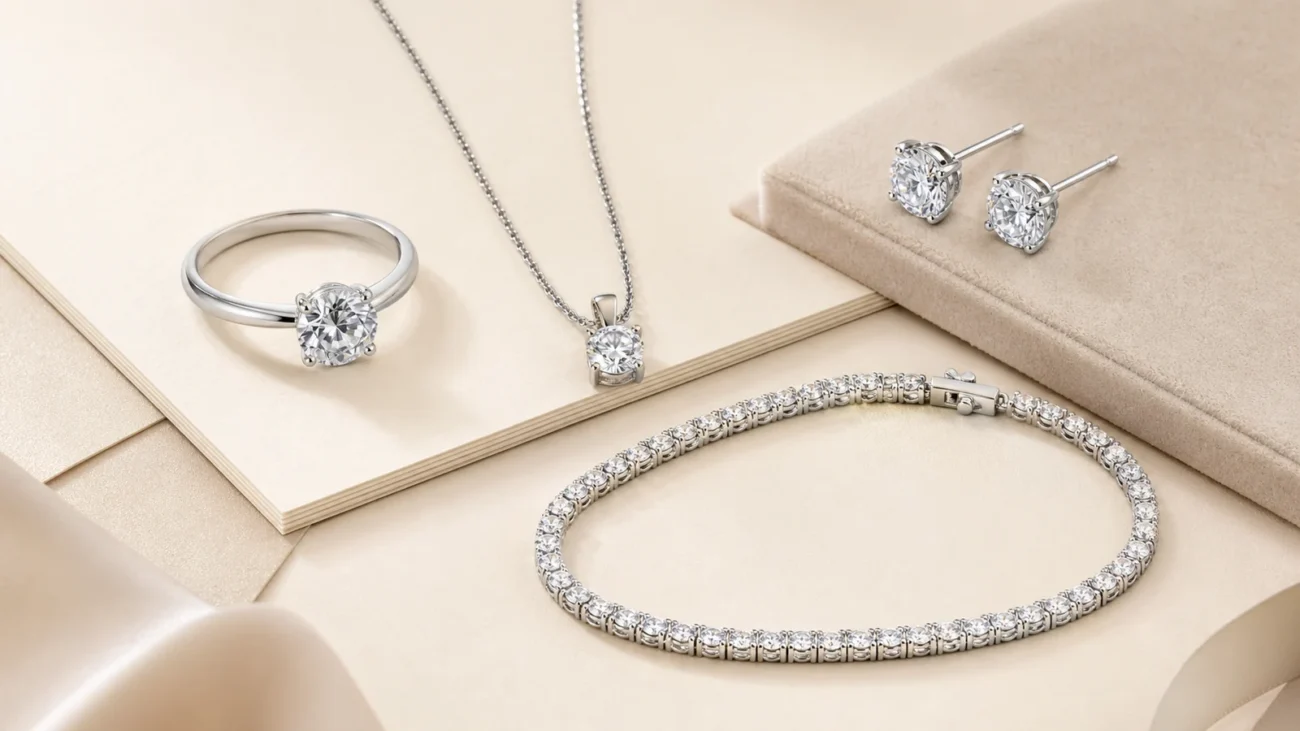
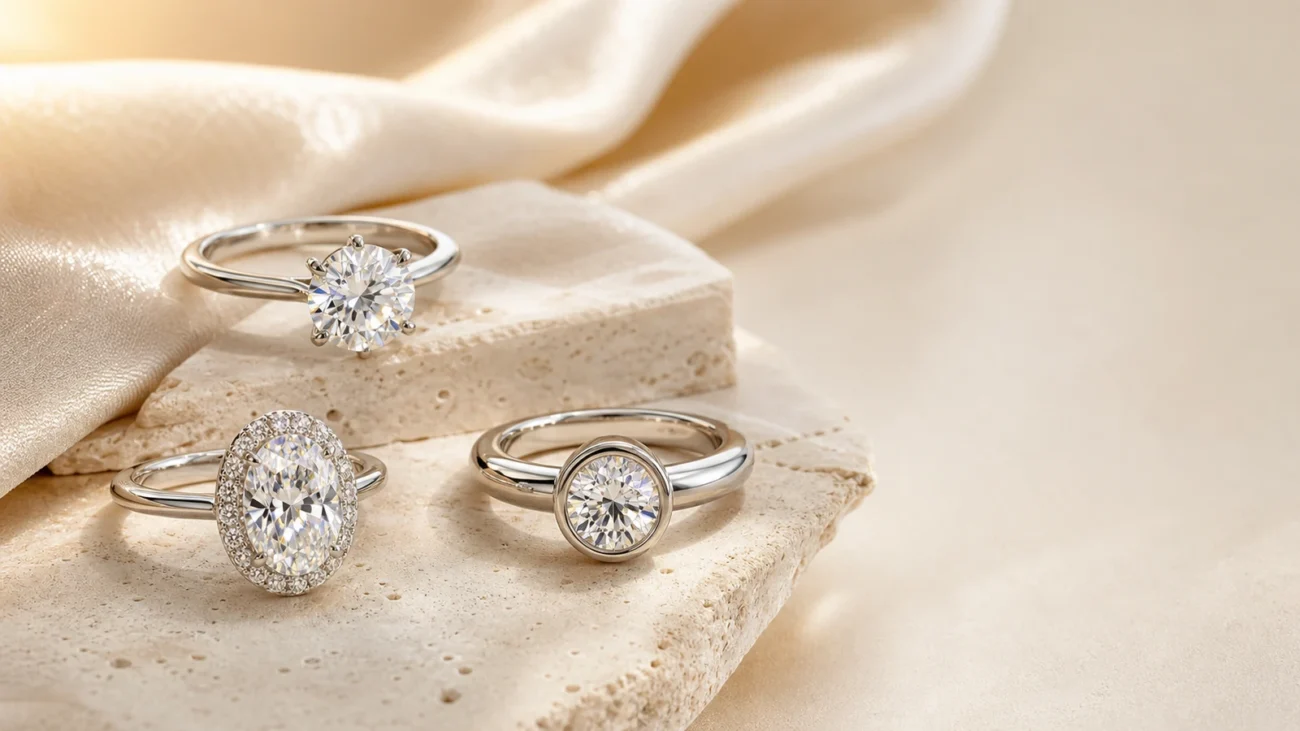
To judge whether a women’s sunshine diamond ring will look proportionate on your hand, compare the full sunburst width with your finger width, then check the band width, setting height, and ring size separately. A balanced choice is not one universal diameter. It is a ring whose face-up coverage, side profile, and comfort match your hand, preferred finger, and daily movement.
Ring size tells you whether the band fits around the finger.
Motif width tells you how much of the finger the sunshine design covers from the top.
Setting height tells you how far the design rises above the hand.
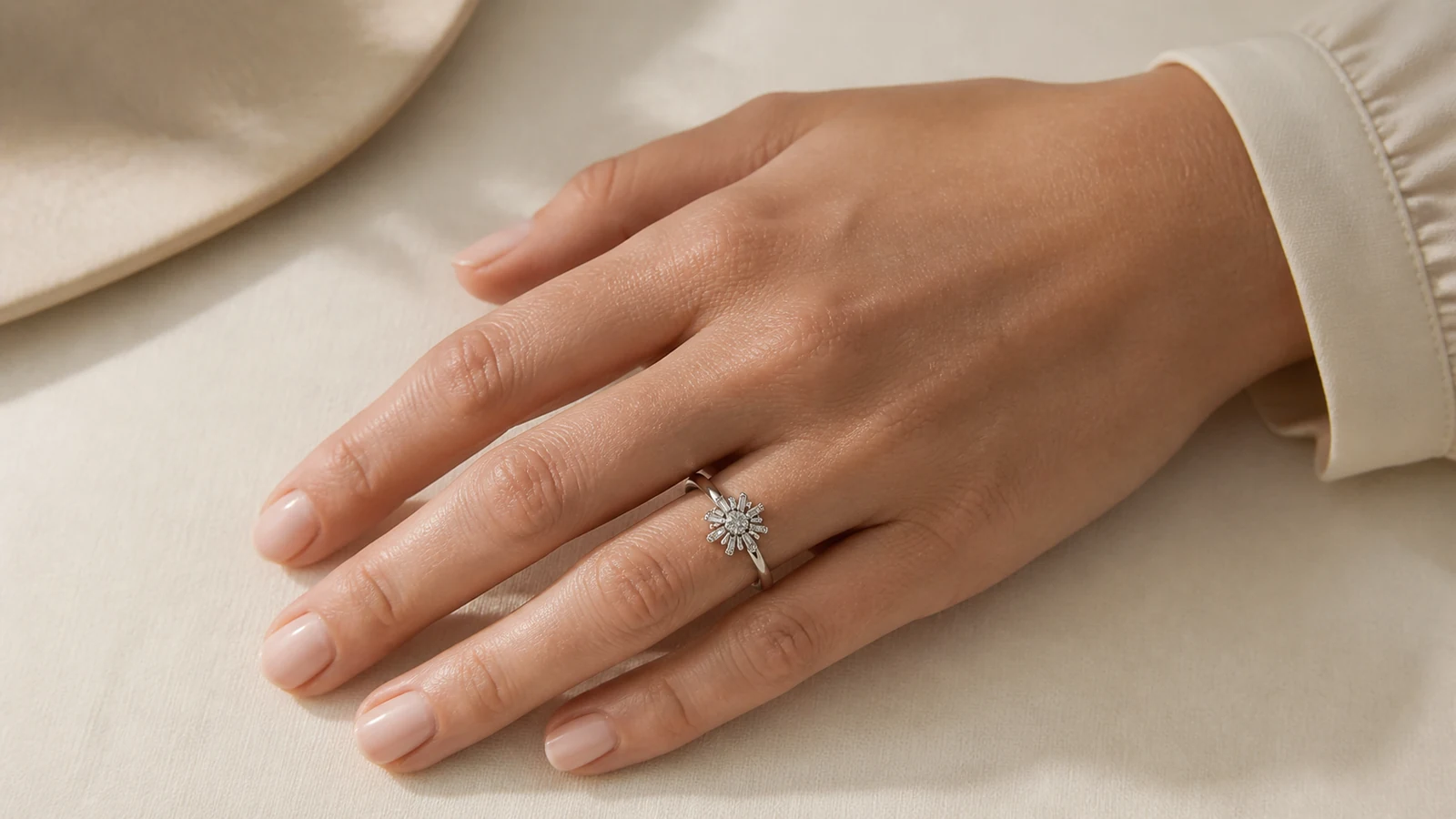
Real hand photos are useful only when the ring measurements and model context are also available.
“Sunshine diamond ring” is a search phrase, not a standardized jewelry category or proof of gemstone identity. A radiant ring can use diamond, moissanite, cubic zirconia, crystal, or another material. This guide discusses visible proportion. Confirm every stone, metal, finish, measurement, and care detail in the live product specifications.
What Determines the Proportion of a Sunshine Ring?
A sunshine ring usually creates its visual size through a central element plus rays, surrounding stones, openwork, or sculpted metal. That means its overall face-up diameter may be much wider than the center stone alone. Two rings with similarly sized centers can cover very different amounts of a finger when one has short restrained rays and the other has a broad sunburst.
For proportion decisions, look at the complete outline from ray tip to ray tip. Also note whether the outline is circular, oval, irregular, or asymmetrical. A circular design tends to create width in every direction. An elongated or directional sun motif can distribute attention along the finger instead. Neither is automatically more flattering; the visual effect depends on the wearer and the intended level of impact.
The broader Sunshine rings for women guide explains how sun motifs, sunbursts, halos, and clusters differ. Here, the focus is narrower: how their complete dimensions relate to the hand.
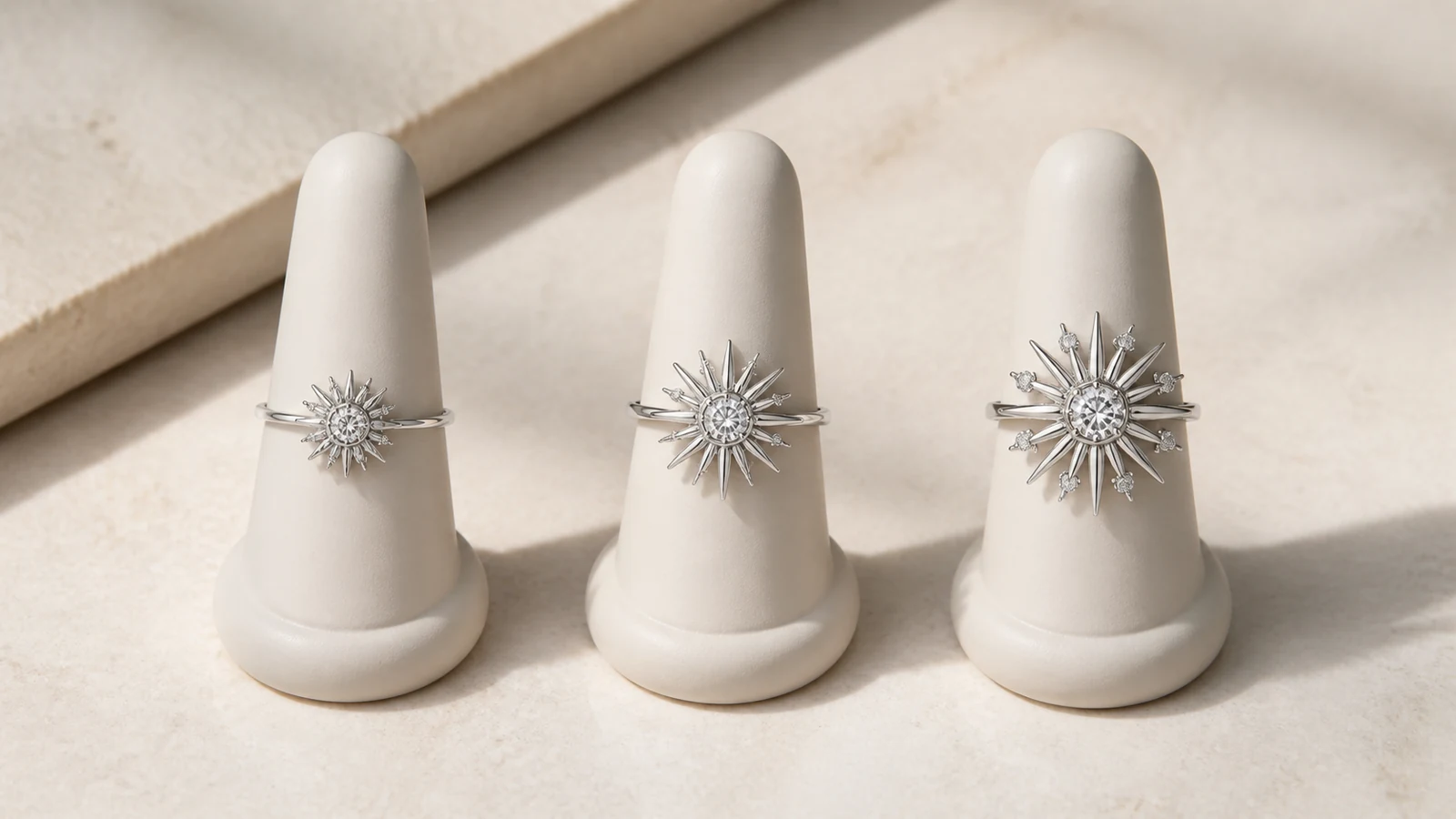
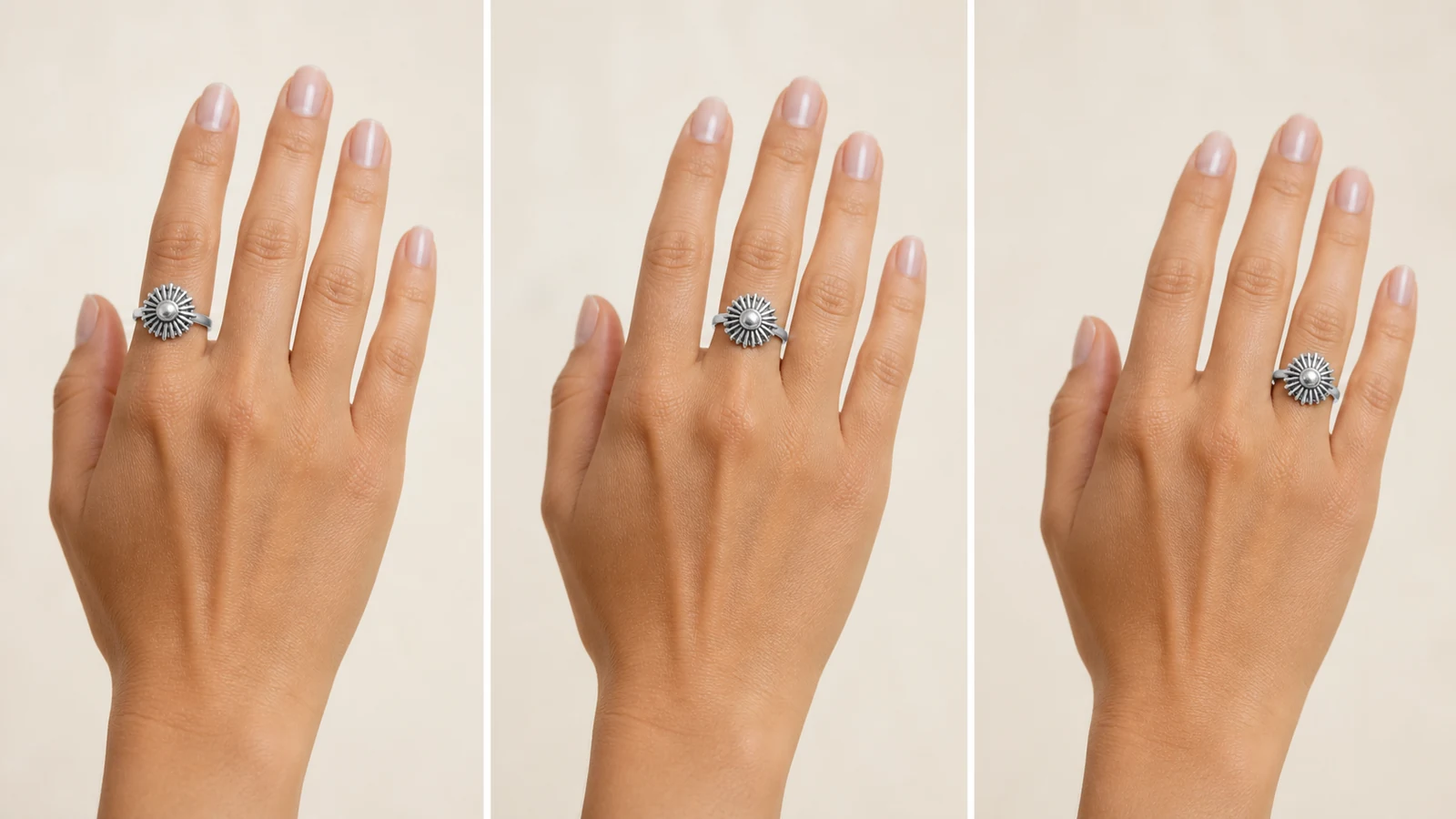
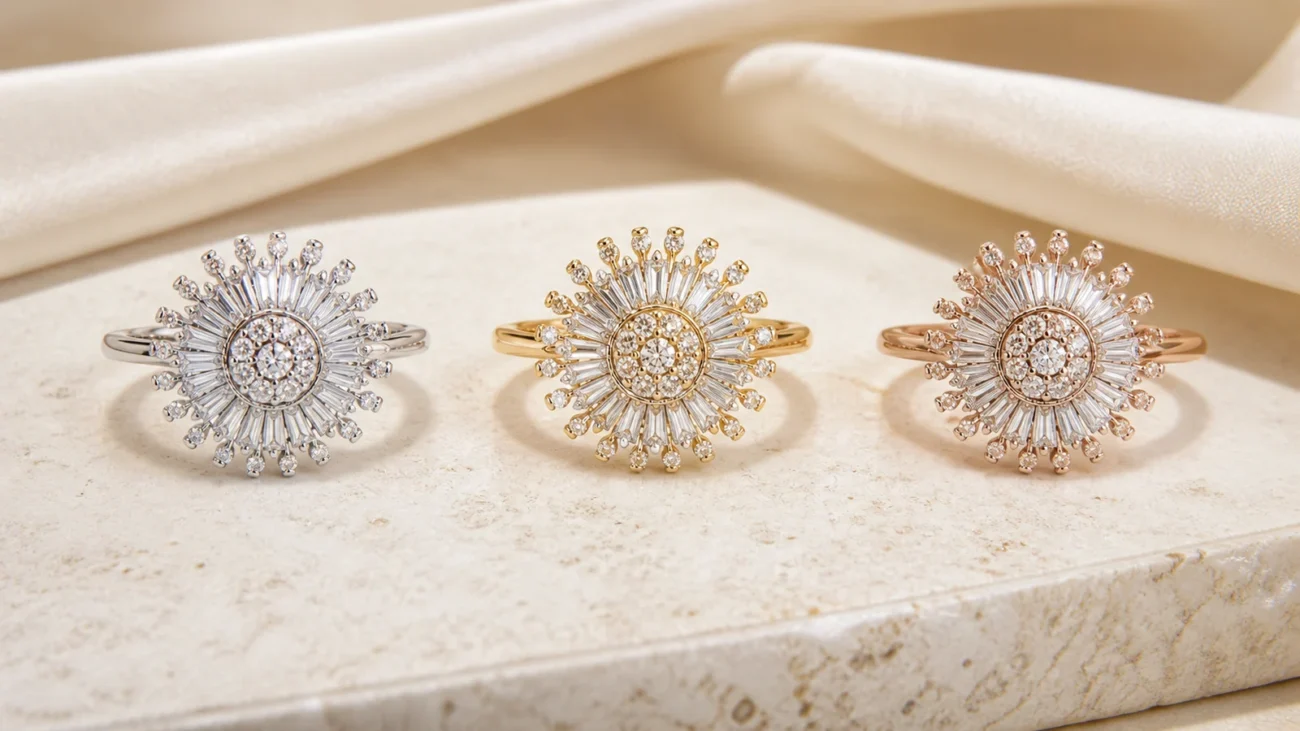
Three generic concepts show compact, medium, and bold face-up coverage; they are not product photographs.
Ring Size, Motif Width, and Setting Height Are Different
One number cannot describe the complete fit. Ring size concerns the inner circumference or diameter of the band. Motif width concerns the decorative area seen from above. Setting height concerns the side profile. Band width and thickness add two more practical measurements. Ask for these separately rather than assuming a correct ring size guarantees a proportionate or comfortable top.
Measurement
What it answers
What it does not answer
Ring size or inner diameter
Whether the band is likely to pass the knuckle and sit on the chosen finger
How large the sunshine motif looks from above
Overall motif width
Approximate finger coverage from the widest decorative points
Whether the band is the correct size
Overall motif length
How far the design extends along the finger
How high the setting sits
Setting height
How far the top rises above the band or finger
The face-up diameter or material durability
Band width and thickness
How substantial the shank feels and how much space it uses between fingers
The exact comfort of an individual ring
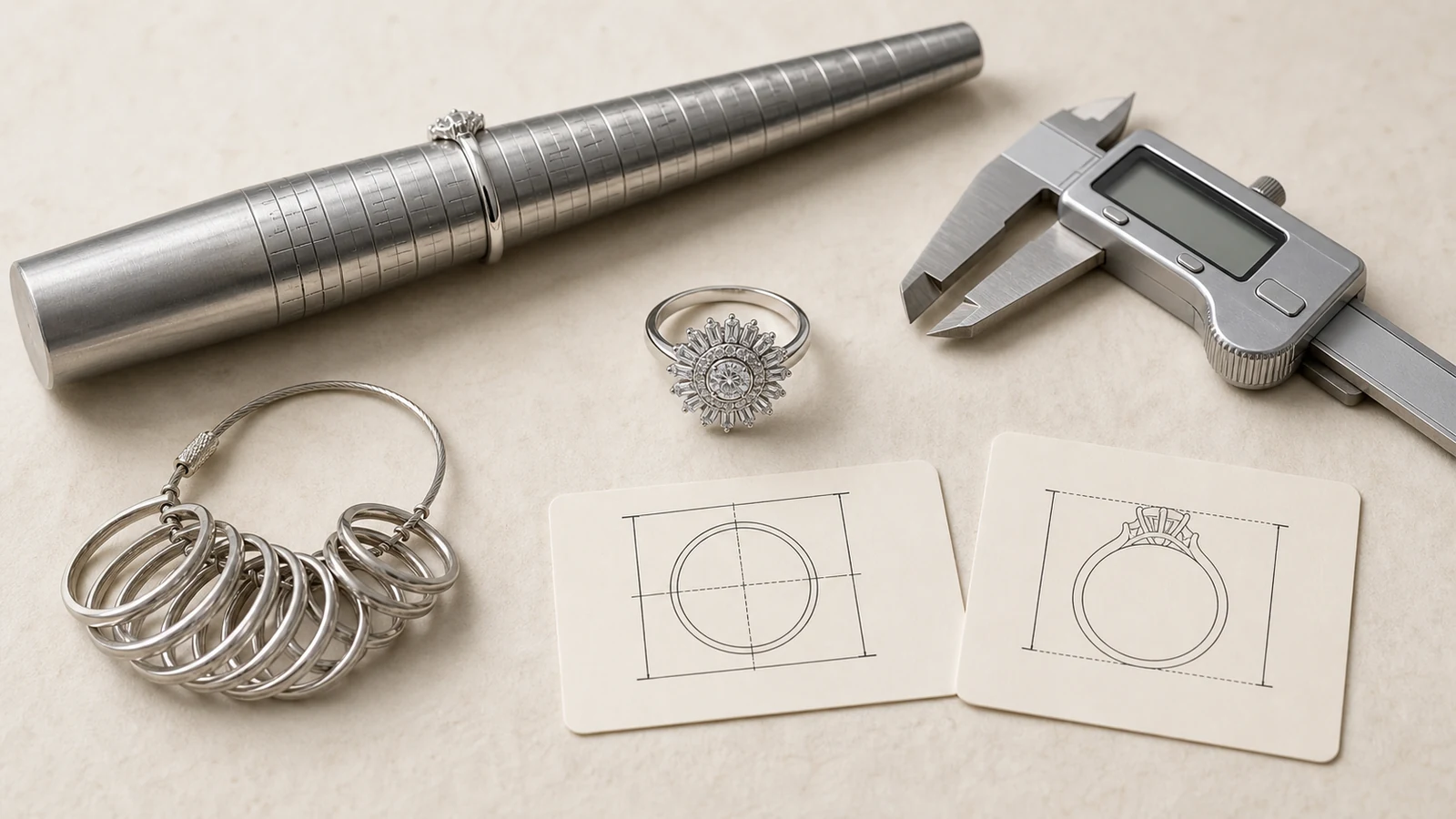
These generic tools illustrate separate measurement questions; the cards intentionally show no product specifications.
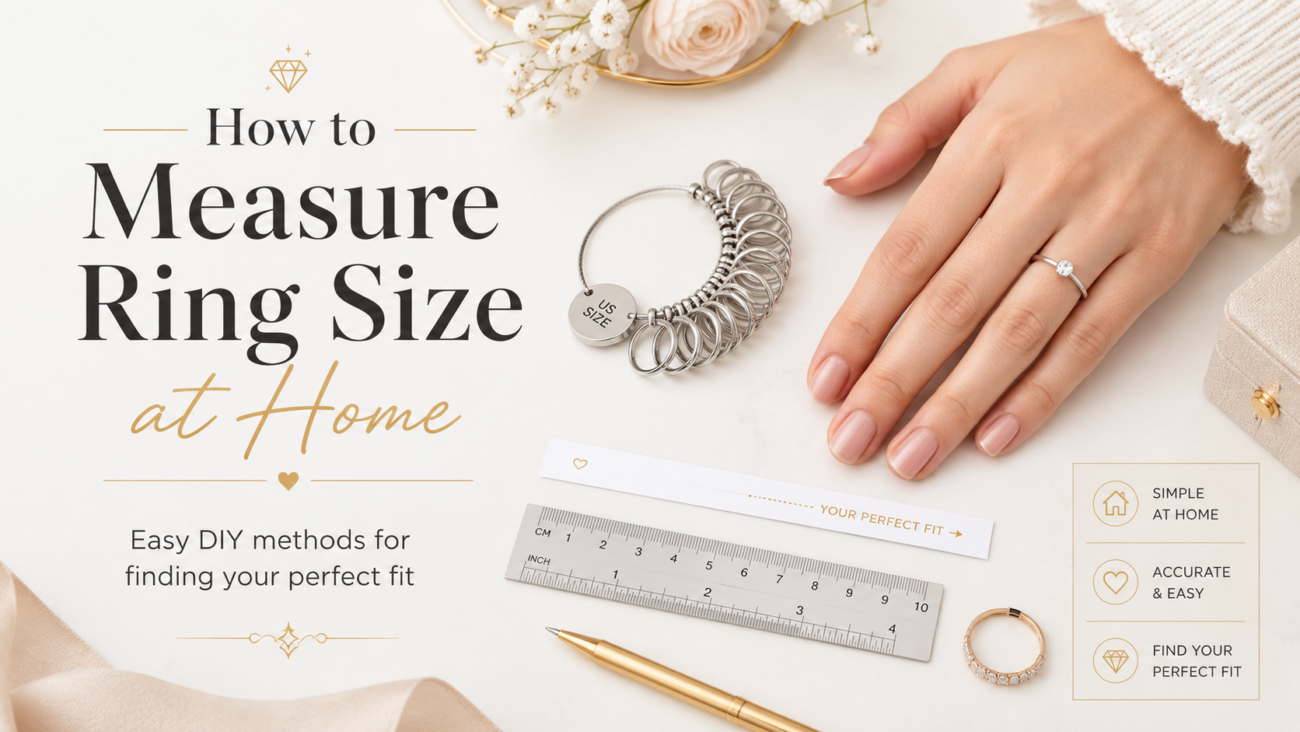
If you need a starting point for the band itself, use the at-home ring-size guide. Measure the intended finger at more than one time when practical, because a single rushed reading may not represent normal fit. Product-specific sizing information should still take priority.
How Hand Proportions Change Face-Up Coverage
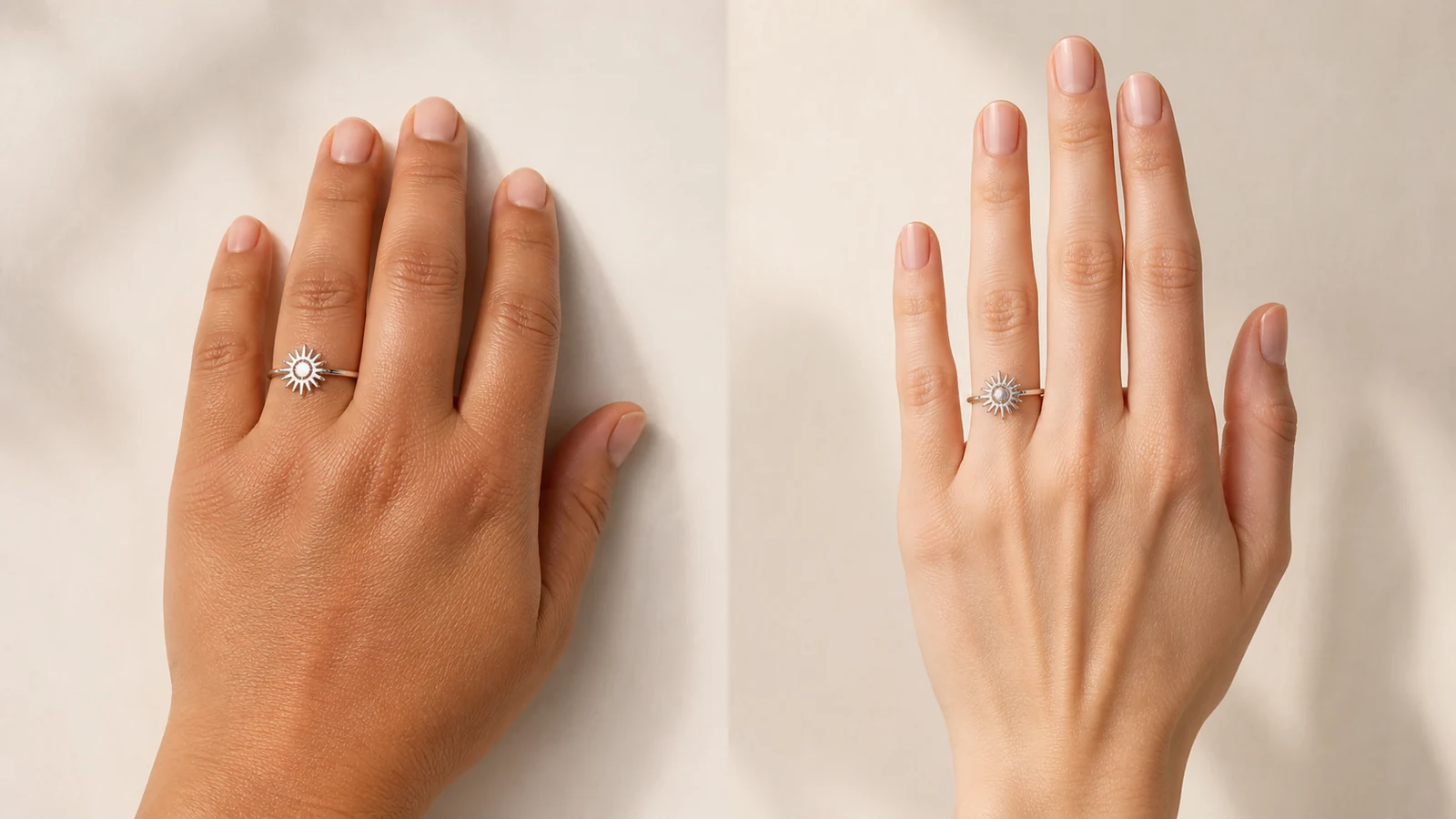
The same decorative diameter can read as restrained on one hand and bold on another. That is a scale relationship, not a judgment about which hand is better. Finger width, visible finger length, knuckle prominence, neighboring-finger spacing, and overall hand size all influence the result.
Natural hand proportions change the visual frame around a generic sunshine motif; neither result is a rule or ranking.
Shorter fingers
A very wide circular motif can occupy much of the visible space between the knuckle and the base of a shorter finger. That may be exactly the statement effect you want. If you prefer a lighter look, compare a compact sunburst, a design with fewer projecting rays, or a motif that distributes detail slightly along the finger rather than only across it. Evaluate millimeters, not labels such as “delicate” or “oversized.”
Longer or narrower fingers
Longer visible finger space can give a broad motif more surrounding room. A small sun may look intentionally minimal, while a medium or large face may feel more centered within the available length. Narrow fingers can still experience side-to-side overlap, so finger length does not remove the need to compare the motif width with the actual finger width.
Broader fingers or larger hands
A compact motif may create a subtle point of light, while a wider sunburst can produce a more deliberate statement. Do not compensate automatically by choosing the largest option. A band that is too thin for the decorative top can appear visually disconnected, and a wide top may press toward adjacent fingers. Look at the complete ring, not only the ornament.
Prominent knuckles
The band may need enough room to pass the knuckle without becoming so loose that the heavy top rotates. This is a fit issue, not something a photograph can solve. Consider the relationship between knuckle and finger-base measurements, the weight distribution of the top, and any sizing guidance supplied for the specific ring. A qualified jeweler can help when the difference is substantial.
For gemstone-cut proportions such as oval, pear, round, or marquise, see the separate moissanite shape and finger-type guide. Gemstone shape and full sunshine-motif diameter are related visual decisions, but they are not the same measurement.
Which Finger Gives the Best Visual Balance?
There is no required finger for a sunshine ring. Choose the finger that provides comfortable clearance and supports the meaning you want. Cultural and relationship customs vary, so placement should not be used to infer engagement or marital status without context.
Finger
Possible visual effect
Practical check
Index finger
A confident standalone statement with open space on one side
Check contact with the thumb and frequent object handling
Middle finger
A centered, symmetrical position across the hand
Check whether a wide motif presses both neighboring fingers
Ring finger
A familiar jewelry placement that can read classic or symbolic
Decide whether another band must sit beside it
Little finger
A compact accent when the motif and band are appropriately scaled
Confirm that the ring is made and sized for that finger
The same generic motif creates a different frame on the index, middle, and ring fingers.
Try the ring position with the hand relaxed, fingers spread, and fingers together. A design that looks balanced in a posed photograph may feel crowded during normal movement. If the ring will be stacked, the neighboring band changes the total width and should be assessed with it.
How Side Profile and Band Width Affect the Result
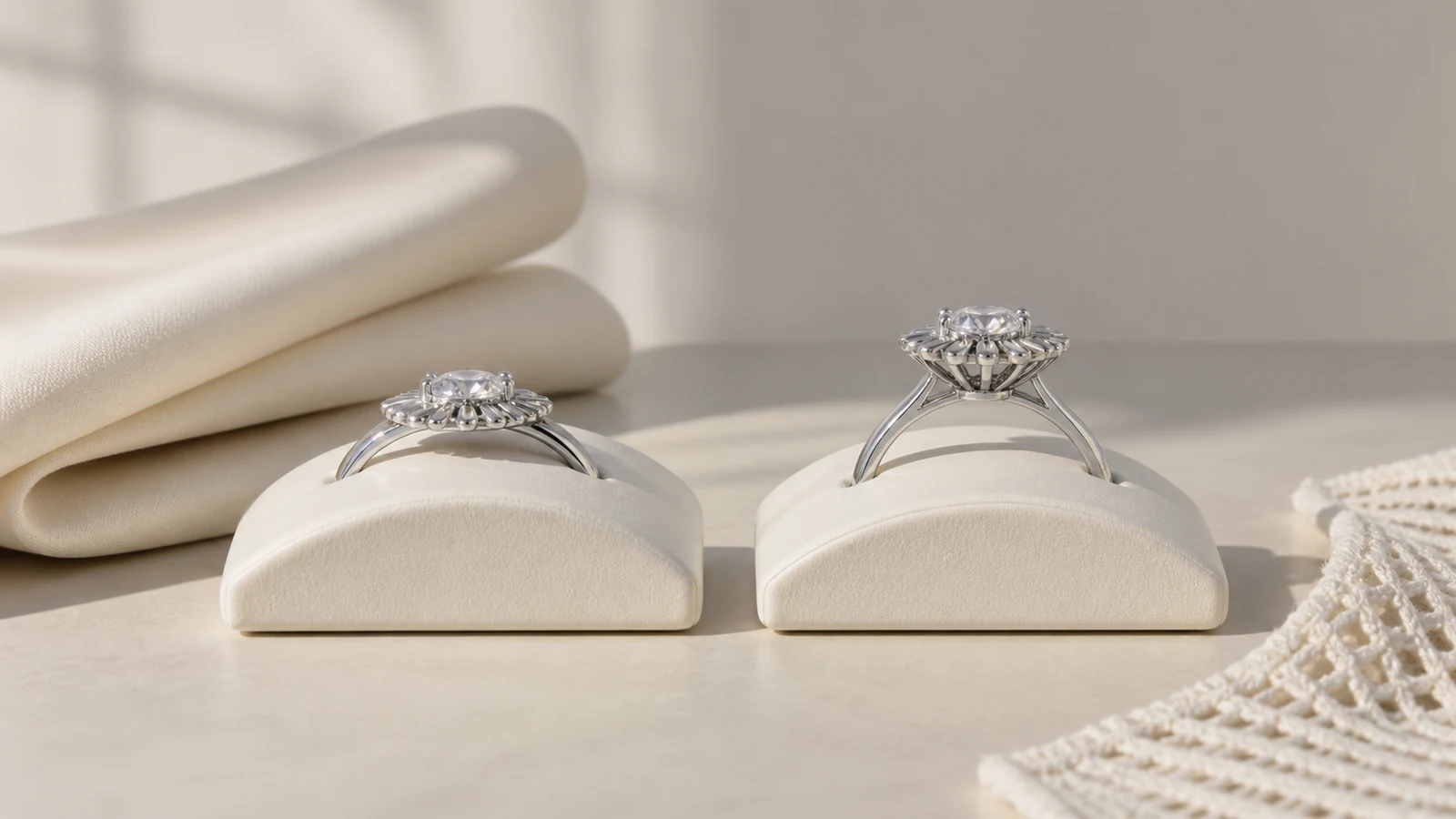
A face-up photograph cannot show how high the sunshine design rises. A lower profile can appear visually integrated with the band, while a higher setting creates more dimension and separation. Height alone does not establish security, durability, or suitability for daily wear; those depend on the individual construction and materials.
Generic low and elevated profiles show why a side view belongs in every proportion check.
Look for clearance under the decorative top, the transition from shoulders to setting, and any projecting rays or prongs. Think about fitted cuffs, gloves, pockets, and open-weave fabrics in your normal routine. The ring settings guide provides a broader introduction to common setting structures, but the live listing must identify the construction of the ring you are considering.
Band width also changes perception. A slim band can make a sunburst appear more prominent. A medium band can visually anchor a broad top. A wide band adds its own scale and may feel tighter than a narrow band in the same nominal size. These are tendencies, not fixed design laws.
How to Evaluate Ring Photos Before Buying Online
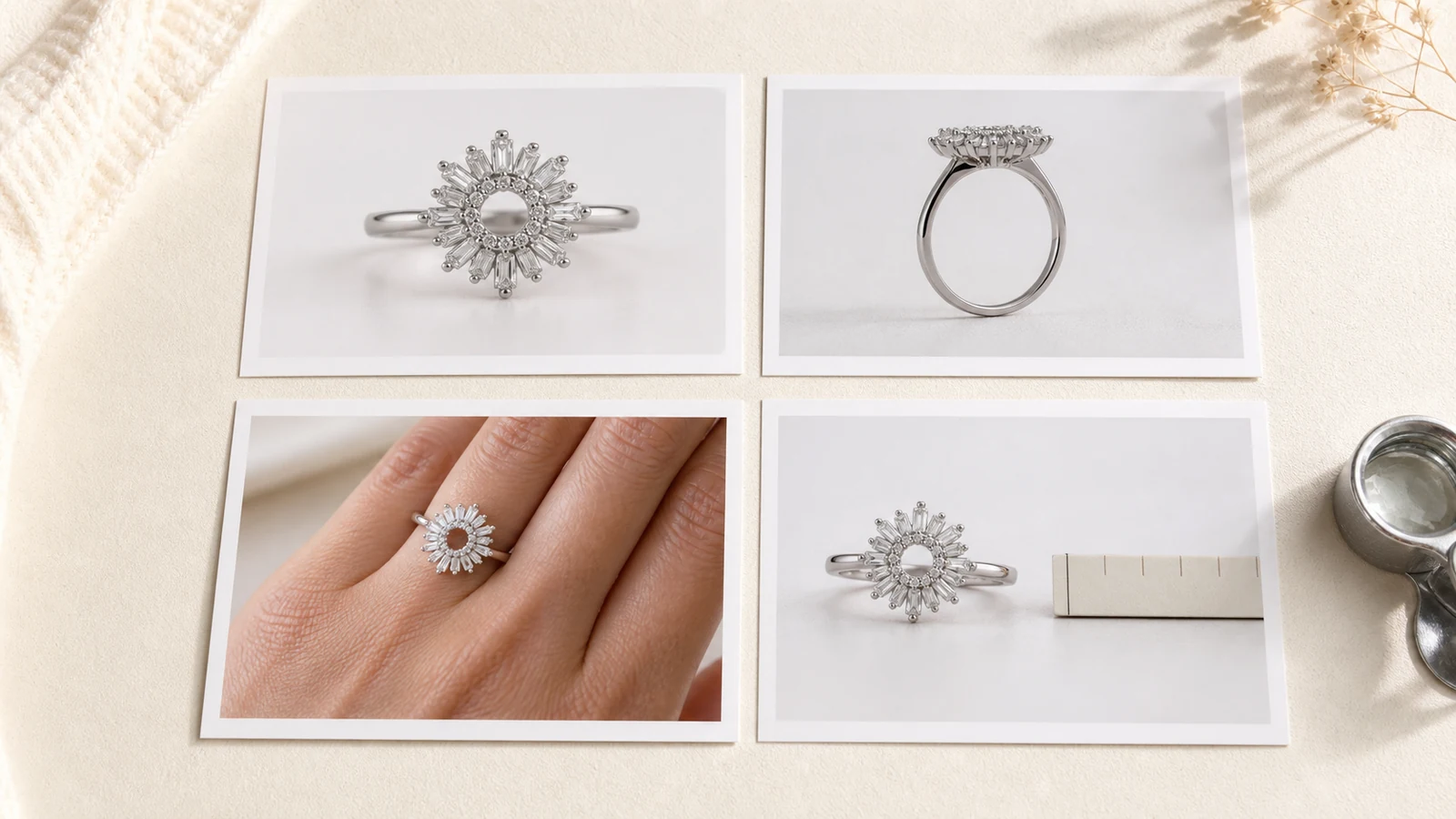
Online images are useful when they answer specific questions. A dramatic macro view shows detail but often hides scale. A hand photo adds context but can mislead when the model’s ring size, camera distance, or lens perspective is unknown. Written dimensions connect the pictures to a measurable reference.
Face-up, profile, on-hand, and scale-reference views each answer a different question; this is a generic illustration.
Face-up view: Can you see the complete ray-to-ray outline and symmetry?
Side view: Is the setting height and under-gallery visible?
On-hand view: Is the full hand shown at a natural distance rather than only a macro crop?
Scale reference: Are overall motif width, length, band width, and setting height stated in millimeters?
Material description: Are the center stone, accent stones, metal, and finish named in writing?
Consistency check: Do all photos appear to show the same design and proportions?
The Sunshine Jewelry catalog guide explains how to move from browsing to a controlled shortlist. When a product page is incomplete or ambiguous, ask for clarification rather than estimating facts from a generated image, styled photograph, or search phrase.
A Seven-Step Fit and Proportion Decision
Choose the exact finger and obtain a reliable size for that finger.
Measure the finger’s visible width at the area where the motif will sit.
Record the listing’s complete motif width and length in millimeters.
Compare the motif width with a paper circle or simple template placed over your finger.
Review the side profile, band width, and neighboring-finger clearance.
Check at least one natural on-hand image without using it as the only scale evidence.
Confirm the written stone, metal, finish, size options, and current purchase terms before deciding.
This sequence separates visual preference from fit and product facts. If you want outfit and accessory ideas after choosing the scale, continue to the sunshine ring styling guide. For current designs, browse the rings category and verify each individual listing.
FAQ: Women’s Sunshine Diamond Ring Fit
What motif size looks best on small hands?
There is no universal best size. A compact motif creates a quieter accent; a wider sunburst creates a deliberate statement. Compare the complete motif diameter in millimeters with the wearer’s actual finger width and preferred visual impact.
Will a large sunburst make short fingers look shorter?
It can occupy more visible finger space, but that does not make it wrong. If you want more open space around the design, compare a smaller diameter or a motif with less side-to-side projection. Use an actual-size template instead of relying on a verbal size label.
Is ring size the same as the size of the sunshine design?
No. Ring size describes the band fit around the finger. The decorative face has separate width and length measurements, and the setting has a separate height. Ask for all of them.
Which finger should a sunshine ring go on?
Any finger that fits comfortably and suits the wearer’s meaning and style can work. Check thumb clearance on the index finger, neighboring-finger contact on the middle finger, and stacking space on the ring finger.
Can a product photo prove the ring contains diamond?
No. A photo cannot reliably establish gemstone identity. Read the written specifications for the center and accent stones. If the description is unclear, ask the seller before purchasing.
How can I preview finger coverage at home?
Use the stated motif width to make a simple paper circle or outline at actual size, then place it over the intended finger without attaching it. This approximates face-up coverage only; it does not reproduce setting height, weight, or comfort.
Choose the Scale You Want, Then Verify the Facts
A women’s sunshine diamond ring should not be chosen from center-stone appearance alone. Compare the whole radiant outline with the finger, treat band fit and decorative coverage as separate questions, inspect the side profile, and use written millimeter dimensions to interpret hand photos. The most successful proportion is the one the wearer enjoys and can use comfortably—supported by verified product details rather than assumptions.
Choose a women's sunshine diamond ring gift by checking her style, exact ring size, verified listing details, daily routine, and current store policies.