A two-tone moissanite ring is easiest to style when you treat its mixed metal colors as a bridge, not a restriction. Let the crossover ring lead the stack, add no more bands than the finger can wear comfortably, and repeat either its silver-tone or warm-tone color elsewhere. Check ring width, height, edge contact, and movement before deciding the combination is suitable for regular wear.
The visual idea is simple: one ring already connects two colors and several lines, so supporting jewelry should clarify that design rather than compete with it. The physical decision is equally important. A stack can look balanced in a photograph yet pinch, spin, trap moisture, or rub adjacent settings in real life. This guide separates style from fit so you can evaluate both.
A two-tone crossover moissanite ring combines two visible metal colors with bands or ribbons that cross, twist, or overlap. “Two-tone” describes the appearance; it does not by itself verify the underlying metal, plating thickness, or alloy. “Moissanite” identifies the named gemstone in the product listing and should not be replaced with “diamond” or “cubic zirconia.”
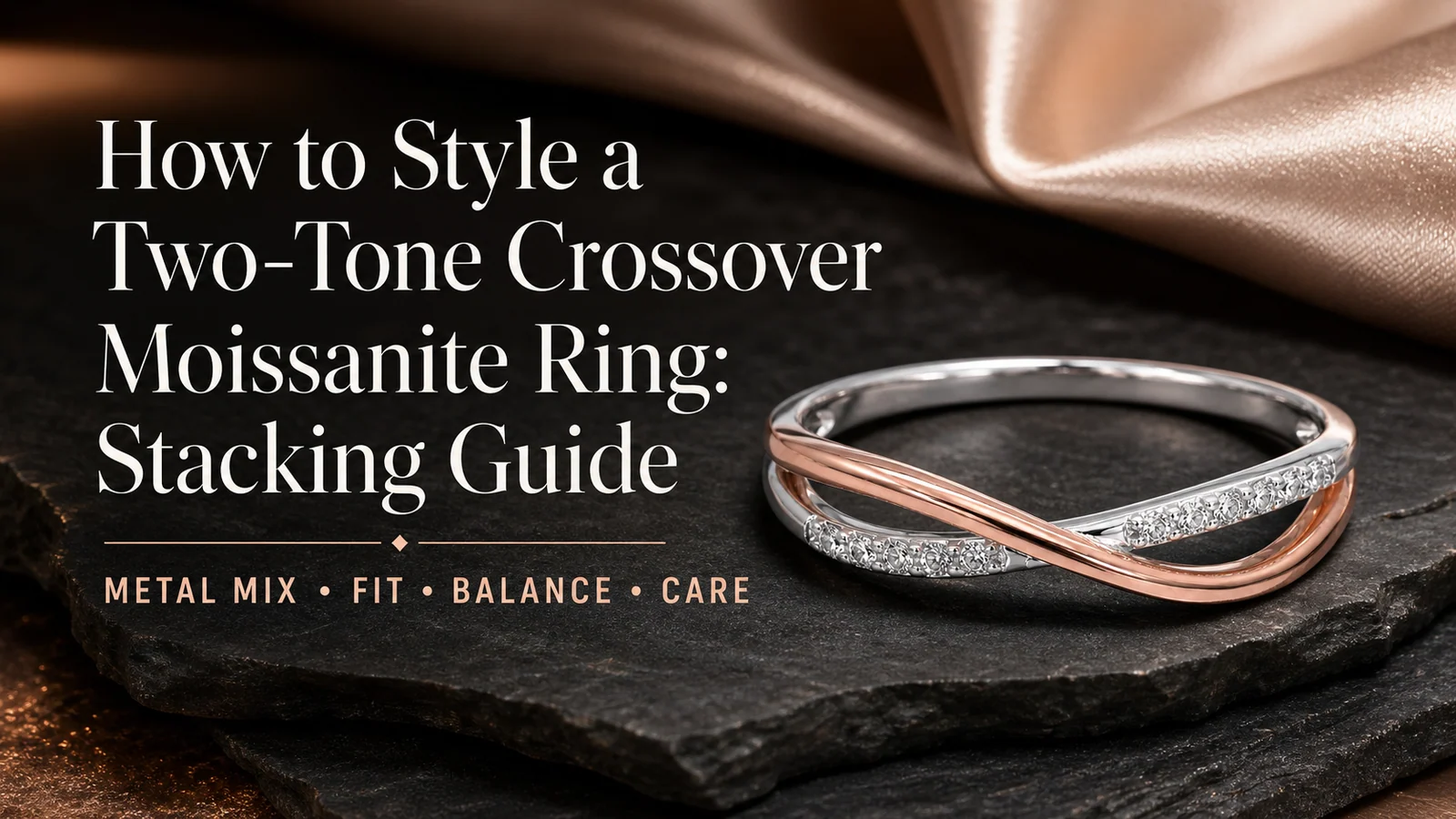
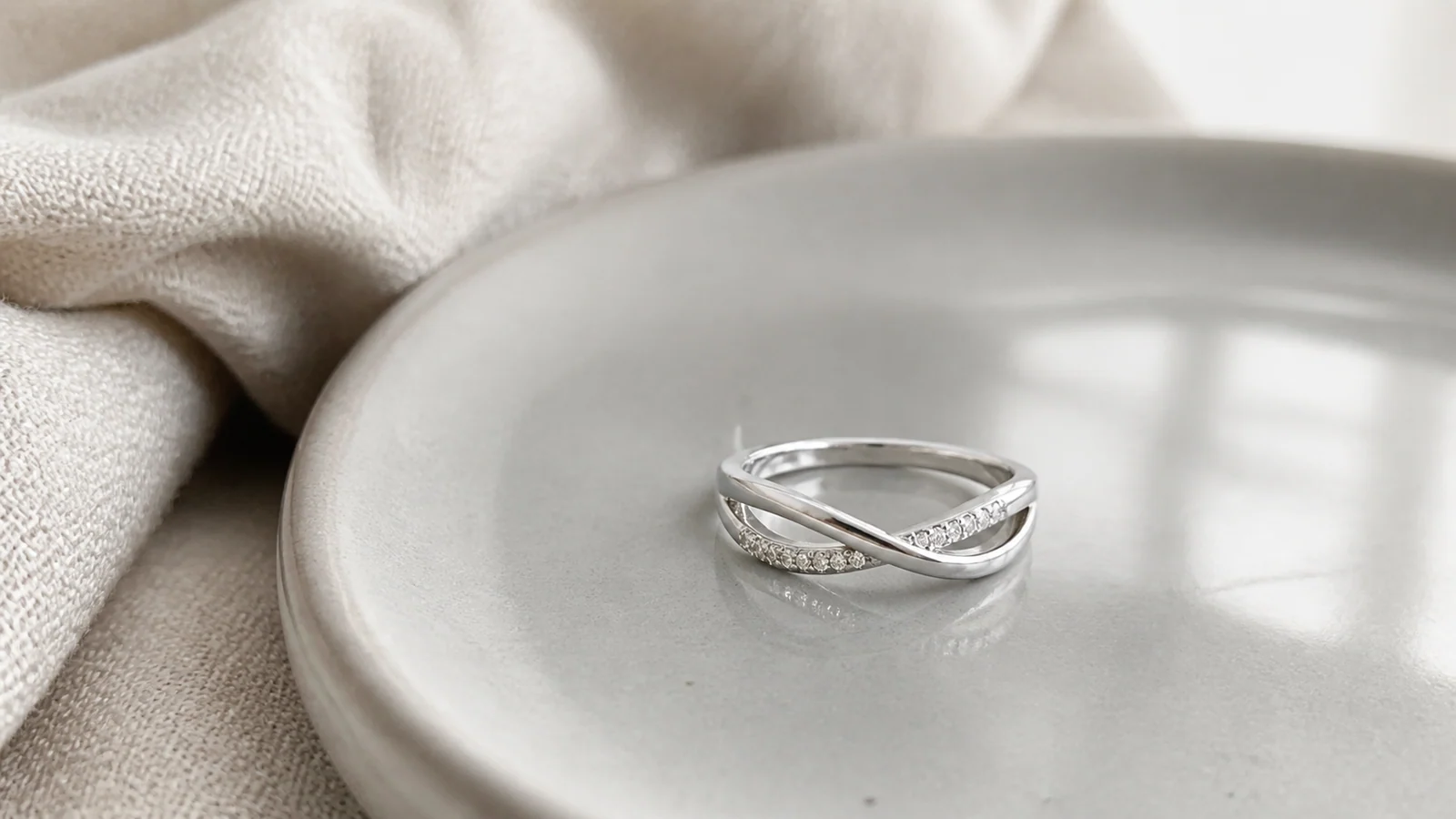
The current Sunshine Jewelry MS0365 product image shows polished silver-tone and rose-gold-tone ribbons, open spaces between those lines, and small clear stones along parts of the silver-tone sections. The design already provides color contrast, movement, and sparkle. That makes it a natural anchor for a stack, but it can also be worn alone when you want the crossover geometry to remain fully visible.
If you are still comparing ring construction terms, the moissanite ring settings guide explains how different settings hold and present stones. That background helps you distinguish a decorative crossover band from a center-stone setting before combining pieces.
How do you style a two-tone moissanite ring?
Start with one of three clear approaches: let the ring stand alone, echo one of its metal colors, or use it as a transition between cool-tone and warm-tone jewelry. You do not need equal amounts of both colors. A deliberate imbalance often looks calmer than a perfectly alternating sequence.
Styling goal
Recommended approach
What to check
Minimal everyday look
Wear the crossover ring alone
Whether the open design remains visible from normal viewing angles
Quiet two-ring stack
Add one slim band in either visible metal color
Edge contact, overall width, and whether one ring forces the other to tilt
Mixed-metal stack
Place the two-tone ring between a cool-tone and warm-tone band
Whether the crossover ring still reads as the visual bridge
Texture-focused stack
Pair smooth crossover lines with one band that has a controlled repeating texture
Whether stone settings or raised details rub against each other
Statement look
Use one wider or sculptural band and leave other fingers quieter
Comfort when making a fist and balance across the whole hand
Can a crossover ring be stacked with other bands?
Yes, but compatibility depends on profile rather than the word “stackable” alone. A ring may have a straight inner edge, a curved or peaked outer line, raised stone settings, or open spaces. The neighboring band needs enough clearance to sit without pressing on vulnerable details.
Compare width, height, and edge shape
View each ring from the side as well as from the top. Width tells you how much finger space the combination needs. Height affects whether adjacent rings touch at their settings. Edge shape determines whether the bands meet evenly, leave an intentional gap, or push each other out of alignment.
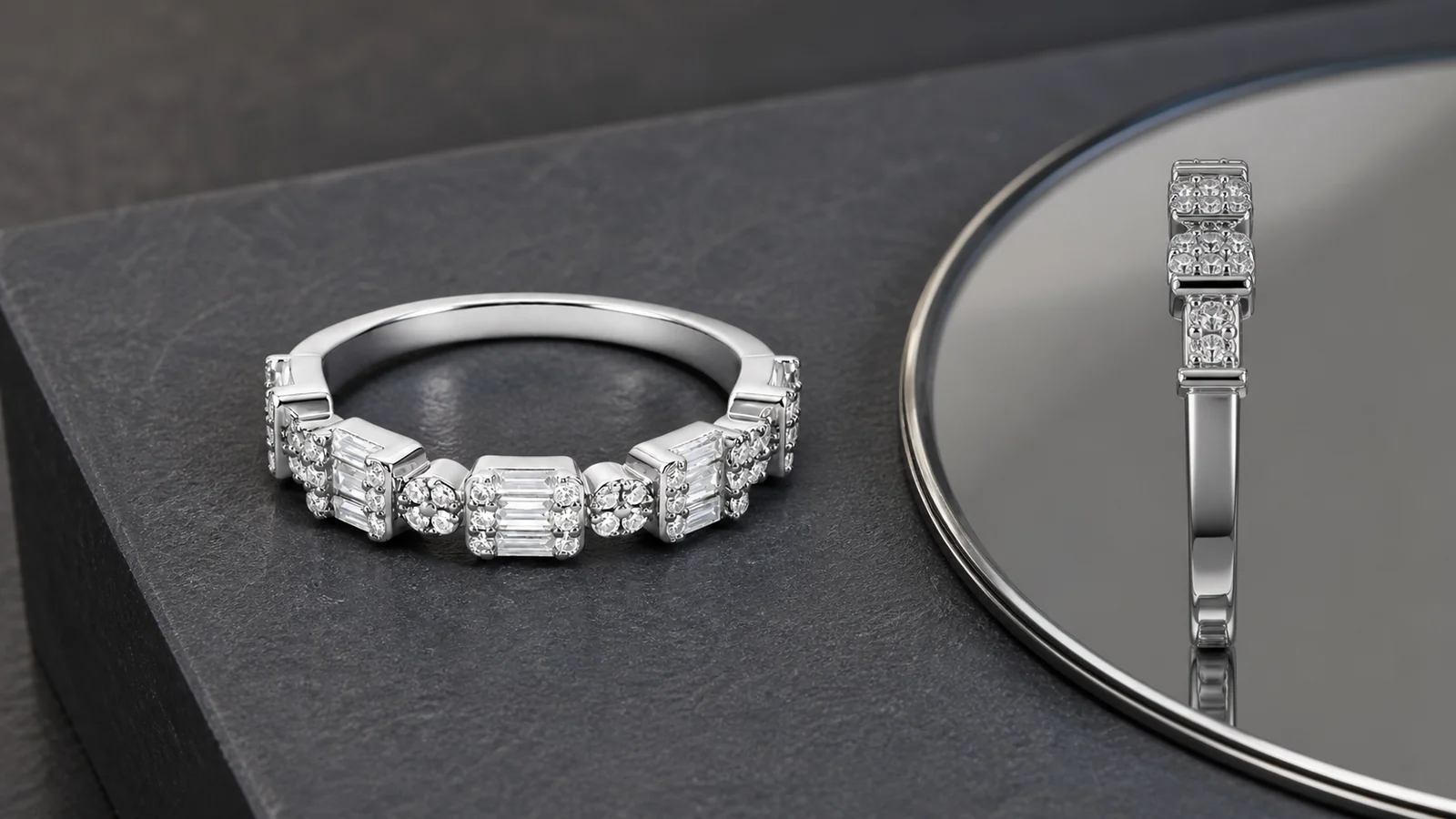
The Sunshine Jewelry Channel-Set Baguette Stackable Moissanite Ring – MS0391 has a more structured repeating front than the flowing MS0365 crossover. That contrast can be visually useful, but the actual rings should be tested together because product images alone cannot confirm side clearance or comfort.
A structured repeating band can contrast with a crossover design; evaluate the actual profile and contact points before stacking.
Decide whether a gap is intentional
Not every stack must sit flush. A small, even gap can make two designs readable and reduce direct contact. An uneven gap that changes as you move may indicate incompatible contours or different ring sizes. Do not force a curved band flat against another ring merely to reproduce a photograph.
How many rings make a balanced stack?
There is no universal best number. Begin with two rings, wear them during ordinary hand movements, and add a third only if the combination remains comfortable and visually clear. More rings increase total width and the number of contact points, so the practical limit may be lower than the visual limit.
One ring: best when the crossover design is already complex or you want minimal friction.
Two rings: easiest way to add one color, texture, or contour without hiding the anchor.
Three rings: useful for a center-and-frame arrangement, provided the finger has enough comfortable space.
Four or more: requires closer attention to width, swelling, movement, and the risk of adjacent settings rubbing.
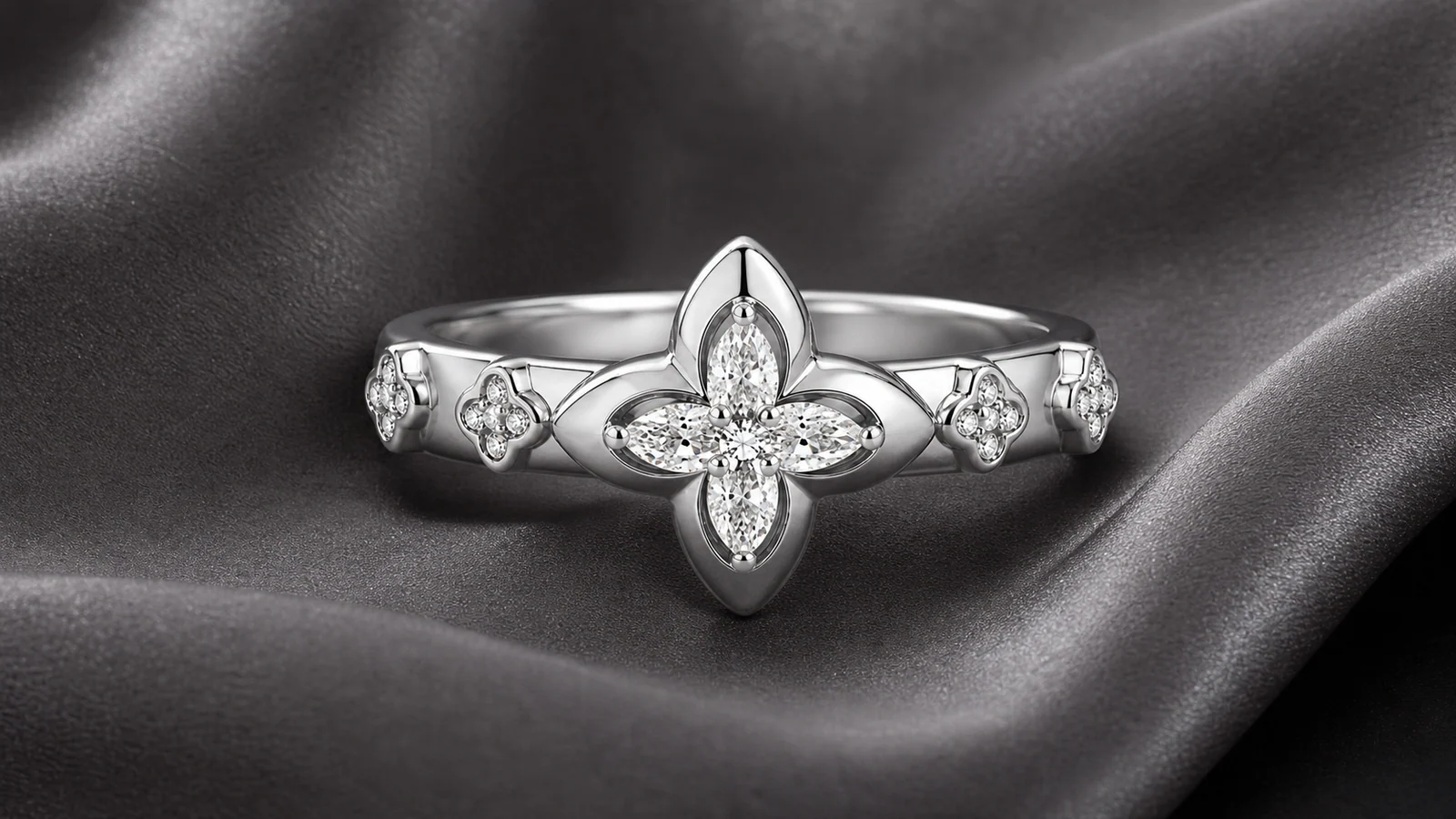
A wider focal motif changes the visual center of a stack. The Stackable Band Floral Marquise Moissanite Ring – MS0395, for example, has a prominent floral center in its reference image. A focal band like this may work better as the main statement with simpler companions than as one of several equally detailed bands.
A wider focal motif needs visual breathing room; simplify neighboring bands so the stack has one clear center.
How do you mix metal colors without making the stack look random?
Repeat one color at least once and let the two-tone ring explain the connection. If MS0365 is the anchor, a cool-tone neighboring band can echo its silver-tone line while a warm-tone watch, bracelet, or small earring repeats the rose-gold-tone accent elsewhere. The repeated color does not have to be on the same hand.
Keep finish as consistent as possible. A highly polished ring, a heavily textured matte band, and a bright pavé band can create three separate visual messages even if their colors coordinate. When the color mix is already active, limit the number of additional textures.
Metal appearance is not the same as verified composition. Use “silver-tone,” “rose-gold-tone,” or “gold-tone” for visible color unless the product listing states the base metal or plating. This prevents the styling description from becoming an unsupported material claim.
Which band shapes pair well with a crossover design?
Straight slim bands are the simplest companions because they add a stable edge. Twisted bands repeat the movement of a crossover ring, creating a coordinated but more active stack. Contour or crown-shaped bands can frame another ring, but their high and low points must align with the neighboring profile.
The Sunshine Jewelry Twisted Pavé Stackable Moissanite Ring – MS0373 uses crossing wave-like lines and alternating polished and stone-set sections in its reference image. Paired with MS0365, it would repeat movement rather than introduce a new geometric language. That can feel cohesive, but the combination should be checked for visual crowding and surface contact.
Repeating a twist creates rhythm; use fewer additional textures so the stack remains readable.
How should a stacked ring set fit?
A comfortable stack should pass over the knuckle without excessive force, rest securely at the base of the finger, and allow the finger to bend without pinching. Because several bands occupy more vertical space, a stack can feel tighter than a single ring in the same nominal size. Finger size can also vary with temperature, activity, and time of day.
Measure the intended finger rather than copying a size from another finger.
Test the total width of the planned stack with bands of similar width if possible.
Make a fist and spread the fingers; note pinching, sharp pressure, or restricted movement.
Check whether rings rotate into each other or expose a raised setting to impact.
Remove the stack if the finger becomes numb, unusually discolored, or persistently indented.
For a measurement workflow, use Sunshine Jewelry’s guide on how to measure ring size at home. Home measurement is an estimate; a professional sizing check is useful when the planned stack is wide, the knuckle is much larger than the finger base, or the fit remains uncertain.
When should you wear the crossover ring alone?
Wear it alone when you want the two-tone paths and open spaces to remain the main design, when neighboring rings rub, or when your daily activities make a wider stack inconvenient. “Stackable” describes styling potential, not an obligation to stack.
A single mixed-metal ring can still coordinate an entire look. Repeat its cool tone in earrings or a watch, repeat the warm tone in a bracelet, and keep the remaining jewelry simple. This approach creates color continuity without adding more width to the finger.
How do you care for a stacked moissanite ring set?
Separate the rings before cleaning and storage. Dirt and moisture can collect where bands touch, while direct contact can mark polished surfaces or stress delicate settings. Follow the care information for each specific piece because coatings, base metals, settings, and decorative details may differ.
Remove stacked rings before strenuous activity, swimming, or exposure to harsh household cleaners.
Wipe each ring separately with a soft, clean cloth after wear.
Use only a cleaning method compatible with every material and finish in that ring.
Store rings in separate soft compartments rather than nested tightly together.
Inspect raised stones, edges, and contact areas; stop wearing a ring if a stone or setting feels loose.
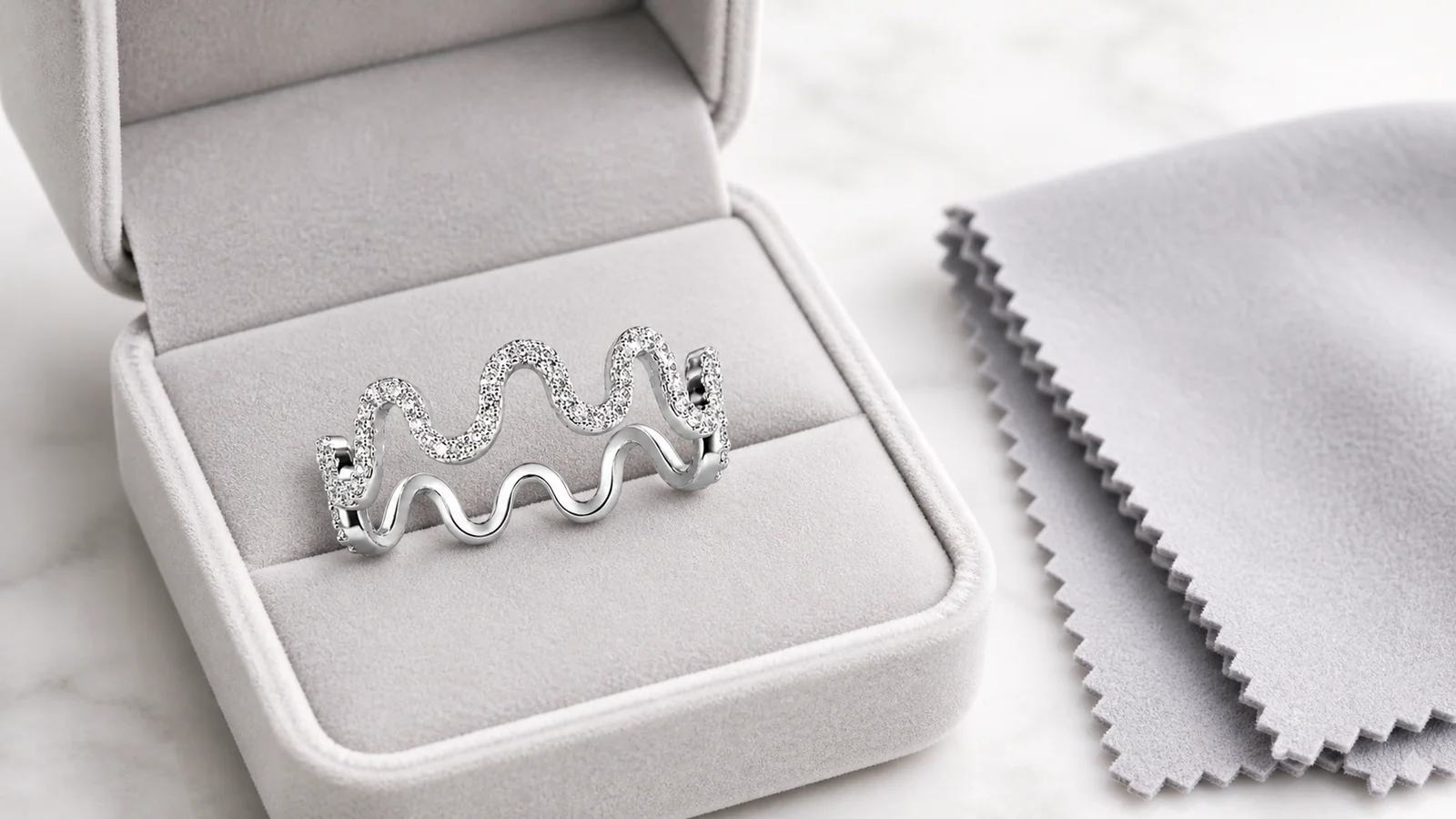
The Wavy Crown Moissanite Stackable Ring has repeated curves and stone-set sections in the reference image. Curves and contact points benefit from separate storage so another ring does not press against them. Sunshine Jewelry’s broader jewelry care guide provides a useful next step for building a routine.
Separate storage helps reduce contact between polished surfaces, curved edges, and stone-set details.
What should you check before buying a stackable band?
The product title and images describe the same ring you intend to pair.
The listed ring size is appropriate for the intended finger and total stack width.
The band’s top and side profiles appear compatible with the anchor ring.
The metal color and finish support the styling plan without unsupported material assumptions.
Raised stones, pointed contours, or openwork details have enough clearance.
The current return, exchange, and care information has been reviewed before ordering.
If you are deciding whether moissanite suits frequent wear, read Can You Wear Moissanite Every Day? for activity-specific cautions. The moissanite guide also helps keep gemstone identity separate from setting, metal, and styling decisions.
Frequently asked questions
Can you mix silver-tone and rose-gold-tone rings?
Yes. A two-tone anchor makes the combination look intentional because both colors already appear in one piece. Repeat one color elsewhere and limit competing textures to keep the result cohesive.
Does a two-tone ring have to be stacked?
No. A crossover ring can provide enough color, movement, and sparkle on its own. Wear it alone whenever stacking hides the design, feels uncomfortable, or creates unwanted contact.
Should the widest ring go in the middle?
Often, but not always. Centering a wider focal ring creates symmetry, while placing it at one edge creates a directional look. Comfort and profile compatibility should decide before symmetry does.
Can two stone-set rings touch each other?
They may touch, but direct rubbing can be a concern. Check whether prongs, bezels, or edges contact another ring’s stones or polished surface. An intentional gap or spacer-style band may be preferable when settings collide.
Why does my ring stack feel tighter than one ring?
The combined bands cover more of the finger. Wider coverage can reduce flexibility and feel tighter, especially when fingers swell. Recheck the total width and sizing rather than assuming each ring will feel unchanged.
Can I stack rings with different textures?
Yes, if one texture leads and the others support it. A polished crossover ring can pair with one pavé or patterned band. Adding several unrelated textures may make the stack visually busy and increase contact points.
How often should I separate and inspect a ring stack?
Inspect it regularly and whenever comfort or appearance changes. Separate the rings for cleaning and storage, and check promptly after an impact or if a stone, setting, or band feels different.
Build the stack in this order
Start with the two-tone crossover ring alone.
Add one compatible band and check profile, movement, and comfort.
Repeat one metal color and limit extra textures.
Wear the combination during ordinary, low-risk movements before extending wear time.
Separate, clean, inspect, and store each ring individually.
A successful ring stack should look intentional and feel uneventful on the hand. Use MS0365 as a color bridge, choose neighboring bands by their actual shape and profile, and stop adding pieces when clarity or comfort declines. Browse Sunshine Jewelry’s verified product pages above to compare real designs, then evaluate the physical rings together before treating any photographed combination as a final fit.
Choose a women's sunshine diamond ring gift by checking her style, exact ring size, verified listing details, daily routine, and current store policies.