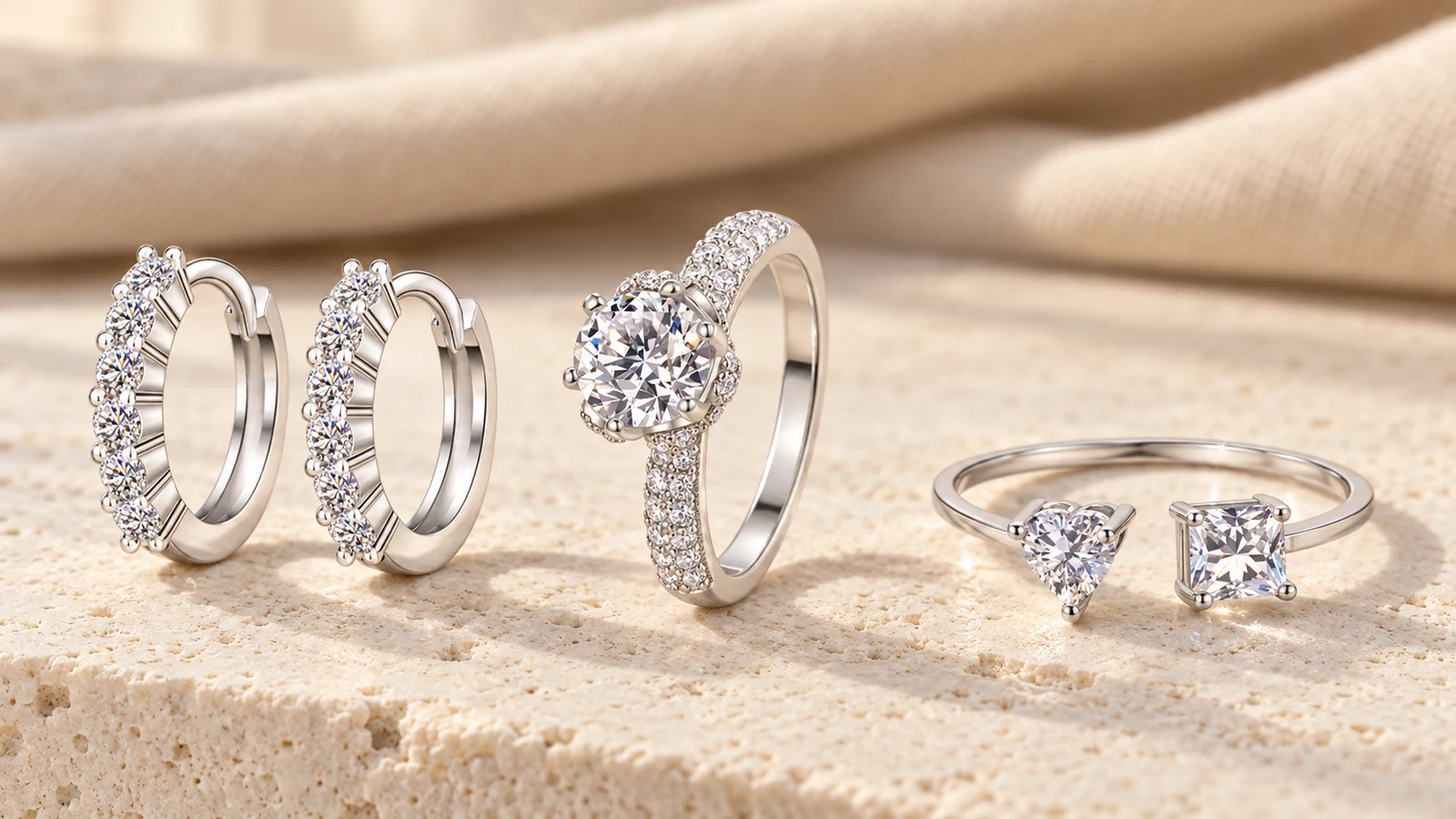
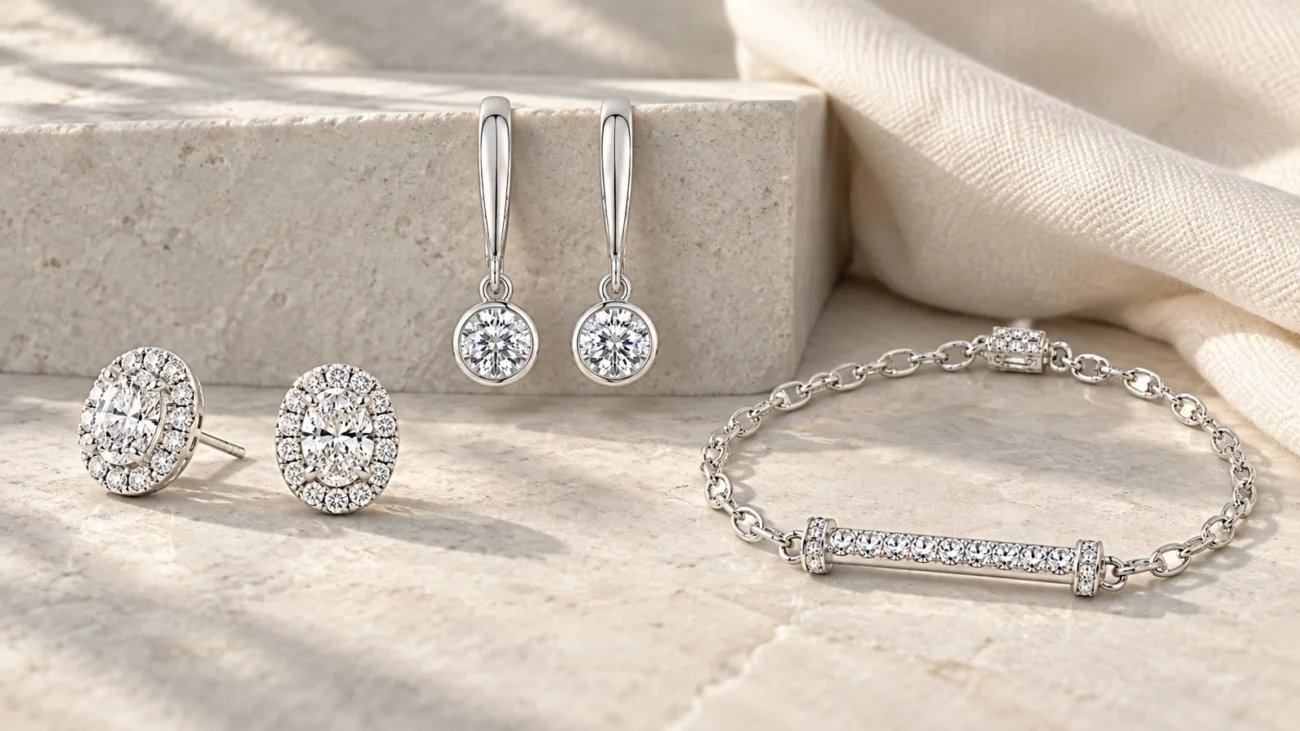
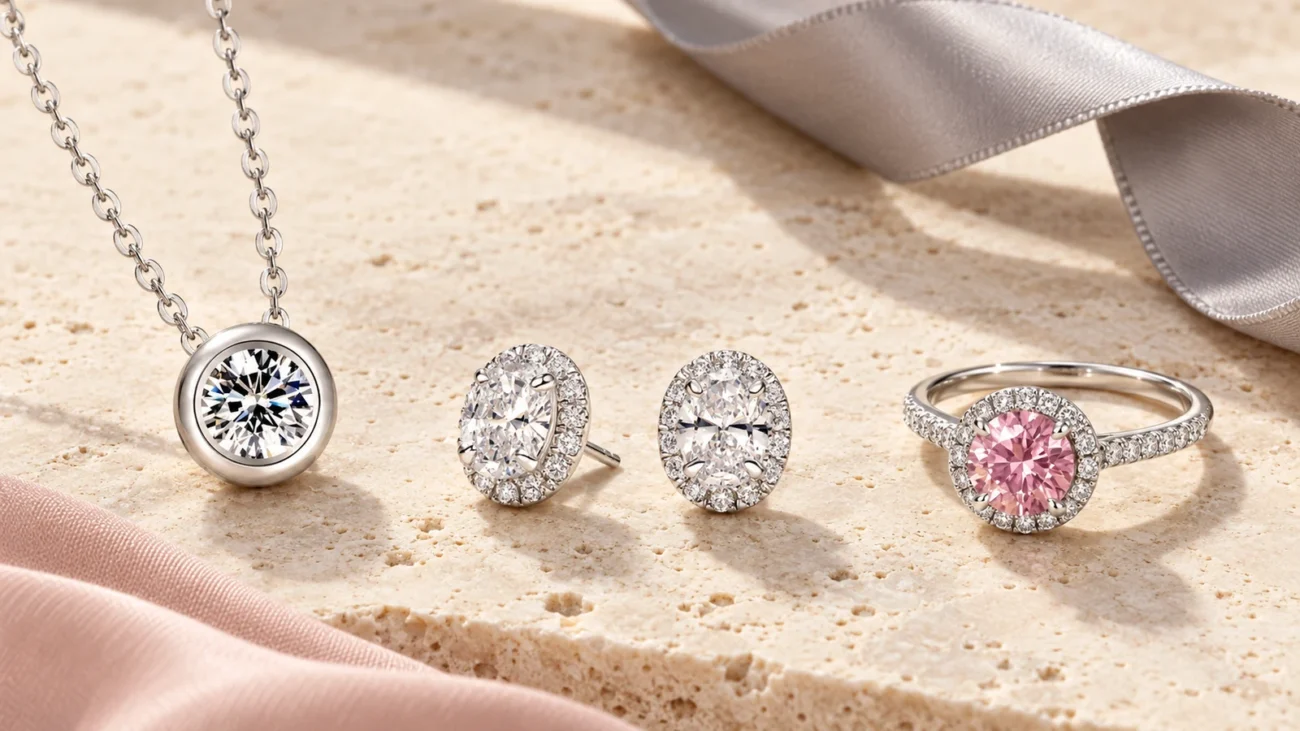
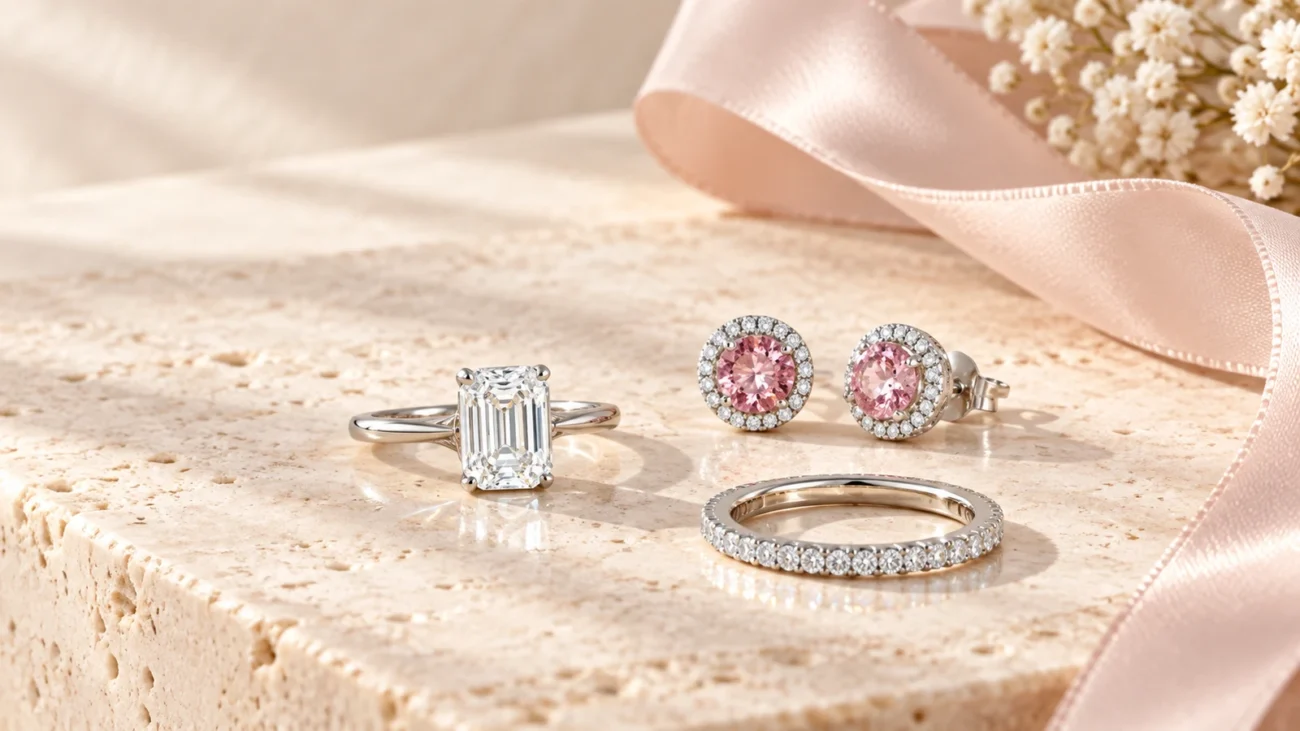
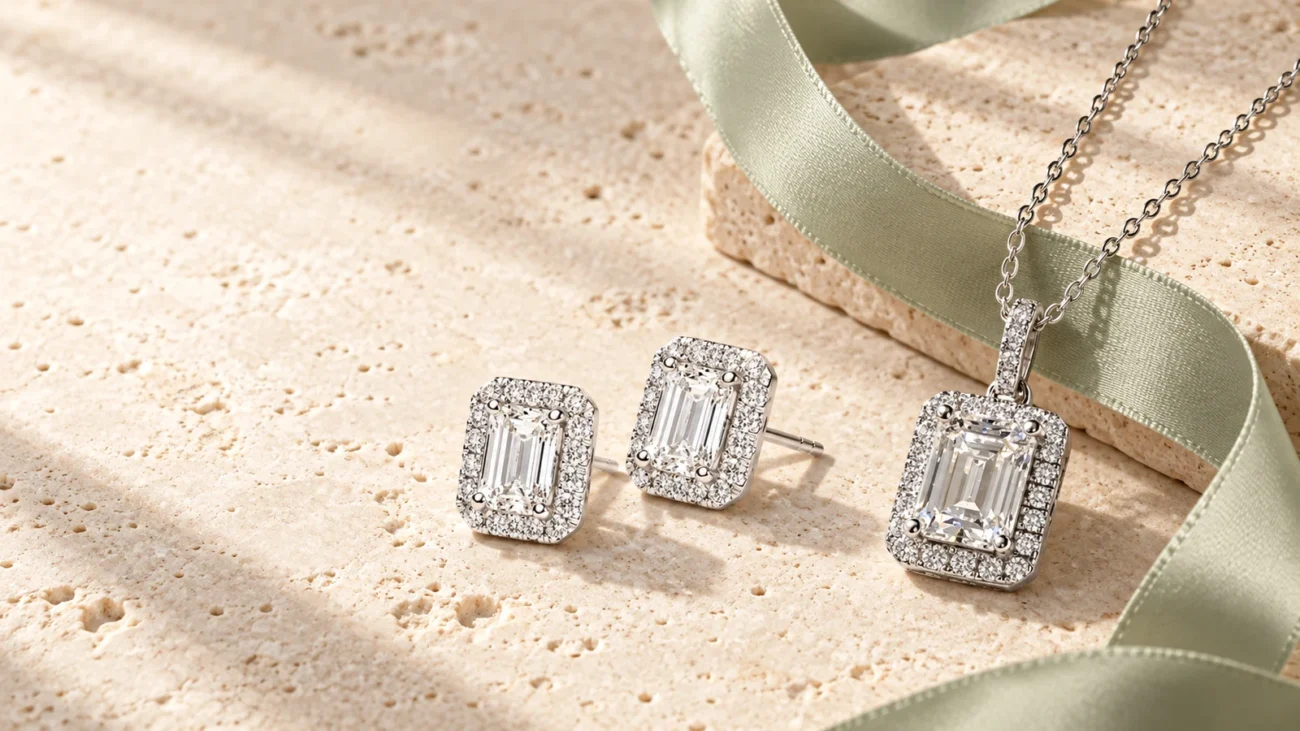
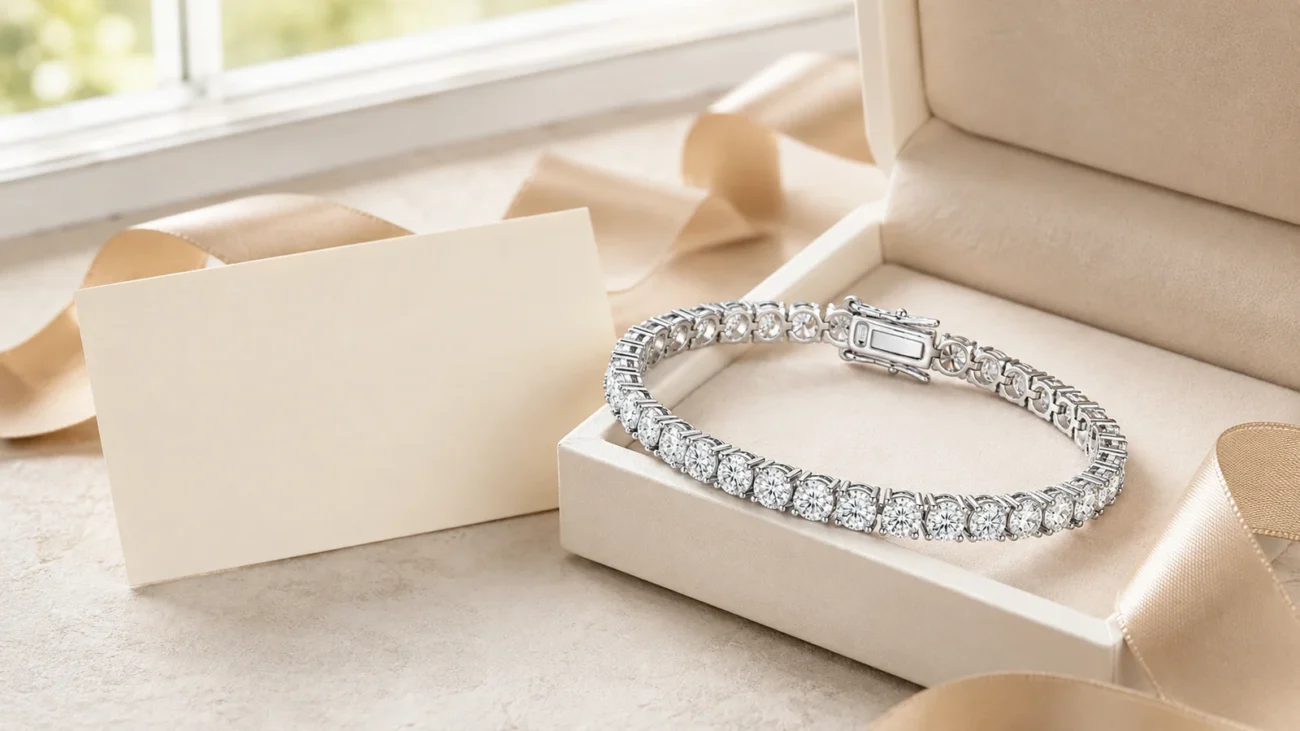
Choose jewelry by visual balance by asking where the design places attention: in a matching pair, at one centered focal point, across a repeated line, between two contrasting ends, or inside a broad frame. Paired and centered designs tend to read quickly and feel orderly. Repeated designs create rhythm. Open, unequal shapes feel more directional. Broad frames make a strong center feel anchored. The right option is the one that supports your preferred focal point, outfit lines, scale, and fit.
This Sunshine Jewelry visual balance guide uses five products that were live and verified when the article was prepared. “Visual balance” describes how shapes and detail appear to distribute attention. It is not a measurement of physical weight, durability, comfort, or stone quality. Those qualities require current specifications, proper fit information, and, where relevant, professional evaluation.
The simplest decision rule is one attention pattern, one leading zone, one scale check. First choose the pattern that feels natural to you. Then decide whether ears or hands should lead the look. Finally, compare the piece with your proportions and nearby clothing or jewelry instead of judging an isolated catalog image.
What Is Visual Balance in Jewelry?
Visual balance is the perceived distribution of shapes, empty space, metal, stones, and detail within a design. Exact mirror symmetry is one kind of balance, but it is not the only kind. Two different shapes can feel balanced when their scale and spacing create a deliberate relationship. A repeated sequence can feel stable even without a single center. A large frame can counterbalance a bright stone by giving it strong boundaries.
Visual balance should not be confused with physical weight. A design that looks visually heavy may be comfortable, and a delicate-looking piece may still have dimensions or closures that matter to the wearer. It is also different from sparkle density. Sparkle describes how concentrated or distributed bright detail appears; balance describes how the whole composition organizes attention. The Sunshine Jewelry sparkle guide addresses that separate question.
Movement can change how balance is perceived, but the two ideas remain distinct. Matching hoops can move independently and still read as a pair. A ring does not need moving parts to create directional tension. For construction-based choices, see the Sunshine Jewelry movement guide.
Paired Balance: Matching Huggie Earrings
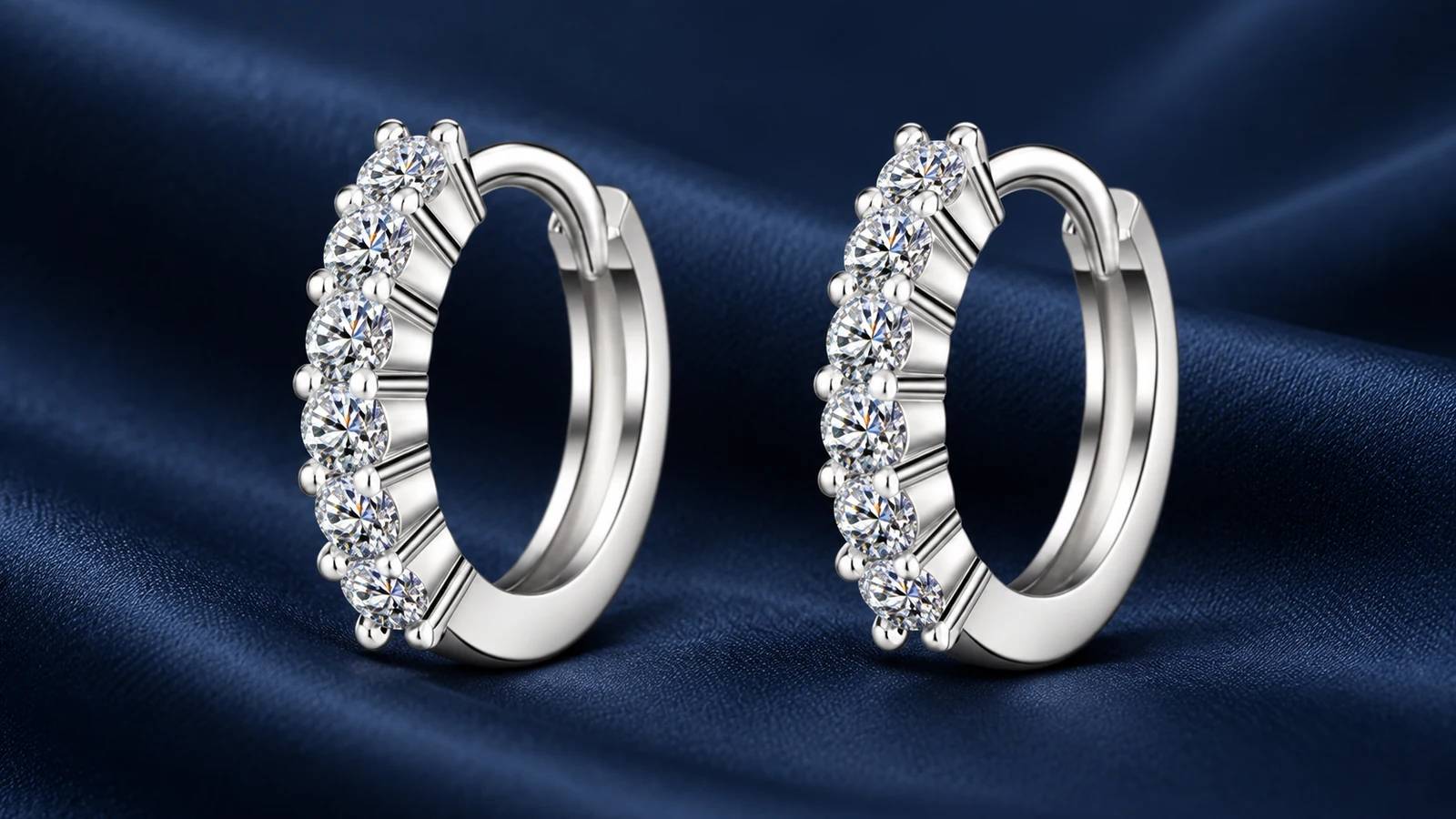
The Round Pavé Huggie Hoop Moissanite Earrings – MS0878 demonstrate paired balance. The live page describes a polished 925 sterling silver earring pair with a graduated row of round stones along compact huggie hoops. Each earring repeats the same arc, metal structure, and stone sequence.
This generated visualization preserves the verified MS0878 pair count, compact hoops, graduated round-stone rows, hinges, polished silver color, and visible proportions.
Matching earrings distribute attention across both sides of the face. That does not mean the wearer’s total look must be perfectly symmetrical. A side part, one-shoulder neckline, or asymmetrical jacket can create contrast while the earrings provide a steady repeated cue. If hair covers one ear, the pair still matches physically, but only one hoop may be continuously visible.
Keep nearby details quieter when you want the paired outline to lead. A simple chain or a neckline without heavy hardware gives the hoops more visual space. If you add a necklace, compare its shape and scale using the earring and necklace pairing guide. The goal is coordination, not automatic matching of every shape.
Centered Balance: One Dominant Focal Point
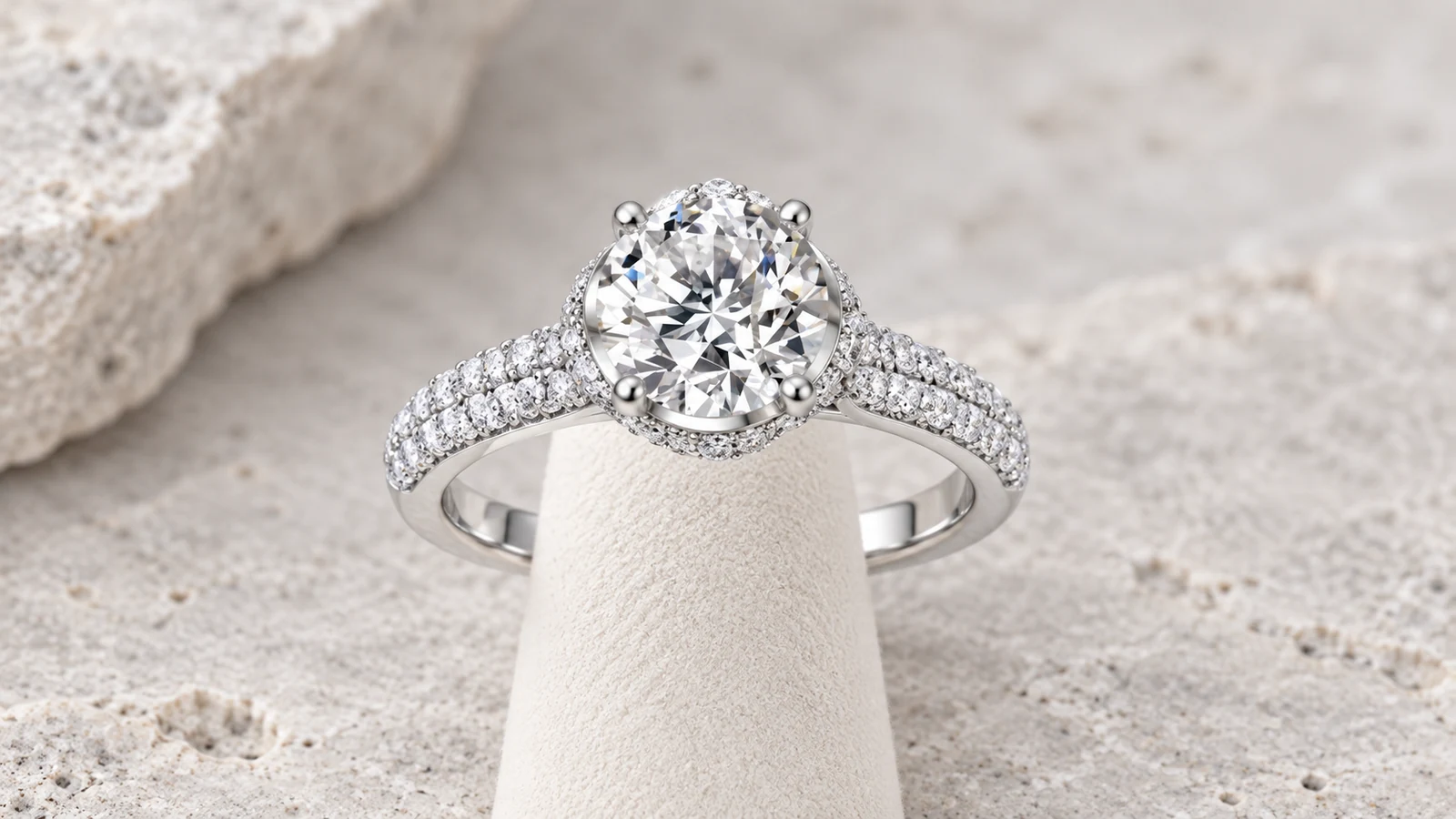
The 1 CT Snow Queen Halo Engagement Moissanite Ring – MS0883 uses centered balance. Its page describes a refined 925 sterling silver setting with a round 1 CT center lifted above a sweeping split pavé halo shank. The middle stone is clearly dominant, while the surrounding detail guides the eye back toward it.
The generated centered view preserves the verified MS0883 round center, prong structure, raised position, sweeping split pavé shank, silver color, and proportions.
Centered balance is useful when you want an immediate hierarchy: center first, supporting detail second. A round focal point can soften straight clothing lines, while the split shank introduces enough direction to prevent the ring from looking like a simple circle. Because the center is raised in the page description, profile and setting height should be checked against daily activities and adjacent rings.
A centered design can stand alone. If you stack it, choose a band that does not hide the split structure or force the rings together. View the stack from the side as well as the top, and check whether any edges or settings contact one another. The statement-versus-stackable ring guide explains that tradeoff in more detail.
Repeated Balance: A Continuous Visual Rhythm
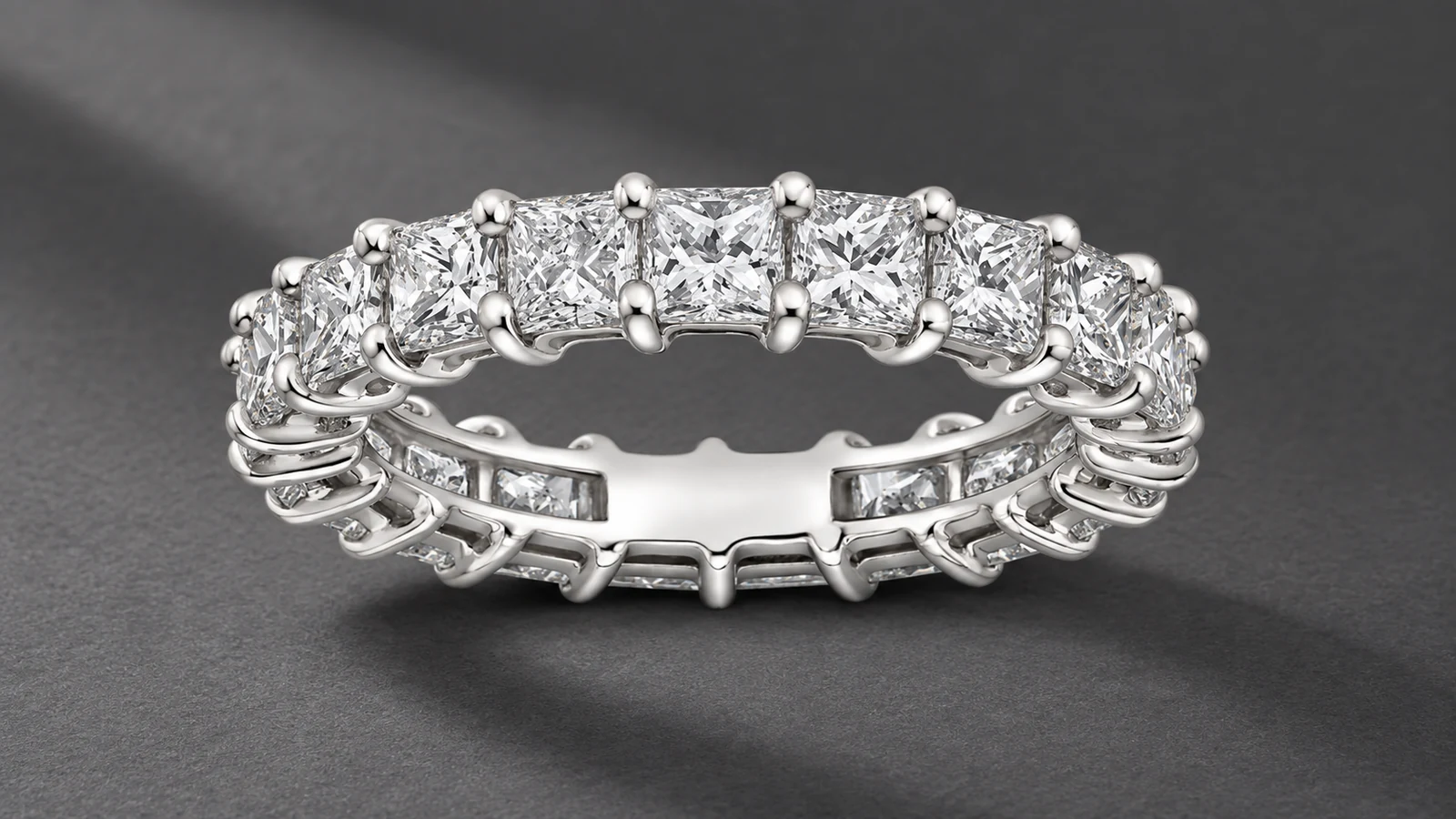
The Princess-Cut Eternity Wedding Moissanite Band – MS0882 shifts attention away from one center. The live page states that the 925 sterling silver setting carries a seamless row of square princess-cut stones in a polished eternity silhouette. Repetition creates the organizing principle.
This generated view preserves the verified MS0882 continuous square-stone sequence, prongs, gallery openings, inner channel, polished silver color, and proportions.
A repeated band reads as a line or rhythm rather than a single point. Square stones make the sequence feel more geometric because their edges create visible intervals. The same design can act as the main ring or as a supporting band, depending on the scale and profile of neighboring pieces.
Repetition does not guarantee that every part will look identical from every angle. Perspective, prongs, finger curvature, light, and normal manufacturing tolerances affect what you see. An eternity silhouette also places settings around the band, so sizing and comfort deserve special attention. Use current size options and product imagery; do not assume resizing is available unless the seller states it.
Open Contrast: Deliberate Asymmetry
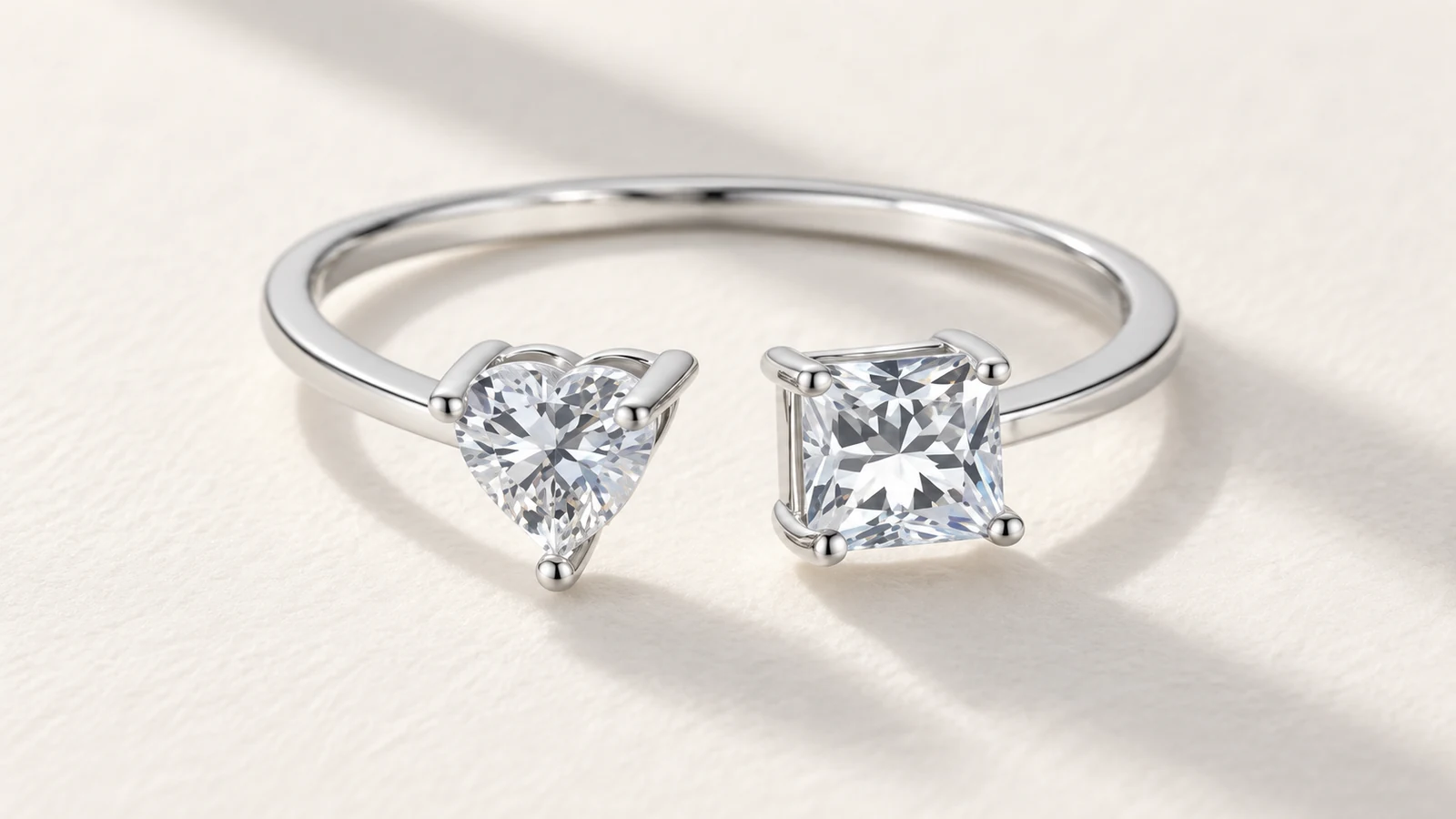
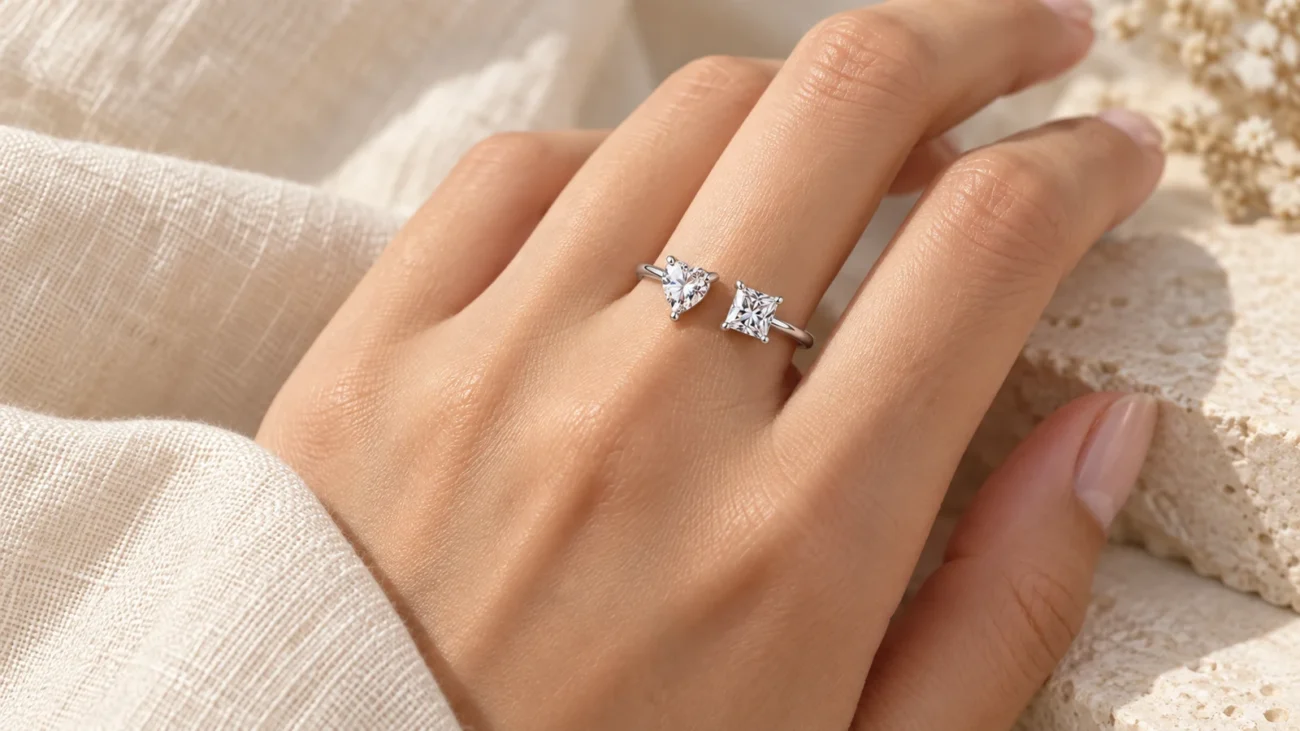
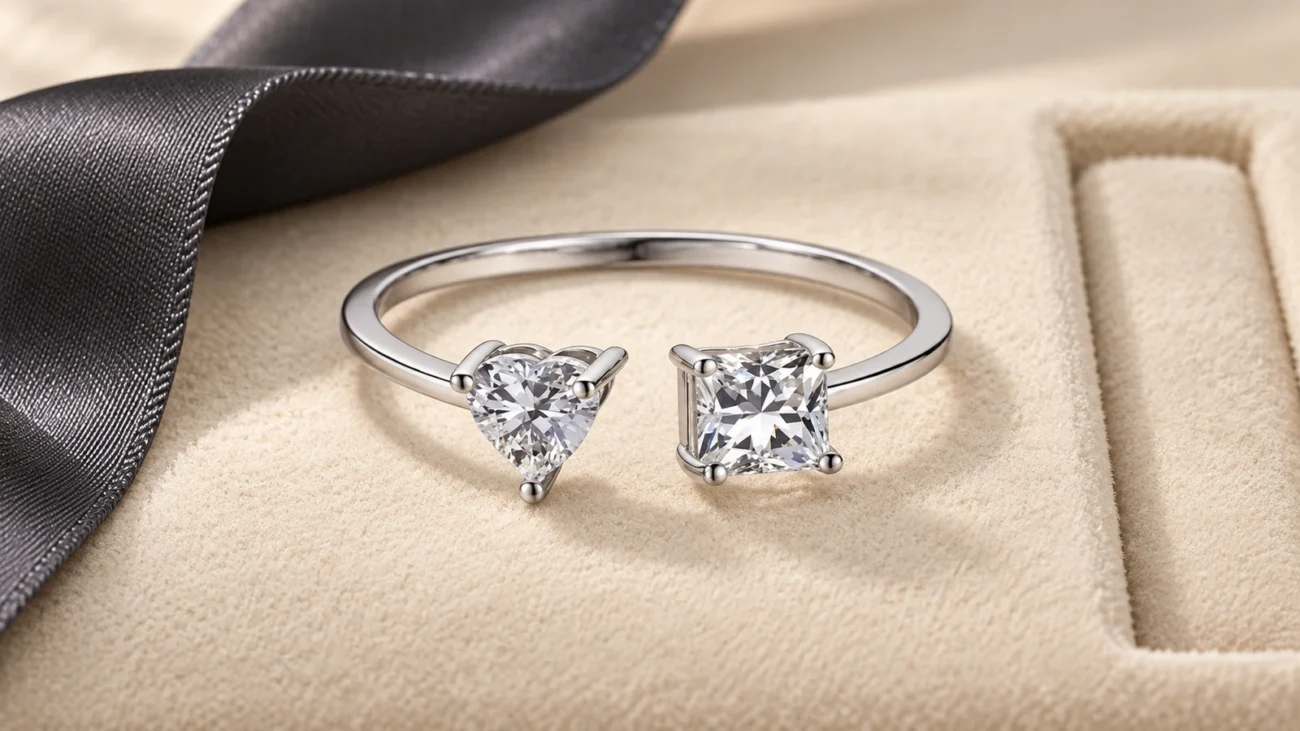
The 0.7 CT Heart and Princess Bypass Moissanite Ring – MS0884 uses open contrast. Its page describes a 925 sterling silver bypass design pairing a heart-cut stone with a princess-cut stone. The two ends do not mirror one another, and the open gap is part of the composition rather than an empty area waiting to be filled.
The generated image preserves the verified MS0884 heart and princess pairing, open bypass gap, prong arrangements, slim silver band, visible color, and proportions.
This kind of balance moves the eye between two different focal points. The heart adds a curved outline; the princess cut adds a square outline. Similar brightness and close spacing let the two ends relate even though their shapes differ. Negative space makes the contrast easier to read.
An asymmetric ring already contains its own visual conversation, so it often needs less support from neighboring rings. If you add a band, avoid covering the gap or making one side look accidentally crowded. Also remember that an open top is a design feature, not evidence that the ring is adjustable. Only a stated sizing or adjustability claim should guide fit.
Broad Framed Balance: Structure Around the Center
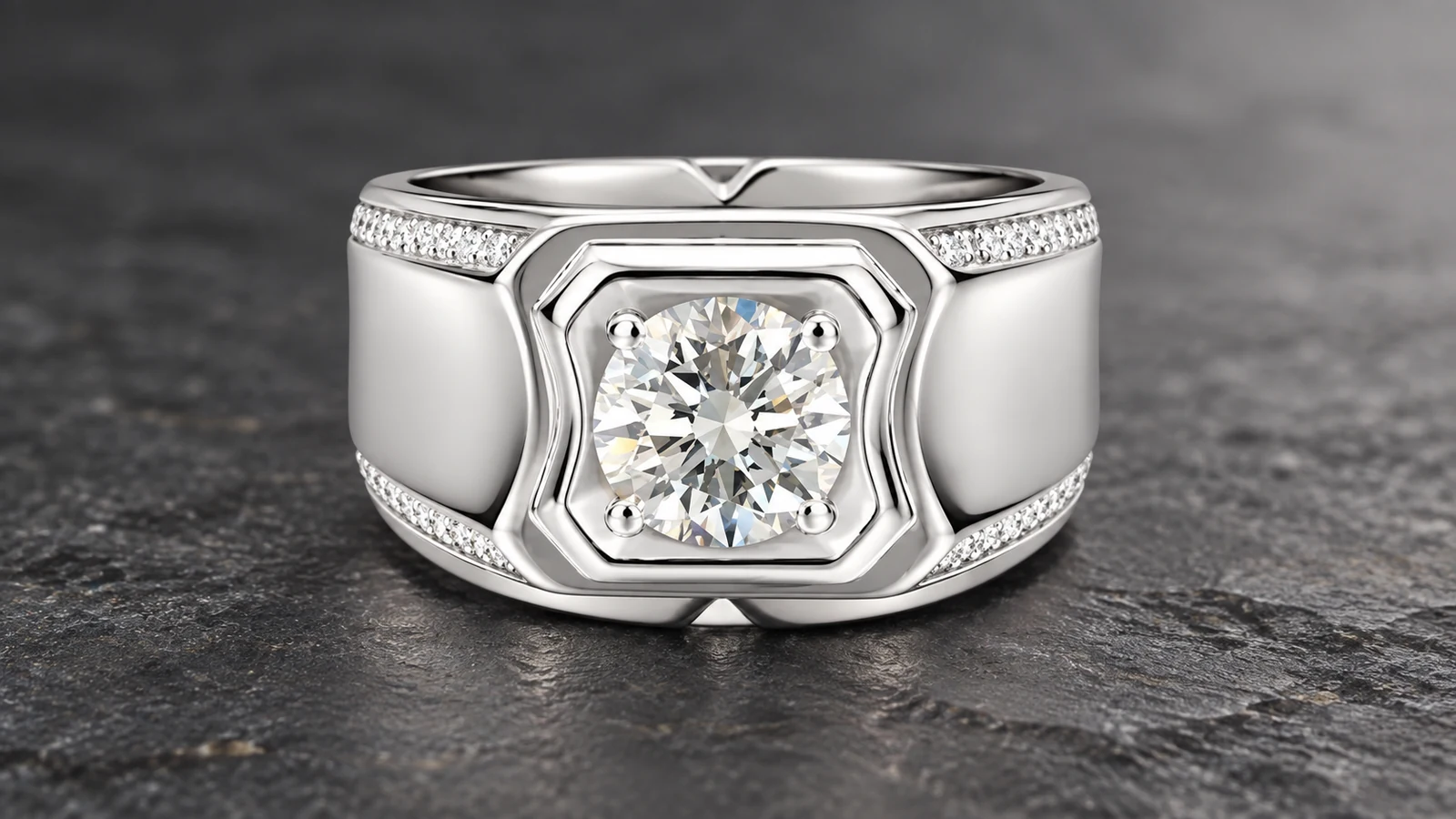
The 2 CT Men’s Cushion-Set Statement Moissanite Ring – MS0877 creates broad framed balance. Its live page describes a 925 sterling silver setting with a 2 CT round center, an angular cushion-style bezel, and broad shoulders. The first-party image also shows narrow bright rows following the upper and lower shoulder edges.
This generated view preserves the verified MS0877 round center, four-prong setting, layered angular cushion frame, broad shoulders, edge rows, silver color, and proportions.
The frame gives the center a strong boundary and spreads attention across more of the finger. Rounded and angular elements work together: the round center supplies a soft focal point, while the cushion-like frame and broad shoulders make the composition feel grounded. This is visually different from a halo made only of small stones, even if both surround a center.
The word “Men’s” is part of the product title, not a wearing rule. Anyone who prefers a broad geometric ring may consider it. Practical fit matters more than the label: compare ring size, band width, finger clearance, and planned activity. A broad ring may feel different between the fingers than a slim band, but the image alone cannot establish comfort.
How to Choose Visual Balance in Five Steps
Name the leading zone. Decide whether the ears or hands should carry the strongest design. This keeps the total look from competing with itself.
Choose an attention pattern. Pick paired, centered, repeated, open-contrast, or broad-framed balance according to how you want the eye to travel.
Compare scale in context. Use on-body photos and published measurements when available. A white-background image is useful for detail but not enough for judging proportion.
Check nearby shapes. Necklines, cuffs, watch cases, adjacent rings, nail shapes, and clothing hardware can either reinforce or challenge the jewelry’s geometry.
Verify the exact listing. Confirm SKU, title, material, stone wording, finish, size options, current photographs, availability, and care guidance before ordering.
You do not need every piece in an outfit to use the same pattern. One balanced anchor is usually enough. For example, matched hoops can sit above an asymmetrical neckline; a centered ring can accompany a repeated bracelet; an open bypass ring can contrast with a simple watch. Repeat one cue, such as silver color or a square outline, and let the rest remain secondary.
These statements come from the live product pages reviewed for this article. This guide does not independently test materials or stones, assign grades not stated on the pages, guarantee comfort, confirm unpublished dimensions, or promise future availability. Generated images are lifestyle visualizations based on first-party product photographs. They are not original catalog photos and should not be used for exact size or color matching.
FAQ: Symmetry and Visual Balance in Jewelry
Does balanced jewelry have to be symmetrical?
No. Mirror symmetry is one kind of balance. The MS0884 bypass ring uses two different shapes and an open gap, yet the paired ends create a deliberate relationship through scale, spacing, and similar visual brightness.
What is the easiest balance pattern to style?
Centered and paired designs are usually quick to read because their hierarchy is obvious. That does not make them universally better. Repeated or asymmetric designs may suit someone who prefers rhythm, contrast, or a less formal composition.
Can I mix symmetrical and asymmetrical jewelry?
Yes. Use one piece as the visual anchor and keep the others quieter. Matching hoops can stabilize an asymmetrical neckline, or an open bypass ring can add contrast to otherwise centered jewelry.
Does a broad ring always look visually heavier?
A broad ring usually occupies more visible finger area, but stone layout, open space, metal color, lighting, and hand proportions affect the result. “Visually broad” does not establish physical weight or comfort.
Is an open bypass ring adjustable?
Not necessarily. An open-looking top is a design feature. Do not bend a ring or assume adjustability unless the exact product page provides those instructions. Order according to stated sizes.
What should I verify before buying?
Check the SKU, exact title, material and stone wording, finish, sizing, closures where relevant, current first-party photos, availability, and care notes. The Sunshine Jewelry online buying checklist provides a complete review sequence.
The Bottom Line
Start by choosing how you want attention organized. MS0878 creates balance through a matching earring pair; MS0883 builds a centered hierarchy; MS0882 uses continuous repetition; MS0884 balances two unequal shapes across an open gap; and MS0877 anchors a round center inside a broad angular frame. Once the pattern feels right, verify scale, fit, product facts, and the surrounding outfit before making a final choice.